Updating your news feed...

NEWS EXPRESS is Nigeria’s leading online newspaper. Published by Africa’s international award-winning journalist, Mr. Isaac Umunna, NEWS EXPRESS is Nigeria’s first truly professional online daily newspaper. It is published from Lagos, Nigeria’s economic and media hub, and has a provision for occasional special print editions. Thanks to our vast network of sources and dedicated team of professional journalists and contributors spread across Nigeria and overseas, NEWS EXPRESS has become synonymous with newsbreaks and exclusive stories from around the world.



.webp)
Loading banners
Loading banners...

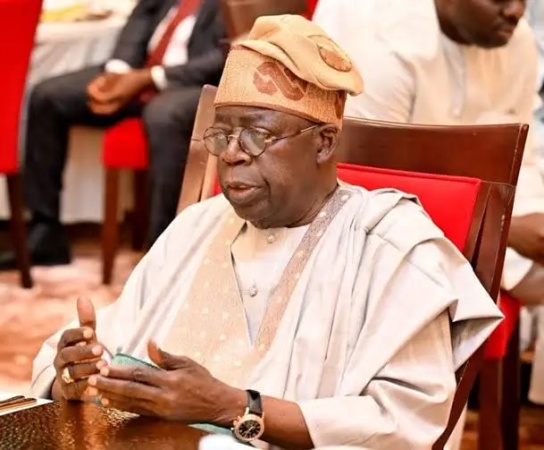
President Tinubu
By ANTHONY UBANI
As the 2027 election draws nearer, Nigerians must ask a simple question. What, exactly, has improved under President Bola Ahmed Tinubu? What hope did we use to have that he has renewed. In short, is our life any better today than it was under the tragedy that was late President Buhari’s government.
Three years is not three months. It is enough time for direction to become visible. Enough time for promises to be tested. Enough time for results to speak – or perhaps, all that have not been achieved in these three years will now be delivered in the nine months remaining before 2027. If we are honest with ourselves, the results of the last three years are grim.
Nigeria today is a nation groaning under darkness, fear, hunger, death, debt and deep disappointment. The pain is no longer abstract. It is lived. It is daily. It is in the market. It Is in the hospital. It is in the school. It is in the empty pocket. It is in the silence of homes that once had hope. It is in the growing number of young people who no longer dream of building Nigeria, only of escaping it.
This is the truth the propaganda cannot hold.
Take electricity. Three years into this administration, Africa’s most populous country still struggles to keep the lights on. In late February 2026, Reuters reported that national generation had slipped to about 4,300 megawatts because gas-fired power plants were receiving just 43 percent of the fuel they required. On March 5, the Nigerian Independent System Operator said total generation on the national grid stood at only 3,940.53 MW. This is not a serious power profile for a country of Nigeria’s size, ambition or pain threshold. It is a scandal. The World Bank estimate cited by Reuters is that unstable power costs Nigeria about $29 billion a year. A nation cannot industrialize in the dark. Small businesses cannot thrive in the dark. Students cannot study in the dark. Hospitals cannot function in the dark. Yet darkness has become one of the defining features of this government.
The tragedy Is not only that power is poor. It is that it remains poor after repeated assurances of reform. The electricity sector’s debt burden has ballooned to about ?6 trillion, according to Reuters, while ordinary Nigerians are asked to pay more for less reliable supply. So, the citizen gets the worst of both worlds: higher pain, lower service. That is not reform. That is failure wrapped in policy language.
Then there is security. Or more accurately, the collapse of security.
On Sunday night, March 29, 2026, gunmen attacked Gari Ya Waye in Jos North, Plateau State. AP reported at least 20 deaths. Reuters, citing residents and local officials, put the toll at least 30. Residents described gunmen arriving on motorcycles and shooting indiscriminately. One local voice told Reuters, “Wicked terrorists came and attacked our people.” The government's immediate response was a 48-hour curfew. Again. After the blood had been spilled. After families had been shattered. After another community had been reminded that In Nigeria, you are often alone when the killers come. Flags are not flying at half-mast. No day of mourning. No tough statements. No immediate action to investigate and reinforce security. No visit of the commander in Chief of the Armed Forces to demonstrate empathy, give condolences, express pain and regret. It would be too much to ask for, too rude and against protocol to disturb the birthday boy at a time when he is enjoying the congratulations, back slapping and champagne induced giggles of sycophants who have besieged the seat of power to supposedly rejoice with him while ha0pless citizens are attacked and slaughtered.
And Jos is not an isolated horror. In January 2026, Reuters reported that more than 160 worshippers were seized in attacks on churches in Kaduna State. That same month, at least 30 people were killed in an attack on a market in Niger State. In March 2026, militants killed 10 security personnel in Kebbi State. This is the pattern: communities raided, worshippers abducted, travelers taken, villages emptied, and official Nigeria responding with condolences, curfews, talking points and recycled outrage. A state that cannot protect life has failed at the first duty of government.
Now look at the economy. The naira has been battered. On June 14, 2023, Reuters reported that the official naira rate was allowed to fall from 477 to 750 to the dollar in one day, a devaluation of more than 36 percent. By March 30, 2026, the Central Bank of Nigeria’s own exchange-rate page showed the official NFEM rate at about N1,383.58 to the dollar. This is not a small slide. It is a collapse in value that has torn through the cost of living, wiped out savings, crushed planning, and deepened insecurity in households and businesses alike.
Defenders of the government will say inflation has been moderating. Yes, the National Bureau of Statistics says headline inflation eased to 15.06 percent in February 2026, with food inflation at 12.12 percent. But any government that hides behind declining percentages while citizens cannot afford food is insulting the intelligence of the people. Prices rose brutally before they began to ease, and millions of families are still living inside the wreckage of that shock. A slower fire is still a fire. Hunger does not become easier because the graph is bending gently.
The broader poverty picture is even more damning. The World Bank’s October 2025 Poverty and Equity Brief says the share of Nigerians living below the $3.00-a-day poverty line rose from 34.7 percent in 2018/19 to 41.8 percent in 2022/23. Nigeria’s own multidimensional poverty index earlier showed that 133 million people were poor. The World Food Program says nearly 5.8 million people in the northeast face severe food insecurity in 2026, including 15,000 people in Borno at catastrophic or famine-like levels, and warns it would run out of emergency food and nutrition resources without urgent funding. Reuters also reported WFP’s warning that nearly 35 million Nigerians could go hungry in 2026. A country this blessed should not be this hungry. A government this loud should not preside over this much suffering.
What of jobs? Official numbers often understate the real distress, but even the official data tells an ugly story. In the National Labour Force Survey for Q1 2024, only 16 percent of workers were in wage employment, 92.7 percent of employment was informal, youth unemployment was 8.4 percent, and 14.4 percent of youths were not in education, employment or training. That is not the profile of a healthy economy. That is the profile of a country surviving from hand to mouth, hustle to hustle, prayer to prayer.
It is no surprise, then, that the “japa” wave has become a national mood. A 2024 LEAP Africa report found that 71 percent of young Nigerians were considering relocating abroad and 85 percent said they would leave if given the opportunity. The drivers were brutally clear: better living conditions, better jobs, insecurity, poor social amenities, naira depreciation and collapsing faith in governance. When the young no longer believe their future belongs here, that is not just migration. It is a vote of no confidence in the country’s direction.
Yet in the middle of all this pain, government waste continues to mock the people. In 2023, Reuters reported that Tinubu signed a supplementary budget that included allocations for new bulletproof cars for himself and his wife, a presidential yacht, official vehicles for the first lady’s office, and renovations to the president’s residential quarters. In the 2026 proposed budget, BudgIT flagged N8.67 trillion in service-wide votes, with weak transparency around such centrally held funds, and also highlighted N233.71 billion for presidential air fleet logistics and keeps luxury for itself. It preaches belt-tightening from inside convoys. It speaks of reform from behind tinted glass.
Then there is debt. The Debt Management Office says Nigeria’s total public debt was ?87.38 trillion as of June 30, 2023. By September 30, 2025, it had risen to ?153.29 trillion. The 2026 fiscal plan projected debt-service costs of about N15.9 trillion. BudgIT noted that debt servicing alone would swallow more than half of proposed recurrent spending. This is how nations get trapped: borrowing heavily, spending poorly, servicing yesterday, and starving tomorrow. Money that should build schools, equip hospitals, modernize infrastructure and support productive citizens is being eaten alive by debt service.
And what of human capital? The 2026 budget speech says healthcare investment is 6 percent of the total budget, net of liabilities. That is still far below the 15 percent Abuja Declaration benchmark. On education, a January 2026 analysis by the development Research and Projects Centre found that education’s share of the federal budget had fallen to 6.15 percent in the 2026 proposal, down from 7.82 percent in 2025, and moving further away from the 15 percent benchmark. Even more troubling, the report linked the growing education funding gap to the crowding-out effect of rising debt service. In plain English: the future is being underfunded so the present government can keep juggling its failures.
And then there is the quiet but dangerous assault on electoral integrity. In a move that should alarm every active citizen, the presidency worked in concert with the National Assembly to dilute key safeguards in the Electoral Act 2026, most notably by stripping electronic transmission of results of its real-time, mandatory status. What was once a clear, technology-backed protection against manipulation has now been reduced to a discretionary process, reopening the door to the very abuses Nigerians thought they had begun to close. Even more troubling is the speed with which the President assented to this law, an urgency rarely seen when it comes to policies that ease the suffering of citizens, but suddenly present when the rules of elections are at stake. It is difficult to recall a sitting president who has invested this level of energy in weakening the mechanisms that protect the people's vote. When the integrity of elections is compromised, democracy itself is placed on trial, and in this case, the signal is unmistakable: power is being secured, not earned.
This is the state of the nation under Tinubu. Darkness without power. Fear without security. Hunger without relief. Debt without discipline. Hardship without humility. Results before elections. And all of it defended by a political machine that keeps asking Nigerians to be patient while life gets harder. This hardly looks like Renewed Hope, it looks, sounds and feels more like Betrayal Promax.
The coming election should not be approached like a tribal festival or a party ritual. It should be approached like a performance review. Citizens must ask: has this government made life safer? Has it made life easier and better? Has it made life more dignified? Has it created believable hope?
For millions of Nigerians, the answer is NO.
It is therefore difficult to see how any Nigerian, examining the record honestly, will conclude that this government deserves a second term. Leadership is not about intent. It is about impact.
And the impact of the last three years is visible everywhere, in the darkness, in the killings, in the abductions, in the fear, in the hunger, in the poverty, and in the quiet exit of a generation that no longer believes. Four more years of this kind of leadership would not be renewal. It would be punishment.
The rest is left to the electorate of this great country. They must decide whether this record deserves renewal or rejection.
•Anthony Ubani, a leadership and governance expert, wrote from Abuja.