Updating your news feed...

NEWS EXPRESS is Nigeria’s leading online newspaper. Published by Africa’s international award-winning journalist, Mr. Isaac Umunna, NEWS EXPRESS is Nigeria’s first truly professional online daily newspaper. It is published from Lagos, Nigeria’s economic and media hub, and has a provision for occasional special print editions. Thanks to our vast network of sources and dedicated team of professional journalists and contributors spread across Nigeria and overseas, NEWS EXPRESS has become synonymous with newsbreaks and exclusive stories from around the world.









.webp)



Loading banners
Loading banners...

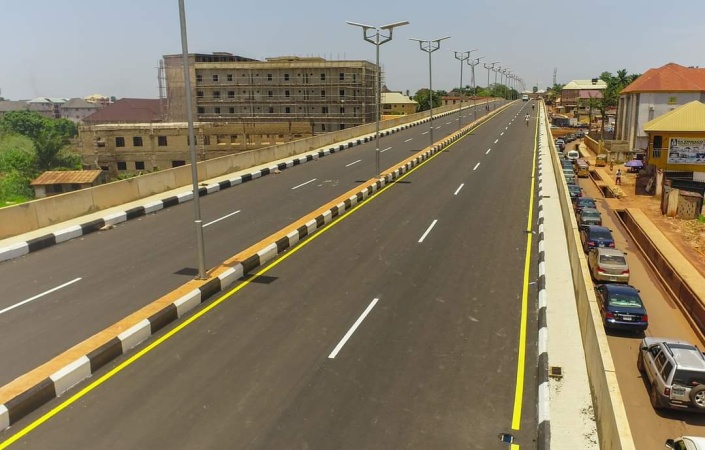
Constructed roads in Enugu
By PAT ONUKWULI
Enugu today presents a study in contrasts, one that is as compelling as it is concerning. On one hand, there is visible, measurable progress: Roads are being constructed and rehabilitated with a sense of urgency not seen in years, traffic flow is improving, and governance appears deliberate, almost business-like in its execution. On the other hand, as evening falls, the same city recedes into shadows, its major streets dimly lit, its promise partially obscured.
This contradiction is not trivial; it strikes at the heart of what it means to build a functional modern city. Governor Peter Mba has demonstrated, within a relatively short period, a commendable commitment to infrastructure development, particularly in road construction. Across Enugu metropolis, critical arteries are being opened, resurfaced, and in some cases entirely reimagined.
For many residents, the difference is that tangible journeys that once felt like endurance tests are now smoother, faster, and more predictable. It is governance that can be seen and, more importantly, felt. But infrastructure, in its truest sense, is not complete at the point of construction. It is complete only when it is fully usable, safe, efficient, and always. And this is where the issue of street lighting becomes impossible to ignore.
What value does a well-paved Okpara Avenue hold if it becomes a passageway of uncertainty at night? How effective is the transformation of Abakaliki Road or Ogui Road if motorists and pedestrians must navigate them under insufficient illumination? Garden Avenue, Chime Avenue, Independence Avenue, Zik Avenue, these are not peripheral streets; they are central to the city’s rhythm. Yet, too often, they are surrendered to darkness when they should be at their most vibrant.
Street lighting is frequently misunderstood as a cosmetic add-on, an afterthought to “real” infrastructure. That assumption is flawed. Lighting is infrastructure. It is as essential as asphalt, drainage, and traffic management.
From a security standpoint, the implications are immediate and significant. Darkness provides anonymity; it creates pockets where criminal activity can incubate. A poorly lit street is an open invitation to mischief. Conversely, illumination is preventive policing in its simplest form; it signals presence, enhances visibility, and reduces opportunity for wrongdoing. A city that invests in lighting invests, indirectly but powerfully, in public safety.
Safety, in the physical sense, is equally at stake. Drivers navigating dimly lit roads face reduced reaction times, increasing the likelihood of accidents. Pedestrians, often the most vulnerable road users, are left exposed. In a metropolis striving for order and efficiency, these are risks that should not be normalised.
Then comes the economic dimension. Enugu is not merely a place of residence; it is a hub of activity. Shops, eateries, transport services, and informal businesses all rely on extending productive hours into the evening. But commerce, like water, flows where conditions permit. When streets are poorly lit, activity contracts. Businesses close earlier, customers stay away, and the city inadvertently imposes limits on its own economic potential.
There is also the matter of aesthetics and identity. Lighting shapes perception. It defines how a city is experienced, both by its residents and by visitors; a well-lit Enugu projects confidence, order, and readiness. A dimly lit Enugu, regardless of its daytime achievements, sends a conflicting message, one of incompleteness.
This is why the current situation is not merely an oversight; it is a gap that risks undermining the very progress the administration has worked hard to achieve. Governor Mba has shown focus, energy, and a results-oriented approach. The progress in road construction shows that leadership understands the importance of foundational infrastructure. But governance is not a sprint; it is a marathon that demands sustained attention and consistency.
This is precisely the moment to keep eyes firmly on the ball. Because the danger in early success is not failure but complacency, it is the subtle shift from urgency to comfort, from momentum to maintenance. Enugu cannot afford that shift, not now, not when the trajectory is promising but not yet secured.
Street lighting offers the administration an opportunity to consolidate its gains, to move from visible progress to comprehensive transformation. The solutions are within reach: solar-powered lighting systems, structured maintenance regimes, and clear accountability frameworks. What is required is not reinvention, but reinforcement of intent.
Okpara Avenue should not just be motorable but fully illuminated; Garden Avenue should reflect not just accessibility but clarity; and Zik Avenue and Ogui Road should support commerce well into the night. In the same vein, Chime Avenue, Independence Avenue, and Abakaliki Road should stand as examples of what a complete urban corridor should look like.
city that works only by day is operating below its capacity. Governor Mba has set the pace. The foundation is being laid, and the direction is clear. But this is not the time to ease off; it is the time to double down, to ensure that progress is not partial, that development is not selective, and that the vision of a modern Enugu is carried through to its logical conclusion.
In governance, as in life, it is not enough to start strong. One must finish well. And for Enugu, finishing well means bringing light to where darkness still lingers, decisively, and without delay.
•Dr Onukwuli, a legal scholar and public affairs analyst, first published this article in The Sun. He can be reached via e-mail: patonukwuli2003@yahoo.co.uk