ADAD
ADADUpdating your news feed...

NEWS EXPRESS is Nigeria’s leading online newspaper. Published by Africa’s international award-winning journalist, Mr. Isaac Umunna, NEWS EXPRESS is Nigeria’s first truly professional online daily newspaper. It is published from Lagos, Nigeria’s economic and media hub, and has a provision for occasional special print editions. Thanks to our vast network of sources and dedicated team of professional journalists and contributors spread across Nigeria and overseas, NEWS EXPRESS has become synonymous with newsbreaks and exclusive stories from around the world.













Loading banners
Loading banners...

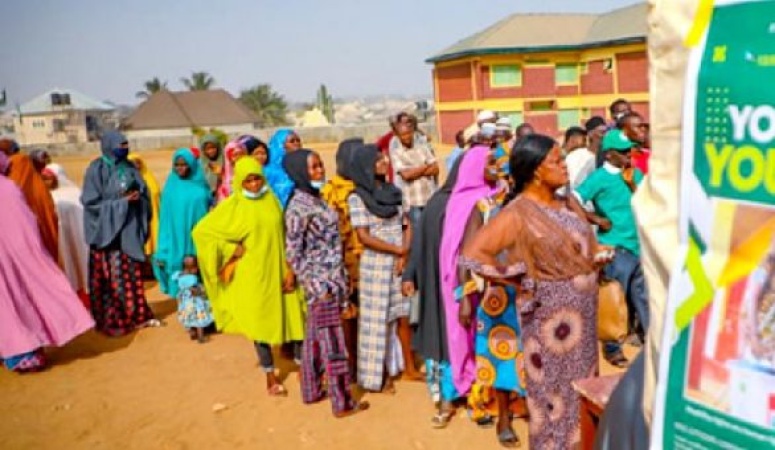
Voters on the queue during the recent FCT council polls
When tear gas drifted across Kuchako Polling Unit in Kuje on Saturday afternoon during the Federal Capital Territory Area Council elections, Blessing Yakubu did not run, not immediately.
The 34-year-old hairdresser had spent much of the day at the polling unit, waiting as officials worked through accreditation, counting and recording, her voter’s card clenched in one hand, her phone in the other.
She had closed her small roadside salon for the day: no customers, no income, because she wanted, as she put it quietly, to try again to make her vote count. Then the shouting began.
Armed security operatives moved into the LEA school compound. People scattered. Someone yelled that result sheets were being taken away. Blessing hesitated for a split second, then grabbed her bag and ran with the crowd, her slippers slapping against the dusty ground.
By evening, she was back home in her one-room apartment, watching television coverage that described the election as largely peaceful.
Speaking with Saturday Vanguard on Wednesday, she let out a tired laugh, not of humour, but of fatigue.
“Peaceful for who?” she asked.
Across the Federal Capital Territory that Saturday, thousands of voters like Blessing encountered delays, uncertainty, inducement; and in some places, outright disruption during the Area Council elections held in Abaji, AMAC, Bwari, Gwagwalada, Kuje and Kwali. Parallel bye-elections in Kano and Rivers states followed a similarly subdued and, in some quarters, contested pattern.
Officially, the polls produced a clear political outcome. The All Progressives Congress (APC) won five of the six FCT chairmanship seats, losing only Gwagwalada to the Peoples Democratic Party (PDP), and also swept the Kano and Rivers bye-elections where major opposition parties were either absent or boycotted the process.
But beneath the tidy result sheets lies a more complicated story; one election monitors, opposition figures and civil society groups say may offer early warning signals for 2027.
A Death in Gwagwa
But in one community on Abuja’s edge, the consequences turned fatal. In Gwagwa, on the outskirts of the capital, the election left behind a quieter, heavier headline.
An African Democratic Congress (ADC) polling agent, identified as Musa Adamu, died following an election-day incident in the area, casting a shadow over what officials described as largely peaceful polls. Within the community, the emotional impact is unmistakable. Residents described moments of confusion and fear as tensions briefly spiked around the voting process. Adamu had been at the polling area in his capacity as a party agent when the situation deteriorated and he was stabbed to death while defending his party’s mandate, according to accounts from the scene.
Opposition figures have since pointed to the episode as a reminder that even lower-tier elections in Nigeria can carry real human costs when political competition turns volatile.
For many in Gwagwa, the incident has deepened anxiety about what future, higher-stakes elections could look like if underlying tensions remain unresolved.
“When you hear that somebody did not return home after election duty because he was killed by supporters of a particular party, it shakes people. What should have been a normal council election became something else. It makes us think twice about voting in the next election,” an eyewitness in Gwagwa who did not want his name mentioned for security reasons said.
Cash, Quiet Deals and EFCC Arrests
Not far from Blessing’s polling unit, anti-graft operatives were making arrests. The Economic and Financial Crimes Commission (EFCC) confirmed it picked up 20 suspects across the FCT with more than N17.2 million allegedly meant for vote buying. In Kwali alone, one suspect was found with N13.5 million in a vehicle parked close to a polling area.
On the ground, the going rate for a vote, according to multiple observer reports, ranged between N5,000 and N10,000. For some voters, the transaction was hardly hidden.
“You will just see them whispering to people after accreditation. Everybody knew what was happening,” said a youth corps member who served as an ad hoc official in AMAC and requested anonymity because he was not authorised to speak publicly.
EFCC’s intervention signalled enforcement, but election monitors say the scale of the arrests likely captured only a fraction of the activity.
Out of roughly 1.68 million registered voters in the FCT, only about 239,000 turned out, about 15 per cent participation. While slightly higher than the 9.4 per cent recorded in 2022, the figure remains troubling to many election observers and monitors. In the Kano and Rivers bye-elections, turnout was even thinner.
Civil society organisations; including Yiaga Africa, CLEEN Foundation and PPDC, linked the apathy in part to growing public distrust, particularly following changes introduced in the Electoral Act 2026 that critics say weakened safeguards around the real-time electronic transmission of results. For voters like Blessing Yakubu, the next election cycle already feels uncertain.
“People are tired. Many of my neighbours didn’t even bother to come out,” she said.
Technology Promises, Practical Delays
The Independent National Electoral Commission (INEC) maintains the exercise was largely successful, stating that between 93 and 97 per cent of polling unit results were uploaded to its IReV portal by Sunday afternoon. However, independent observers noted the uploads were not done in real time in many locations. In Kuje especially, delays stretched into Sunday, fuelling suspicion among party agents.
INEC attributed some discrepancies on the portal, including altered or “mutilated” result sheets, to handwriting corrections by officials.
Opposition parties were unconvinced. The PDP and several civil society groups have demanded full polling-unit-level disclosures to enable independent verification.
Security Presence Raises Questions
One of the most contentious aspects of the polls was the visible role of armed security personnel at some voting centres.
PDP National Publicity Secretary Ini Ememobong alleged that security operatives were used in certain locations to cart away result sheets and intimidate voters.
“Reports and video evidence abound where armed security personnel were used to cart away result sheets in polling units, intimidate voters, and unduly influence the outcome,” he said.
Similar concerns surfaced in parts of AMAC and Kuje, where opposition figures warned of what they described as heavy-handed tactics.
Weak Opposition, Skewed Field
In Kano’s bye-elections, the absence of major opposition parties dramatically thinned the competitive field.
The PDP, NNPP and ADC boycotted the exercise, citing INEC’s failure to publish their candidates’ names and describing the process as skewed in favour of the ruling party.
Even within the FCT contests, although 17 parties fielded candidates on paper, reports indicate many wards saw minimal opposition presence. Some parties also complained of missing or late logos on ballot papers, including the SDP in parts of Gwagwalada.
The result, stakeholders say, was an electoral battlefield that in many places looked decided before voting began.
Logistics Still a Recurring Weakness
Operational challenges, long familiar in Nigerian elections, again surfaced. Observer groups including CLEEN, Yiaga and PPDC documented late arrival of officials and materials across multiple polling units, with some centres opening after 10 a.m. and a few nearing noon.
There were also reports of BVAS glitches, missing names on voter registers and confusion caused by relocated polling units.
In Abaji, voting was temporarily halted at AU Suleman II polling unit after hoodlums reportedly snatched ballot papers. Each incident on its own may appear isolated. Together, they form a pattern.
Public Reactions
Concerns from political actors and civil society groups have been swift and unusually aligned.
Martins Wale Egbeola, National Publicity Secretary of the Inter-Party Advisory Council (IPAC), told Saturday Vanguard the election exposed serious credibility gaps.
“The key lapses observed in the just concluded FCT Area Council elections range from vote buying and voter apathy to alleged state sponsored intimidation in areas where the ruling party was either threatened or perceived to be losing. These issues significantly undermined public confidence in the process.
“When voters are fully assured that no third party can determine how they voted, it will significantly reduce vote trading and undue influence,” he said.
There Were Technical, Security Concerns — ADC
From the African Democratic Congress, spokesman Bolaji Abdullahi pointed to technical and security concerns.
“We noted disruptions to the INEC Result Viewing Portal (IReV), which remained inaccessible even as results are being collated. The ADC also received reports of voter suppression and intimidation in parts of the FCT, including alleged collaboration between APC agents and some security personnel,” he said.
PDP Warns of 2027 Implications
The PDP struck an even more cautionary tone. “These Local Council polls may just be a foreshadowing of the forthcoming general elections in 2027, if changes are not urgently made. The people have completely lost faith in the electoral outcomes from elections conducted under this Act,” said Ini Ememobong, the party’s National Publicity Secretary.
Obidient Movement Links Apathy to INEC Decisions
Dr Tanko Yunusa, National Coordinator of the Obidient Movement, linked voter apathy directly to administrative decisions.
“The independent Electoral Commission (INEC) contributed to the voters Apathy by dividing the polling units without informing the people. Making it difficult for voters to locate their polling units. Many left in frustration and not voting,” he said.
CHRICED Warns of Democratic Deficit
Civil society voices echoed the warning. Dr Ibrahim Zikirullahi of CHRICED described the polls as a stress test the system failed.
“If elections in just six Area Councils could be riddled with such failures, the implications for the 2027 general elections are deeply troubling. Such a scenario represents a profound democratic deficit and signals a dangerous erosion of public trust,” he said.
Odinkalu’s Stark Verdict
Human rights lawyer and former NHRC chairman Chidi Odinkalu delivered perhaps the harshest public assessment during an appearance on Channels Television.
“INEC failed. Amupitan’s INEC failed woefully. On this evidence, nobody can trust Joash Amupitan to organise credible elections in 2027. There’s nothing else to it; it is not about the law. It is about the failure of will, the failure of electoral administration,” he said.
Official Pushback
Government and ruling party officials strongly reject the negative characterisation. INEC insists all polling units eventually opened, turnout improved compared to 2022, and enforcement actions, including EFCC arrests, demonstrate institutional vigilance.
Minister Festus Keyamo described opposition complaints as exaggerated, noting that disputed result sheets represented fewer than 10 out of 2,822 polling units.
APC National Chairman Prof Nentawe Yilwatda framed the victories as public endorsement of President Bola Tinubu’s reforms, while the President himself congratulated winners, saying the polls strengthened Nigeria’s democratic culture.
The Road to 2027
Back in her small salon, Blessing Yakubu has reopened for business. Customers come and go. Life moves, as it always does.
But when asked whether she will vote again in the next election cycle, she pauses.
“I will think about it,” she said slowly. In Gwagwa, meanwhile, conversations about the election carry a different weight. Between the hesitation of voters like Blessing and the unease lingering in communities that witnessed election-day tension lies the real story of the February 2026 polls.
Because beyond the arrests, the uploads, the party statements and the official briefings, the deeper question confronting Nigeria’s electoral system is one of belief.
If citizens increasingly conclude that outcomes are predetermined, turnout will keep falling. If turnout keeps falling, legitimacy will keep eroding.
The council and bye-elections were, on paper, routine local contests. But on the ground; in the dust, the delays and the drifting tear gas, they looked unmistakably like something else: A rehearsal whose final performance may come in 2027. (Saturday Vanguard)