













Loading banners


NEWS EXPRESS is Nigeria’s leading online newspaper. Published by Africa’s international award-winning journalist, Mr. Isaac Umunna, NEWS EXPRESS is Nigeria’s first truly professional online daily newspaper. It is published from Lagos, Nigeria’s economic and media hub, and has a provision for occasional special print editions. Thanks to our vast network of sources and dedicated team of professional journalists and contributors spread across Nigeria and overseas, NEWS EXPRESS has become synonymous with newsbreaks and exclusive stories from around the world.
Isiokwu-Ihioma community in Orlu LGA of Imo State is facing an existential threat resulting from devastating erosion which has affected over 70 buildings. DAMIAN DURUIHEOMA, who visited the community, reports that residents are appealing to the local government authorities to create an access road to enable them interact with the outside world.
Arriving in Isiokwu-Ihioma Autonomous Community in Orlu Local Government Area of Imo State, the first thing you notice is silence. It is not the tranquil quietness of a rural settlement at midday when farmers are away in their fields and children are in school. It is a heavy, watchful silence; the kind that lingers in places that have endured so much. The earth itself seems to hold its breath.
Here, in this agrarian community tucked within Imo State, the land has turned against its people. What began as seasonal flooding has metamorphosed into monstrous gullies and landslides that now snake across villages like open wounds.
Homes have been swallowed. Roads have disappeared. Families have fled while those who remain live daily with the fear that the ground beneath their feet may give way without warning.
The devastation stretches from Umunguma Umunneme Ihioma to Ogberuru-Acharagba-Iyiuzor, cutting through communities that once thrived on farming and close-knit communal life.
The gully — if that word still suffices — runs for more than four kilometres. Its depth exceeds 60 metres in places. Stand at its edge and peer down, and it feels like staring into the throat of the earth itself.
width is deceptive. In residential areas, it spans over 20 feet. In farmlands, it is twice as wide, yawning open like a canyon that has no intention of closing.
Community leaders who guided ‘The Nation’ through the sites spoke with a mixture of resignation and restrained anger. They have told this story many times. Yet each telling reopens wounds.
“This is no longer erosion, it is displacement,” one elder said quietly.
At one of the worst hit clusters, Umuezikeoha Umudurunguma village,the destruction is almost surreal. Over 70 buildings have been affected and stand on the brink of collapse. Some are cracked from foundation to rooftop. Others hang precariously at the gully’s edge, their verandas suspended over emptiness.
Among them is a house of deep symbolic value: the family home where the traditional ruler of the community, HRH Eze John Nwosu, was born. Today, it stands abandoned. Gates and doors ajar. Windows hollow. The building that once echoed with laughter now waits, perhaps, for the final slide into oblivion.
Perhaps nothing captures the community’s vulnerability more than the makeshift palm tree bridge. To reach certain homes, residents felled tall palm trees and laid them across the gully — a crude, trembling lifeline suspended over a 60-meter drop. It is meant for one person at a time. One misstep could mean instant death.
Our correspondent watched, heart in throat, as a woman carrying a little baby attempted to cross. She moved slowly, toes gripping the rough bark, eyes fixed ahead. The child clung to her chest, oblivious of the abyss below.
On either side, villagers held their breath.
“It is only young people that can use it,” Lolo Ifunanya Ijemba said later. “But even then, it is a risk. If you slip, that is the end.”
For the elderly and children, the crossing is nearly impossible. Some families must trek through dense forest for hours just to access the outside world.
During the rainy season, the danger multiplies. Nobody returns home after 7:00 p.m. If rain threatens, they stay put wherever they are.
“Rain that brings growth, brings us destruction,” the monarch would later say.
The cost of resistance
The people of Isiokwu-Ihioma did not surrender easily.
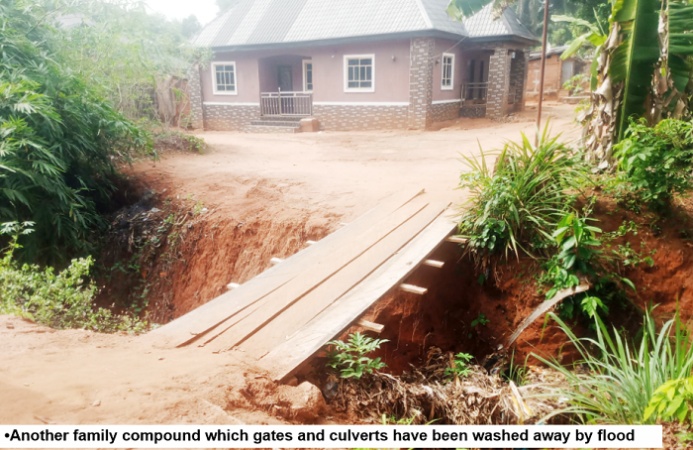
In three separate entrances to Umuezikeoha Umudurunguma, villagers pooled resources to construct large culverts — mini bridges designed to contain the floodwaters. Each cost between N3 million and N5 million, staggering sums for a rural farming community.
They built them once, the floods washed them away. They built them again, the gullies deepened. In some spots, this effort was repeated up to four times.
Today, only one structure remains standing. The rest lie buried or broken, silent monuments to resilience overwhelmed.
“This whole thing started when it washed away the mini bridge our people built here,” Ichie Augustine Chinedu Nwosu explained, pointing to what remains of his once accessible neighbourhood.
“There was someone on that bridge when the flood took it,” he said. The bridge, and the person on it, were swept away together. Since then, the gully has expanded aggressively. Homes that once sat safely inland now hang at its rim. His own house is among those nearly submerged.
Lives lost, lives uprooted
At least four fatalities have been recorded within this corridor alone: two women, a 22-year-old man who fell into a gully and died there, and a small schoolboy washed away by floodwaters. The casualty figure, residents insist, is far higher if one counts injuries, trauma, and those who lost everything but survived.
About a year ago, the 22-year-old fell into one of the gullies at night. By the time help came, it was too late.
Since then, fear governs movement. Children are sent away to maternal homes to continue schooling safely. Parents who can afford it have relocated, renting modest apartments elsewhere. Those who cannot remain, navigating daily hazards as best they can.
Mrs. Augustina Nwosu has lived in the community for over 50 years. “It started little by little,” she recalled. “It washed away our gutters. Then our roads. Now it is consuming houses.” Her voice trembled when she spoke of farming.
“Our wives can’t access their farmlands,” the President General of the community, Hon. Walter Oleghara, added. “You can imagine what that means to our livelihood.”
Farming here is no longer a routine; it is a gamble with death. The land can cave in without warning. Most collapses occur at night, residents say, but unpredictability has become the only constant.
A cultural fracture
Beyond the physical destruction lies a quieter loss: cultural disintegration.
“Our people abroad hardly come home,” Sir Kennedy Udeze said. “They have no place to return to. No access road.”
Festivals, such as masquerades, that once drew sons and daughters back from cities and foreign lands now feel diminished. Markets struggle. Interactions between neighboring communities have been severed as roads vanish into chasms.
“Even our cultural diversity,” he continued, “we cannot interact again with our neighbours because the roads have been cut off.”
In rural Igbo communities, home is more than shelter. It is identity. To lose access to ancestral land is to lose a piece of oneself.
The protest
As our correspondent moved through the area, women and youths gathered with handwritten placards. Their message was direct: “Orlu LGA, create access road for us;” “We are dying here;” “The lives of Isiokwu-Ihioma people matter too”;
“Save Isiokwu-Ihioma;” among others.
The protest was not violent. It was weary.
For years, the community says, it has reported the crisis to successive local government administrations. Officials have visited. Promises have been made. Photographs have been taken. But no lasting intervention has followed.
The monarch’s cry
Standing before members of his cabinet, town union, and other members of the community after the tour, HRH Eze (Sir) John Nwosu did not mince words.
“My gentleman of the press, after what you have seen, further elucidation is unnecessary,” he said. “Some of my people live in conditions below what can be described as subhuman in the 21st Century.”
Residents cannot drive to their homes. Some vehicles have remained stranded in neighbours’ compounds for three years because gullies formed overnight, cutting off access.
“We have suffered in silence. We have cried quietly. We have screamed to no effect,” the monarch lamented.
He acknowledged that the scale of work may exceed local government capacity. But he insisted that indifference is unacceptable.
“Just give us access to our homes,” he pleaded. “Even if you cannot work on the erosion, provide a footpath. Retrieve our vehicles. Bring us into the 21st Century.”
On why the community has not escalated the matter directly to the state government, the monarch offered a perspective rooted in governance structure: if the local government chairman had shown empathy and initiative, he would have been better positioned to take the matter up as an existential emergency.
A project that stalled
Residents point to an incomplete intervention by the Nigeria Erosion and Watershed Management Project (NEWMAP), which began work around 2012 and ended around 2019. At Pa Okorie Nwosu Road Junction stands the last culvert or mini bridge constructed before activities ceased.
“Since that time,” Sir Kennedy Udeze said, “no funding, no presence of contractor.”
The result? The impact tripled. Floodwaters from Ogberuru Amaifeke and Orlu towns cascade from upper watersheds into this lower basin, depositing force and debris into Isiokwu-Ihioma’s fragile terrain.
Each rainy season carves new “fingers” into the land. Each day widens the wound.
Efforts to reach the management of NEWMAP in Imo State yielded no results. However, a staff member, who preferred anonymity, told our correspondent that the project in Ihioma and other communities in Orlu LGA were never abandoned, but the project lifespan ended.
“Every project has a lifespan and the one you are talking about in Ihioma town in Orlu ended because it was designed to be so.
“One thing I can tell you is to be hopeful because we’re still coming again to embark on another phase of intervention. That’s all I can say,” he said.
Nightfall in Isiokwu-Ihioma
When evening approaches, doors shut early. Conversations quicken. The sky is watched with suspicion.
At the onset of rain, fear becomes palpable. Darkness conceals the shifting ground. Snakes and wild animals now inhabit some of the deeper gullies, adding another layer of danger.
No one wants to be outside when thunder cracks.
Parents lie awake listening not only for rain, but for the rumble that signals collapse.
A community in waiting
In abandoned compounds, weeds creep up cracked walls. Beautiful houses built with remittances from abroad stand empty, their owners now tenants elsewhere. Children grow up away from ancestral compounds.
“It’s painful,” Ichie Augustine said, staring at homes no one returns to. “We just hope government will hearken to our cries so we can begin to experience communal life again.”
The plea is simple: access. Safety. Restoration.
Not luxury. Not grand projects. Just the basics that allow human dignity to survive.
Beyond statistics
Erosion figures can sound abstract — four kilometers long, 60 meters deep, over 70 buildings affected. But numbers do not capture the sight of a mother balancing on a palm trunk over an abyss. They do not capture a monarch pointing at his abandoned birthplace. They do not capture the silence of homes that once held weddings and funerals and Christmas reunions.
In Isiokwu-Ihioma, the earth is not merely eroding. It is rearranging lives.
And as the rainy season gathers strength once more, the question hangs in the humid air: How much longer can this community endure before silence gives way to disappearance? (The Nation)