ADAD

Updating your news feed...
NEWS EXPRESS is Nigeria’s leading online newspaper. Published by Africa’s international award-winning journalist, Mr. Isaac Umunna, NEWS EXPRESS is Nigeria’s first truly professional online daily newspaper. It is published from Lagos, Nigeria’s economic and media hub, and has a provision for occasional special print editions. Thanks to our vast network of sources and dedicated team of professional journalists and contributors spread across Nigeria and overseas, NEWS EXPRESS has become synonymous with newsbreaks and exclusive stories from around the world.









.webp)



Loading banners
Loading banners...

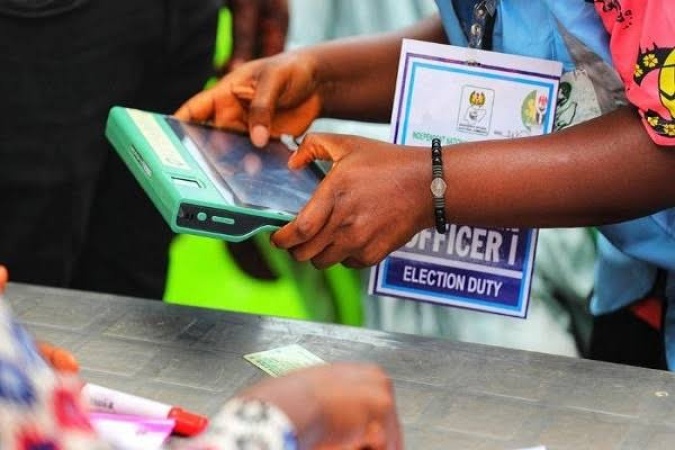
INEC Bimodal Voter Accreditation System
Nigeria’s voter register has grown dramatically since 2011, but participation in presidential elections has declined. As the country prepares for 2027, the bigger question is whether Nigerians still believe their votes can make a difference. Deputy Political Editor RAYMOND MORDI examines why turnout is falling and what it will take to persuade more citizens to vote.
In 2011, more than half of registered Nigerians voted in the presidential election. By 2023, just over a quarter did. Over the same period, the country spent heavily on technology meant to make voting more credible and encourage more people to participate. So why are fewer registered citizens turning out, and can 2027 change that?
Nigeria has registered millions more voters over the past four general elections, yet progressively fewer of those registered have turned out during presidential polls. Turnout, measured as votes cast as a share of registered voters, fell from 53.7 per cent in 2011 to 42.7 per cent in 2015, 34.0 per cent in 2019 and 27.1 per cent in 2023. In February 2026, Prof. Joash Amupitan, chairman of the Independent National Electoral Commission (INEC), cited the same downward trend and described the dwindling turnout as a serious concern for Nigerian democracy.
The timing is striking. The Smart Card Reader was introduced nationwide in the 2015 election to verify voters’ identities biometrically. The Bimodal Voter Accreditation System (BVAS) was deployed in 2023, combining biometric verification with the scanning and uploading of polling-unit result forms.
But the chronology does not establish a direct cause-and-effect relationship. Some of the decline may be due to the removal of duplicate or ineligible entries. INEC says these technologies helped eliminate “ghost votes,” multiple voting and large-scale ballot stuffing that inflated the 2011 figures. Even allowing for that, the introduction of technology has not solved voter apathy. The harder question is why better mechanisms for determining who may vote have coincided with a shrinking proportion of registered voters actually exercising that right.
Registration rises, participation falls
Ahead of the 2015 election, INEC registered 68.83 million people on its biometric register. That year’s presidential election produced about 29.4 million votes. By 2019, the register had grown to more than 84 million, yet total votes cast fell slightly to about 28.6 million, a turnout of roughly 34 per cent.
The European Union Election Observation Mission (EU mission) described the decline as significant, noting that registered voters and the population had grown while the number of votes cast had fallen.
In 2023, the register reached 93,469,008 voters. Total votes cast in the presidential election were roughly 25.3 million, a turnout of about 27.1 per cent. Valid votes were lower still, because some ballots were rejected.
The decline cannot be explained simply by a loss of interest in registration, since millions continued to register. The problem has increasingly been converting registration into participation on election day.
This distinction matters. A registered voter is not necessarily an accredited voter, and accreditation does not necessarily translate into a valid vote. None of these measures captures the share of eligible citizens who participated, since those who never registered are not counted.
Technology is not the whole story
The Smart Card Reader was meant to verify genuine Permanent Voters’ Cards (PVCs), authenticate voters biometrically and create an auditable record of accredited voters. It also created problems. On election day, INEC acknowledged that card-reader failures slowed accreditation in many locations and prevented it from starting in others. Manual accreditation was permitted where card readers failed and could not be replaced.
The fall in turnout, however, cannot reasonably be attributed to the card reader alone. The decline continued after 2015 and accelerated in 2019, when the same basic technology was still in use.
BVAS added another layer in 2023. It was designed to authenticate voters through fingerprints or facial recognition, reduce multiple and proxy voting, and transmit polling-unit results electronically through INEC’s Result Viewing portal (IReV). The EU mission acknowledged its potential to significantly reduce multiple voting and manipulation of voter figures.
Implementation problems, however, damaged confidence. EU observers reported that uploading results did not work as expected and that presidential results appeared on IReV much later than anticipated. The mission concluded that shortcomings in implementing the technology, and the delayed publication of results, contributed to lower public trust.
The trust problem
An Afrobarometer survey published shortly before the 2023 election found that only 22 per cent of Nigerians trusted INEC somewhat or a lot, while 78 per cent had little or no trust in the commission. Still, 71 per cent supported elections as the best way to choose leaders.
That tension is revealing. Nigerians have not necessarily rejected democracy. Many remain sceptical that the electoral process reliably converts their preferences into political outcomes.
The mood persists ahead of 2027. Yiaga Africa’s third National Voting Intentions Survey, conducted in September 2026 and released on Wednesday, October 7, 2026, found that 84 per cent of respondents intended to vote. But only 41 per cent were certain and had picked a candidate. Confidence remains fragile: just 34 per cent expressed confidence in INEC’s ability to conduct credible polls, and 63 per cent doubted the judiciary would resolve disputes fairly. In short, the electorate is willing but wary.
Turnout is ultimately a behavioural decision. A voter must believe the cost of travelling or the effort it would take to be at a polling unit, waiting in line and navigating accreditation, is justified by the prospect that the vote will count.
Insecurity, hardship and electoral fatigue
Given the prevailing situation in the country, security is a major part of that calculation. Ahead of the 2023 election, 77 per cent of Nigerians surveyed by Afrobarometer described the country as somewhat or very unsafe, and crime and insecurity ranked as the most important problem citizens wanted government to address. EU missions in 2019 and 2023 recorded violence, intimidation and voter suppression in several areas.
Yiaga Africa’s survey identifies fear as a major barrier: 61 per cent said violence could deter them from voting in 2027, rising to 78 per cent in the Northeast. At the same time, 83 per cent said improved security would boost participation, suggesting that the security forces’ protection of citizens is seen as essential to turnout.
Economic hardship adds another layer. Afrobarometer reported in 2023 that 79 per cent of Nigerians had experienced moderate or high levels of lived poverty in the preceding year, with unemployment and economic management among leading concerns.
For citizens struggling with transport costs, food prices or personal security, voting becomes a costly gamble of time and safety, particularly when confidence in the outcome is already eroded.
Electoral fatigue compounds the problem. Voters who have watched successive elections bring little visible change may find each new poll less compelling. Queuing for hours, travelling at personal expense and then waiting for delayed results can reinforce the belief that participation is a ritual with little benefit.
There are also more immediate obstacles. Problems with registration and PVC collection, relocation of polling units, late deployment of personnel and equipment, and uncertainty over polling arrangements can turn willingness to vote into non-participation. The EU mission in 2023 noted that about 6.7 million voters had been assigned to new polling units, and inadequate information about the changes caused confusion.
A divided electoral map
National turnout conceals substantial differences. In 2019, turnout ranged from 54.5 per cent in Jigawa to just 17.6 per cent in Lagos, according to the EU mission. Such gaps caution against treating apathy as a uniform national phenomenon.
Political competition, security, mobilisation and local political culture can produce very different outcomes from state to state. In some places a closely fought contest creates strong incentives for parties and voters to mobilise. Where the outcome appears predictable, the incentive to vote may be weaker.
This makes competition particularly relevant to 2027. The 2023 presidential election offered a comparatively broad choice, with 18 candidates, and Afrobarometer found that 69 per cent of respondents believed Nigeria needed many political parties to ensure voters had a real choice. But a fragmented field does not automatically produce higher turnout. Voters must also believe the candidates offer meaningful alternatives and that the system will faithfully record their choices.
What could happen in 2027?
INEC is already attempting to strengthen the register. The commission says the 2023 register contained 93.47 million voters and has begun a nationwide revalidation and clean-up exercise to improve its credibility. INEC announced on Monday, October 5, 2026, that the register had grown to more than 103 million voters ahead of the 2027 general election. The announcement was made by its chairman, Prof. Joash Amupitan.
That creates a paradox. The larger the register, the less meaningful registration alone becomes as a measure of participation. The critical question is how many registered voters will actually appear at polling units to cast their ballots.
The role of mobilisation
On Tuesday, September 8, 2026, during the commission’s Southwest readiness assessment and staff interactive session in Lagos, Amupitan appealed to the Oba of Lagos, Oba Rilwan Akiolu, and the traditional institution to help mobilise citizens for the 2027 elections. The appeal went beyond the commission’s familiar emphasis on electoral technology.
Amupitan acknowledged the importance of technology but insisted that democracy depends on citizens.
“Technology alone cannot build a democracy; people do,” he told the monarch, asking traditional rulers to encourage citizens to take ownership of the electoral process and turn out in large numbers.
He also asked traditional rulers to encourage registration, PVC collection and peacemaking among political actors and community groups.
That remark captures the central dilemma of Nigeria’s turnout since 2011. The country has invested heavily in machinery to identify legitimate voters and protect the ballot, yet those improvements have not produced a corresponding rise in participation. Mobilisation of that kind, however, will depend heavily on the quality of the 2027 contest.
Two possible paths
If the presidential race becomes genuinely competitive, parties mount sustained grassroots campaigns, security improves, and voters believe their ballots will be protected and counted, turnout could recover. A credible accreditation process would then reinforce participation rather than merely regulate it.
The reverse is also possible. If insecurity persists, economic pressures intensify, logistical failures recur, and confidence in INEC or the results process remains weak, recent trends offer little reason to expect a dramatic rebound.
The lesson of BVAS
In 2023, BVAS raised expectations by promising more reliable voter authentication and greater transparency in results management. The EU mission’s concern was less with the concept than with its execution, particularly the delayed upload of presidential results. A technology may reduce opportunities for multiple voting or impersonation yet become a source of frustration if it malfunctions, is poorly communicated or is followed by delays that create doubts about the results.
Public confidence is central. Nigerians have not rejected elections in principle, but their continued support for elections rests on fragile trust in the electoral umpire. The Oba of Lagos, responding to the appeal, urged politicians to move from short-term patronage towards issue-based engagement free of hate speech. Mobilisation by itself cannot substitute for credible political competition.
In 2011, more than half of registered Nigerians voted during the presidential election. Fifteen years later, the register is larger, the technology more sophisticated and the safeguards against fraud more robust. But fewer citizens are casting ballots. The Smart Card Reader and BVAS can establish whether a person at the polling unit is entitled to vote.
They cannot persuade that person that the journey is worthwhile. That is the task for 2027: convincing voters that they can travel safely, that the choices before them are real, and that their votes will be counted and reported without delay. If those conditions hold, the queues may return. If not, Nigeria will have a larger register and a quieter election day. (The Nation)