Updating your news feed...

NEWS EXPRESS is Nigeria’s leading online newspaper. Published by Africa’s international award-winning journalist, Mr. Isaac Umunna, NEWS EXPRESS is Nigeria’s first truly professional online daily newspaper. It is published from Lagos, Nigeria’s economic and media hub, and has a provision for occasional special print editions. Thanks to our vast network of sources and dedicated team of professional journalists and contributors spread across Nigeria and overseas, NEWS EXPRESS has become synonymous with newsbreaks and exclusive stories from around the world.





















Loading banners
Loading banners...

•Why the Socialist Library and Archives Matters to Nigeria’s historical memory
By FRIDAY IKPEME
A society that loses the records of its struggles gradually loses the ability to understand itself. When newspapers decay, pamphlets disappear, journals go out of print and private collections are dispersed, we lose more than paper. We lose the arguments that shaped public life, the voices that challenged injustice and the evidence of how ordinary people organised for freedom, dignity and social change. Preserving that evidence is a national responsibility that now requires broader public support. The Socialist Library and Archives, known as SOLAR, was established in May 2021 to meet this responsibility.
The Socialist Library and Archives grew from the combined archives and libraries of Edwin Madunagu and Bene Madunagu. Their collection was a product of the life and work they shared from 1973. Over the decades, it took different forms, affiliations and names, and served various revolutionary purposes. One early deployment began in December 1975, with the formation of the Revolutionary Directorate.
In 1996, the Madunagus lent the collection to Conscientising Nigerian Male Adolescents (CMA). The arrangement was extended in 2000 to the Calabar International Institute for Research, Information and Documentation (CIINSTRID). When that lending arrangement ended in 2020, the Madunagus’ personal archives and books were separated from materials acquired by CMA and CIINSTRID. Edwin and Bene Madunagu’s holdings were then brought together as their combined archives and libraries.
On 1 May 2021, Edwin and Bene Madunagu formally handed over that collection to the Nigerian Left. This act of stewardship gave rise to SOLAR. What had been assembled, preserved and put to use over decades became the foundation of an institution intended to serve a wider public and future generations.
SOLAR preserves and makes accessible leftist and progressive literature from Nigeria and beyond. Its collections document labour organising, student activism, democratic struggles, feminist scholarship, public debate, international solidarity and alternative approaches to social and economic development. Many of these materials are rare, out of print, physically fragile or absent from conventional libraries. Without deliberate intervention, important chapters of our history could disappear quietly.
The urgency is clear. Progressive publications were often produced in small quantities and passed from hand to hand in workplaces, union halls, campuses and community meetings. Some survived censorship, military rule, police raids, organisational decline and decades of poor storage. Others now exist only as isolated issues in personal collections. Yet a single surviving edition may contain a union statement, feminist intervention, student manifesto or account of state repression available nowhere else. These fragmentary archives still speak, if we act before the paper is lost.
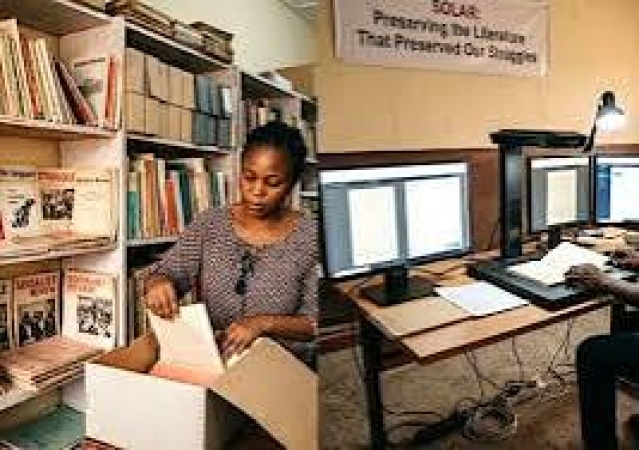
Support from IFRA-Nigeria through the Centre for Democracy and Development (CDD), and from the Open Society Foundations (OSF), has shown what focused investment can achieve. Over the past year, SOLAR has digitised approximately 21,000 pages of journals, magazines, speeches, pamphlets and other archival materials. Among speeches and pamphlets, 130 publications were fully processed and uploaded, 78 had completed metadata work and awaited publication, and 45 had been digitised and are being processed. Among journals and magazines, 389 issues were fully processed and uploaded, 141 awaited publication after metadata work, and 143 had been digitised but not yet described.
These figures represent professional labour, not simply scanning. Each item must be assessed, prepared, captured, checked, described, organised, backed up and made discoverable. The work includes rare titles such as Mass Line, The Lagoon Echo, The Progressive, Dawn Informs, African Red Family, The African Communist, and Socialist Review alongside campus publications including The Vanguard, Struggle, and The Nigerian Scholar. SOLAR has also digitised The Guardian Lecture Series from 1989 to 1991.
Contributions from organisations and individuals, including the late Comrade Biodun Jeyifo, SOLAR’s first Board chair, have helped the organisation retain a digital archivist to continue digitisation, uploading and metadata creation. They have also supported stronger infrastructure, including the acquisition of a CZUR ET16 Plus overhead scanner. The scanner handles bound, oversized and fragile materials more safely, reduces pressure on delicate spines and improves image correction. Such practical improvements directly protect vulnerable publications.
Cataloguing the physical collection is equally important. With the recent engagement of an indexer working alongside SOLAR staff, more than 2,000 books have been indexed, and the work continues. A catalogue provides a reliable picture of the holdings, identifies gaps and guides future digitisation priorities. For a researcher, an uncatalogued item can be almost as inaccessible as a lost one. Description is therefore an essential part of preservation.
SOLAR is open to the public. Researchers, students, journalists, activists, educators and other interested people may visit, consult its resources and engage with the collection. They can also contact SOLAR to request materials where appropriate. The organisation balances access with copyright and ethical obligations: its website makes publications discoverable, while full documents are supplied responsibly. Digital master files are stored separately and backed up, so preservation does not depend on a single device or the public website alone.
The progress is substantial, but the unfinished work extends beyond any short grant cycle. Hundreds of captured or metadata-ready items remain in the processing pipeline. Thousands of physical holdings still require cataloguing, conservation and digitisation. Storage must expand, equipment must be maintained, software and the website must improve, and skilled staff must be retained. Search, filtering and navigation need continued development so that a student or journalist can move from curiosity to reliable evidence. Preservation succeeds when saved material can also be found and used.
For this reason, SOLAR is seeking to broaden its funding base. Institutional grants have provided an indispensable foundation, and the support of OSF and IFRA-Nigeria through CDD deserves recognition. But an archive intended to serve generations cannot depend entirely on time-bound projects. SOLAR aims to build a community of sustained supporters who understand that preserving progressive literature is a public good. Regular and one-off contributions can keep archivists and cataloguers at work, maintain equipment, strengthen digital storage, improve public access and rescue endangered collections before they vanish.
The appeal extends to individuals, trade unions, universities, publishers, civil society organisations, companies and philanthropies. Supporters can sponsor a publication series, fund cataloguing, contribute to storage and equipment, or underwrite public programmes for younger audiences. Contributions of every size have a place in this work. Larger partners can support multi-year preservation programmes and give SOLAR the stability required for continuous progress.
Support need not be financial. Members of the public can donate books, journals, pamphlets, photographs and personal papers; alert SOLAR to threatened collections; offer technical expertise or relevant skills; and publicise the resources already available. Unions, political organisations and civil society groups should review their records before office moves, leadership transitions or closures scatter them. Families of activists, writers and public intellectuals can work with SOLAR to place historically important materials in safer custody. Every rescued box may fill a gap in Nigeria’s collective memory.
Preserving an archive does not require agreement with every idea it contains. Its democratic purpose is to keep evidence available for study, criticism and debate. Leftist and progressive organisations have shaped Nigeria’s labour history, anti-colonial thought, student politics, pro-democracy campaigns, women’s movements and arguments about development. Their records belong within the national story alongside those of governments, businesses, political parties and religious institutions. Without them, future generations may inherit a history told mainly from the viewpoint of those with the greatest institutional power.
SOLAR’s next phase must reduce the processing backlog, complete the catalogue, prioritise endangered Nigerian publications and make the digital repository easier to search. It must deepen partnerships with universities, unions, scholars, publishers and private collectors. Fundraising is central to whether fragile pages become durable public knowledge or continue to deteriorate beyond recovery.
The invitation is simple: visit SOLAR, use the archive, recommend it to students and researchers, donate relevant materials, offer expertise and support the work financially. Organisations can discuss sponsorships and partnerships; individuals can contribute according to their means. To engage directly with SOLAR or explore how to support its preservation programme, write to info@socialistlibraryandarchives.org.
When we fund the preservation of the literature of struggle, we protect society’s capacity to remember, question and imagine a more just future. That is an investment whose value will outlive every present grant and every present generation.