 ADAD
ADAD
Updating your news feed...
NEWS EXPRESS is Nigeria’s leading online newspaper. Published by Africa’s international award-winning journalist, Mr. Isaac Umunna, NEWS EXPRESS is Nigeria’s first truly professional online daily newspaper. It is published from Lagos, Nigeria’s economic and media hub, and has a provision for occasional special print editions. Thanks to our vast network of sources and dedicated team of professional journalists and contributors spread across Nigeria and overseas, NEWS EXPRESS has become synonymous with newsbreaks and exclusive stories from around the world.


.webp)












Loading banners
Loading banners...

Nine days after flash flooding washed away valleys and buried entire villages, rescue workers in Nepal had started to shift their operations from finding survivors to recovering bodies.
But then on Friday morning, at the Trishuli 3A hydropower plant, they heard an unmistakeable sound: “Okay.”
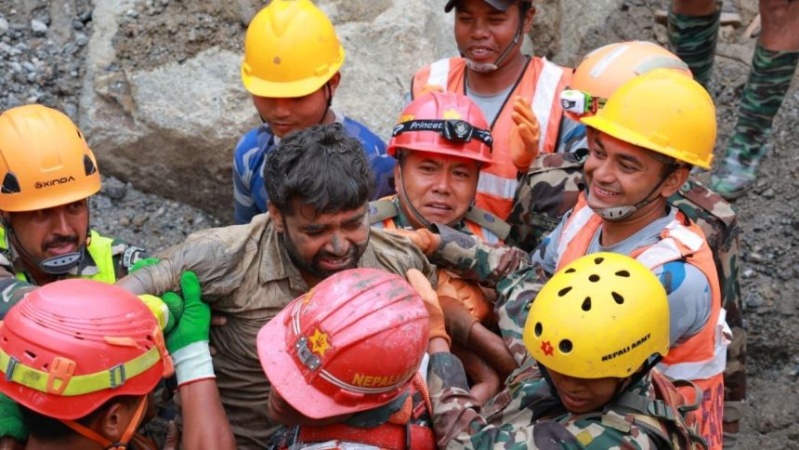
In a dramatic breakthrough for what has been a desperate, round-the-clock rescue effort in treacherous conditions, two men were pulled from an underground chamber of the hydropower plant, where Nepali rescue crews had been boring in search of 42 missing workers.
Rescuers had earlier reported hearing voices after days of a complex search and clearing mission, according to Bipin Regmi, police chief in the flood-hit district of Nuwakot.
Through a patchwork of grey debris, the two men emerged.
Carried out on a rescuer’s back, Sanjay Sah raised his hand in a wave before resting his head on the Nepal Army rescuer’s helmet. His first question was: “What day is it?”
The second man, Kabir Maharjan, was placed on a stretcher with an oxygen mask over his face.
That moment was the culmination of nine days of work that started with almost nothing to go on. After the August 26 disaster, the Trishuli 3A power station was unrecognizable and initially Nepali rescuers had no idea where to start digging.
To find a way in, the team had to work off satellite data, as-built drawings of the power station and topographic information, according to Arnold Dix, a geologist advising Nepali rescuers on the ground.
That’s how they narrowed down the location of the tunnel least likely to have collapsed – an area Dix calls the “Goldilocks zone.”
Once inside, the rescuers found water and sludge which had to be drained. Once water levels had dropped, they were able to use white-water rafts to travel down the tunnels.
But that path was also blocked by enormous rocks that Dix said were “the size of cars.”
“So we have to blow them up in the tunnel, which is incredibly dangerous because we’re in the tunnel and there might be people on the other side,” he said.
Above ground, five excavators, compressors and breakers did the heavy lifting to bring rescuers closer to any possible survival zone, said Lt. Col. Ganga Baral of the Nepal Army. The team also blasted areas around the tunnel’s entrance.
As rescuers got closer to where they thought survivors might be, the explosives and heavy machinery had to stop, and they resorted to using their hands to clear rock and mud to avoid any further causalities.
Video shows rescue workers squeezing through narrow, debris-choked tunnel access points and navigating through confined, mud-slicked spaces.
These tunnels were built to harness Nepal’s rivers and fuel its booming hydropower industry, from which Nepal generates over 90% of its electricity.
Some people previously rescued told CNN the tunnels were “filled with bodies,” and that the flood had stripped them of everything they had, including their clothes.
Then, early Friday, rescuers heard voices.
The men were found 60 meters into the 200-meter tunnel, Dix said.
“Don’t panic, we are rescuing you,” emergency workers shouted down, according to Nepali lawmaker Shri Ram Neupane, who has been involved in the operations at the site.
Within minutes they had a hole, then a rope, then a man. And then a second.
The two men were named by Nepal Electricity Authority as 30-year-old Sah, a mechanical foreman from Saptari district and Maharjan, 45, a mechanical supervisor who had traveled to the site from Kathmandu.
Both were airlifted for emergency medical attention and are being treated at a military hospital in the capital.
In a video seen online, Sah – lying under a blanket, wearing an oxygen mask – described his ordeal.
With his eyes closed, he said it took time to get others in the tunnel to evacuate and that he didn’t have enough time himself to get out.
Normally there were usually just a handful of people there, he said, but at the time of the disaster there were some 40-45 people there, without expanding as to why.
“After the accident happened, I could not run by myself. I had to save everyone,” he said. “I asked everyone to escape outside. Doing so, I wasted time, and I could not get out. I got trapped.”
He added that he kept his spirits up by chanting Hindu mantras.
Maharjan remains in critical condition and in intensive care, according to the Nepali Prime Minister’s Office.
Nepali authorities say there are at least 900 workers missing at a dozen energy projects, including at least 557 people from the Trishuli 3A hydropower site. Of those, 115 are believed to be trapped in the main tunnel, according to the Independent Power Producers Association of Nepal.

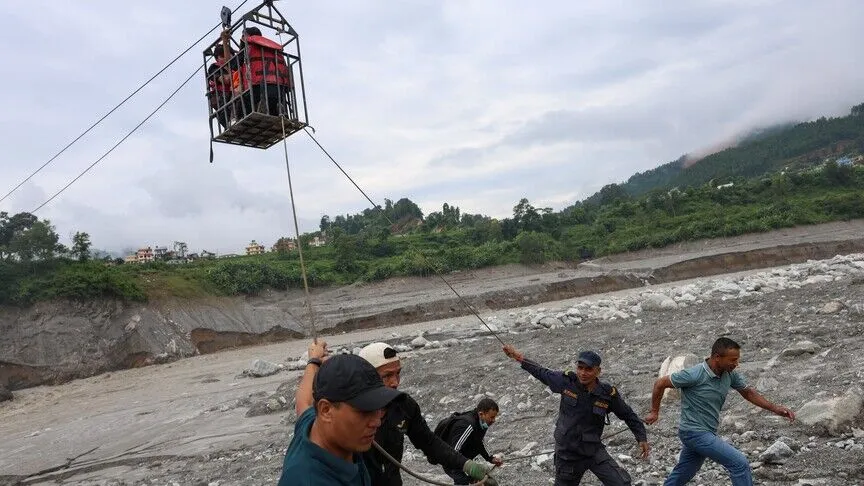
Rescue team members work to enter the tunnel at the Upper Trishuli 3A Hydropower Station as they search for survivors and retrieve bodies
Sah said he wasn’t optimistic about the fate of those still left in the tunnels.
“I don’t think everyone was able to escape, the tunnel is very long,” he said.
Still, family members of the missing were buoyed by Friday’s dramatic rescue, with the brother of one man who had gone missing nearby saying it had renewed his hope that his brother could be returned alive.
“We hope the rest of the team are all inside together, that they have somehow helped each other to stay alive,” Kshitiz Samaser Regmi, 30, told CNN via telephone.
Regmi said his brother, 40-year-old Niraj Babu Regmi, usually works at a different site, but had been moved to Trishuli just two days before the flood hit.
“We don’t know if he was inside, whether he is dead or alive. But we are seeing the team’s working day and night and this helps and brings us hope,” he said.
However, Friday’s rescue was a small speck of hope after a disaster that has killed more than 1,200 people, with thousands more still unaccounted for.
“We see less possibility of finding other missing people at this tunnel,” Suresh Raut, deputy manager at the Nepal Electricity Authority, said.
The same morning, rescuers pulled the body of another worker who didn’t survive from the tunnel, Raut said.
Earlier this week, Parikshit Mehra, an Indian army colonel, told CNN that the first 48 hours are the most crucial for a rescue operation of this scale.
“People who are stuck tend to panic much more than when they are outside in the open,” Mehra said.
But, Mehra added: “There have been miracles.” (CNN)



