
Updating your news feed...
NEWS EXPRESS is Nigeria’s leading online newspaper. Published by Africa’s international award-winning journalist, Mr. Isaac Umunna, NEWS EXPRESS is Nigeria’s first truly professional online daily newspaper. It is published from Lagos, Nigeria’s economic and media hub, and has a provision for occasional special print editions. Thanks to our vast network of sources and dedicated team of professional journalists and contributors spread across Nigeria and overseas, NEWS EXPRESS has become synonymous with newsbreaks and exclusive stories from around the world.










Loading banners
Loading banners...

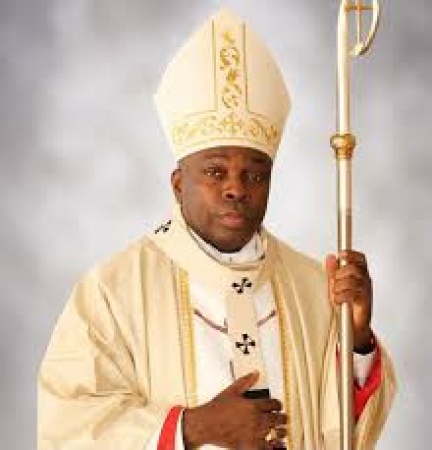
The departed Metropolitan Archbishop of Benin City, His Grace, Most Rev Augustine Obiora Akubeze
By Fr. OKHUELEIGBE OSEMHANTIE AMOS
The bells of Holy Cross Cathedral, Benin City, on Thursday, July 9, 2026, spoke in a language every Catholic understands. Their solemn peal has travelled beyond the ancient walls of the Archdiocese, beyond the Province of Benin, beyond the shores of Nigeria, carrying a message that has descended upon the Church like the stillness that follows the final Amen. His Grace, Most Rev. Augustine Obiora Akubeze, Metropolitan Archbishop of Benin City, has completed his earthly pilgrimage. A shepherd has returned to the Chief Shepherd. A successor of the Apostles has laid down the crozier. A father whose gentle voice steadied anxious hearts has entered that eternal sanctuary where faith yields to sight and hope gives way to everlasting joy. The cathedral bells continue their solemn conversation with eternity, but beneath their mournful cadence lies the quiet assurance that another faithful servant has gone home.
The official announcements have now been made. The Chancellor of the Catholic Archdiocese of Benin City, Very Rev. Fr. Michael Oyanoafo, has spoken for the local Church. The Catholic Secretariat of Nigeria, through its Secretary General, Very Rev. Fr. Michael Banjo, has done likewise for the Church in Nigeria. Their duty has been faithfully discharged, for they have informed us that the Archbishop has fallen asleep in the Lord. Yet there are lives whose meaning cannot be contained within official communiqués. There are men whose passing demands not merely an announcement but contemplation, not merely an obituary but interpretation. Some occupy offices; others ennoble them. Archbishop Augustine Obiora Akubeze belonged unmistakably to the latter.
Born on 25 August 1956, he departed this earthly life on 9 July 2026, having lived for sixty-nine years, ten months and fourteen days. In scarcely seven weeks he would have celebrated his seventieth birthday. Only a few months ago, the Church rejoiced with him as he marked the twentieth anniversary of his episcopal ordination, giving thanks to Almighty God for two decades of fruitful episcopal ministry. How mysterious are the ways of Divine Providence. What appeared then to be the celebration of an anniversary has now become, in retrospect, Heaven's gentle preparation for homecoming. None imagined that the thanksgiving of yesterday would become the farewell of today.
There is a sacred beauty in the departure of those who have spent themselves entirely in the service of Christ and His Church. They seldom leave behind controversy. They leave behind fragrance. Their memory lingers not because they sought greatness but because they embraced faithfulness. Their lives become quiet commentaries upon the words of the Apostle, "I have fought the good fight, I have finished the race, I have kept the faith" (2 Timothy 4:7). Such was the earthly pilgrimage of Archbishop Augustine Obiora Akubeze, whose death has not merely left an episcopal chair vacant but has created an emptiness within the heart of the Church in Nigeria and beyond.
Ordained to the Sacred Priesthood on 1 October 1987 for the Diocese of Issele Uku, the young priest soon distinguished himself by intellectual brilliance, pastoral sensitivity and uncommon humility. His profound knowledge of Canon Law never erected barriers between himself and ordinary people. Rather, it became an instrument through which justice was tempered with mercy and discipline was illumined by charity. Those who knew him in those early years encountered a priest whose quiet simplicity concealed remarkable depth, a man who never mistook authority for superiority and never confused learning with pride.
When Pope Benedict XVI erected the Diocese of Uromi in 2005, Augustine Obiora Akubeze was entrusted with the daunting responsibility of becoming its first Bishop. Every pioneer writes history, but only a few write it with serenity. Like David, whose seven years in Hebron prepared him for his reign in Jerusalem before he ruled over all Israel for thirty-three years thereafter, so too did Bishop Akubeze's years in Uromi become God's providential preparation for his translation to the Metropolitan See of Benin City (2 Samuel 2:11; 5:5). During those years he did not merely establish diocesan structures. He cultivated an ecclesial culture rooted in communion, discipline, missionary zeal and pastoral closeness. He built institutions, yet never forgot that the greatest institution entrusted to a bishop is the human heart.
The chancery he established in Uromi became more than an administrative complex. It stood as a visible proclamation that the Church had come to remain. Priests found in him a father who corrected without humiliating and encouraged without flattering. Seminarians discovered a mentor who believed that the future of the Church would hardly rise above the quality of her priestly formation. The lay faithful encountered a shepherd who preferred listening before speaking and serving before commanding. His authority flowed naturally because it was born not of power but of credibility.
His translation to the Archdiocese of Benin City in 2011 opened another luminous chapter in his episcopal ministry. As the third Metropolitan Archbishop of that historic See, he inherited a Church rich in missionary heritage and distinguished leadership. Yet greatness never tempted him towards imitation. He honoured the legacy of his predecessors while quietly writing his own chapter with dignity, prudence and evangelical simplicity. He understood that history does not remember those who imitate greatness, but those who embody it.
His episcopal motto, Ut Testimonium Perhibeam Veritati, "That I May Bear Witness to the Truth," was never a decorative inscription beneath an episcopal coat of arms. It became the grammar of his entire ministry. Whether preaching from the pulpit, guiding the Catholic Bishops Conference of Nigeria or addressing a nation burdened by insecurity, injustice and uncertainty, truth remained his preferred language. He neither surrendered conviction for applause nor sacrificed charity for confrontation. His was the calm courage of one who understood that the Church speaks most powerfully when she speaks with fidelity to Christ.
The Church in Nigeria recognised these gifts and entrusted him first with the office of Vice President and later President of the Catholic Bishops Conference of Nigeria. Those years demanded wisdom more than popularity and courage more than convenience. Archbishop Akubeze never mistook silence for peace nor harshness for strength. His interventions reflected the equilibrium of a shepherd who knew that the prophetic mission of the Church is fulfilled not through noise but through truth spoken in love. He became one of the nation's clearest moral voices because he spoke not to please the powerful but to strengthen the weak.
Archbishop Ignatius Kaigama once affectionately described him as "Mr. Generosity." Few descriptions have proved more fitting. His generosity was never theatrical. It revealed itself in quiet assistance to struggling priests, discreet support for the needy, patient listening to the burdened and an almost instinctive willingness to place others before himself. There are countless stories that will never appear in official records, stories known only to grateful hearts that discovered hope because Archbishop Akubeze quietly became the answer to their prayers.
Perhaps nowhere did the beauty of his character shine more brightly than in the filial affection he showed Archbishop Emeritus Patrick Ebosele Ekpu. In an age increasingly fascinated by novelty, Archbishop Akubeze reminded the Church that gratitude is one of her noblest virtues. He cared for his predecessor with the tenderness of a devoted son, ensuring that the shepherd who had once carried the burdens of the Archdiocese never experienced neglect in the evening of his life. Without preaching a single homily, he offered an unforgettable lesson on continuity, gratitude and ecclesial communion.
He was also a builder in the truest biblical sense. The chancery in Uromi remains a testimony to his pioneering vision. The magnificent chancery in Benin City bears witness to his administrative foresight. Only weeks before his passing, the Archbishop's residence reached completion, standing now as an unintended memorial to a shepherd who continued building until the twilight of his earthly labour. Yet buildings, impressive as they are, remain only the visible monuments of a much deeper legacy.
His greatest construction project was people.
He expanded parishes, established new Mass centres and strengthened the pastoral structures of the Archdiocese with quiet determination. He invested deeply in priestly formation because he understood that the future of the Church depends upon the holiness, learning and pastoral maturity of her clergy. For many years he chaired the All Saints Seminary Commission, nurturing generations of future priests long before they mounted pulpits or stood before the altar of sacrifice. He also served faithfully on the Governing Council of the Catholic Institute of West Africa, convinced that scholarship, when united with faith, becomes a powerful instrument of evangelisation.
His influence reached well beyond diocesan boundaries. As Metropolitan Archbishop he strengthened the Province of Benin, fostering deeper communion among its dioceses and encouraging missionary expansion. During his provincial oversight, Bomadi matured into a Diocese, further extending the missionary presence of the Church. Later, when the Diocese of Warri entered a delicate period of transition, the Holy See entrusted him with the responsibility of Apostolic Administrator. He accepted that assignment with characteristic humility, proving once again that genuine leadership is measured not by prestige but by readiness to serve wherever the Church calls.
He possessed another gift increasingly rare in public life. He built bridges. Governments respected him without fearing him. Traditional rulers welcomed him without reservation. Other Christian communities found in him a trustworthy partner. He understood that while the Church must never surrender her prophetic voice, neither should she abandon society to moral loneliness. His ministry became a bridge between the sanctuary and the public square, between doctrine and dialogue, between conviction and compassion.
Those who encountered him casually often remembered something deceptively simple. He was always impeccably neat. He wore the cassock not merely as ecclesiastical attire but as the visible expression of an interior consecration. Elegance accompanied him without extravagance. His words were measured, his voice gentle and his bearing dignified. There was refinement without ostentation, authority without intimidation and simplicity without carelessness. He reminded all who met him that holiness possesses its own unmistakable beauty.
Today, therefore, the Church does not mourn merely an accomplished administrator. She mourns a father whose charity embraced both priest and lay faithful, a canonist whose knowledge served mercy, a shepherd whose gentleness became his strength, a bridge builder whose life united rather than divided and a successor of the Apostles who spent himself generously for the People of God. The grief that fills Catholic hearts today is deep, yet it is not without hope, for the Lord Himself has declared, "I am the Resurrection and the Life; whoever believes in me, though he die, yet shall he live" (John 11:25).
The episcopal chair will in time receive another occupant. Another shepherd will take up the crozier and continue the apostolic ministry within the Archdiocese of Benin City. Such is the enduring continuity of the Church founded upon Christ. Yet no successor, however gifted, will replace Augustine Obiora Akubeze, because every faithful bishop leaves behind an imprint that belongs uniquely to his own vocation.
History will remember him as the pioneer Bishop of Uromi, the third Metropolitan Archbishop of Benin City, former President of the Catholic Bishops Conference of Nigeria, an accomplished canon lawyer, a prudent administrator, a patient builder and an unwavering witness to the truth. Heaven, however, will remember him by a title infinitely greater than every earthly honour, that simple yet eternal commendation spoken by the Divine Master, "Well done, good and faithful servant; enter into the joy of your master" (Matthew 25:23).
As the bells of Holy Cross Cathedral continue their solemn conversation with eternity, one imagines that another voice, infinitely more beautiful than bronze, has already broken the silence of Heaven. It is the voice of the Good Shepherd calling home the shepherd who spent sixty-nine years, ten months and fourteen days leading souls towards Him. The crozier has been laid aside. The mitre has yielded to the crown that does not fade. The pilgrim has reached the eternal homeland. The labourer has entered into his rest. The father has gone to the Father's house.
Eternal rest grant unto him, O Lord, and let perpetual light shine upon him.
May he rest in peace. Amen.
•Fr. Dr. Okhueleigbe Osemhantie Amos, a priest of the Catholic Diocese of Uromi, whose Ph.D. studies were sponsored by the Archdiocese of Benin City through the generosity of Archbishop Augustine Obiora Akubeze