ADAD
ADAD
Updating your news feed...
NEWS EXPRESS is Nigeria’s leading online newspaper. Published by Africa’s international award-winning journalist, Mr. Isaac Umunna, NEWS EXPRESS is Nigeria’s first truly professional online daily newspaper. It is published from Lagos, Nigeria’s economic and media hub, and has a provision for occasional special print editions. Thanks to our vast network of sources and dedicated team of professional journalists and contributors spread across Nigeria and overseas, NEWS EXPRESS has become synonymous with newsbreaks and exclusive stories from around the world.



















Loading banners
Loading banners...

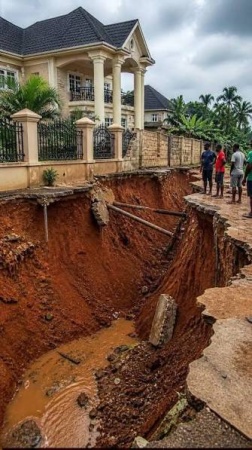
Abandoned building beside a gully erosion site
The rate at which gully erosion, occasioned by heavy rainfall, is eating up residences, farmlands and roads is eliciting worries in the South-East. LAWRENCE NJOKU, GORDY UDEAJA, OSIBEREOHA OSIBE, and NNAMDI AKPA report.
Sights of beautiful houses standing empty while their owners have become tenants elsewhere at Isiokwu-Ihioma Autonomous Community, in Orlu Local Council of Imo State, evoke sheer bewilderment.
While some of these abandoned compounds have been overtaken by weeds, farmlands are also being swallowed up, and life is becoming increasingly difficult for the victims as their structures and farmlands are being eaten away.
In the agrarian community, land is gradually turning against its people as what began as seasonal flooding has birthed gullies and landslides in the area. Homes have been swallowed; roads have disappeared; families have fled, and those who remain live daily in fear that the ground beneath their feet may give way without warning.
In April this year, The Guardian discovered during a visit that the gullies stretch for more than four kilometres, and exceed 60 metres in depth in places. It is said to span over 20 feet in width.
Members of the community have continued to lament their woes, as rains that ordinarily should bring growth now bring destruction and leave residents wondering what could happen next.
“This is not just erosion; I think the earth has decided to rumble,” a resident of the community, Jude Igwe, told The Guardian. It was further observed during the visit that even trees are sometimes felled to cross gullies formed by the rains.
In Umuchima, Akpulu in Ideato, Nekede, Isu, Orlu in Imo State, devastating gullies have always unsettled residents and caused relocation of residents and businesses.
In Uhuala Obibi Community, Orlu LGA, Imo State, in April this year, a gully triggered by the overflow of Ezize River submerged over 20 houses, including the Nkwo Market. The incident measured about 80 meters deep and over 100 metres wide.
Beyond Imo communities and farmlands, several South-East residents also have cause to worry during rainy seasons due to devastating erosion and floods that continue to displace communities, damage infrastructure, and undermine food security.
The Deputy Speaker of the House of Representatives, Benjamin Kalu, had recently said that no fewer than 2,300 gully erosion sites exist in the South-East.
Kalu noted that there are about 700 gully erosion sites in Anambra State, 400 in Enugu, 450 in Imo, 350 in Ebonyi, and 300 in Abia State.
Members of Umabor Eha-Alumonah community in Nsukka Local Council of Enugu State, on June 17, this year, took to the streets protesting the plethora of poor infrastructure, which they stated has continued to rob them of the essence of life.
They particularly pointed out the Agu Umabor dilapidated road, saying that residents may be cut off from the rest of Enugu State should the road continue to be neglected.
During the protest, they threatened to boycott electoral activities for the 2027 general elections until there was intervention to secure the road.
Last May, an alarm was raised after devastating erosion threatened to completely cut off the Oji River–Awgu Federal Highway in Enugu State. The development has already halted vehicular movement on the critical road corridor, as many residents now fear for their lives using the road.
Anayo Onwuegbu, the member representing Aninri/Awgu/Oji River Federal Constituency, was literally forced by the alarm to visit the area, where, after an assessment described the situation of the road as “unfortunate and worrisome.”
Onwuegbu had lamented that some portions of the road had been completely cut off by severe erosion following incessant rainfall, even as he appealed to the Federal Ministry of Works to treat the situation as an “emergency.”
At Oma Eke, a town in Udi Local Council in Enugu State, which comprises other communities, the people have continued to endure menacing erosion that has created gullies on the roads and ravaged farmlands and houses.
A visit to the area revealed many homes fitted with high steps, intentionally built to prevent running water from reaching the residences. One of the residents, Mr Obed Eke, told The Guardian that: “As a community, we have continued to intervene in the gully erosion situation. Almost every week since the rains intensified, every adult male must come to join community work to create channels for rainwater to flow or to fix certain portions of the road. Even with these interventions, it is still not easy to assess certain communities by vehicle at this period”.
In the last three years, what appears to be perennial flooding has hit the Ugwuoye Community in Nsukka Local Council, unsettling residents each time it rains.
The floods have always submerged the dual carriageway, overrun the banks, and flooded petrol stations, shops, and homes. As the rains intensify, several residents have relocated as the floods continue to make living unbearable in the area.
Also worrisome in the state are gully erosion sites along the Enugu-Onitsha highway, Eha-Ulo, Eha-Ndiagu, Umabor Ring Road in Nsukka, as well as the Ezeagu axis.
There are also several active erosion sites documented across Anambra State. Among them are Nanka and Oko in Orumba North Local Council, Ekwulobia in Aguata Local, Ukpor in Nnewi South Local Council, Oba in Idemili Local Council, Obodi in Idemili North Local Council, Abatete/Ogidi in Idemili North Local Council, Agulu in Anaocha Local Council, Ozubulu in Ekwusigo Local Council and Ogwuikpele in Ogbaru Local Council. These sites have continued to eat up the state’s small landmass, as affected residents have always relocated to safer locations, while reclaiming the sites has been difficult due to a lack of resources.
Schools, business premises, and farmlands in Isuikwuato and Umunneochi in Bende Local Council; Amuda-Mbala in Isuochi and Uturu in Isuikwuato, in Abia State, are also being threatened by gully erosion.
Recently, to support state government efforts to tackle surging gully erosion, Age Grades in Ohafia, one of the communities hit by the erosion menace, raised funds among themselves to fight erosion.
The Secretary General, Ebem Ohafia Development Union, Kalu Ogboso Nnoke, disclosed that the Ohafia Age Grade Groups had spent over N400 million on erosion preventive measures in the past few years, explaining that gully erosion has become a serious challenge to the people of the area.
In Ebonyi State, the impact has been severe, especially at Nguzu Edda in Afikpo South Local Council. The devastation stretches across Ogwuma Edda, Mgborokum Road in Ekoli Edda, Omanwu Ezieku Road, Isiofu, Ekoli Okagwe Road, Libolo Erei Road and the old council secretariat axis.
The community has become a symbol of the devastating consequences of unchecked erosion. Years of advancing gullies eventually forced the relocation of the local council headquarters and several surrounding structures to a safer location.
What remains of the old site serves as a haunting reminder of nature’s destructive power.
Community leaders estimate that no fewer than 15 active gully erosion sites exist across Afikpo South, which continue to swallow roads and pose threats to residential buildings and other structures.
Residents stated that they have “watched helplessly” as the earth beneath them gives way.
During a visit to Nguzu Edda last week, a resident, Oko Inya, said: “We have lost roads, public infrastructure and homes to erosion.
“The old council headquarters had to be relocated because the gully kept expanding every rainy season. Many families have moved to safer areas”.
Also, Ndiulo Amofia Ngbo in Ohaukwu Local Council remains one of the state’s most vulnerable erosion corridors. The area has repeatedly been identified by the Federal Ministry of Environment as a high-risk zone requiring urgent intervention.
Residents say each rainfall widens existing channels and threatens nearby homes and farmlands.
The community, located between the Ebonyi and Oto rivers, also experienced recurrent flooding between June and October last year, which affected farmland, among other areas.
Residents say the absence of a functional bridge across the Oto River has compounded their hardship.
Alfred Agbo noted that: “This year’s flood is the worst we have experienced”. He said so because the flood swept through his rice and cassava farm, completely destroying them.
Many have blamed the worsening crisis on a combination of natural and human-induced factors. They pointed to poor urban planning, blocked drainage channels, deforestation, sand excavation, unregulated construction activities, and weak enforcement of environmental regulations as possible factors that have continued to cause gully erosion in the region. They also insist that many roads are built without adequate drainage, while natural waterways are frequently obstructed by indiscriminate refuse dumping.
To stem the tide, the Anambra State government has intervened through water retention method by digging community catchment pits/run-off containments, planting of trees like bamboo, cashew etc., non-building of roads within channels, distilling of water channels, concrete channeling, adoption of measures to manage sandy soil, behavioural change, enforcement of compliance, checking indiscriminate disposal of wastes including plastics blocking drains, regulation of development/economic activities like farming, quarrying, and sand mining.
The state governor, Charles Soludo, on June 2, 2026, approved N803 million for the construction of a floodwater diversion channel at Ezi-Oko-Nanka in Orumba North Local Council, awarded to Lebtech Construction Limited to remediate the menace.
Mr Handel Okoli, the Coordinator of Ezi-Oko Erosion Management Group, had, while reacting to the development, stated: “For years, Ezi-Oko and Oko continue to battle destructive floods and landslides that destroy homes, farmlands and lives. The government intervention supports our self-help efforts to check this scourge going forward.”
Similarly, multi-agency bodies are intervening on environmental restoration, sanitation, waste disposal and climate action. They include Emma Nwasinoke-led Anambra State Erosion Watershed and Climate Change Agency (ANSEWCA); charged with management of erosion-prone areas and implementing mitigation, and Anambra State Clear Drainage and Inland Flood Management Agency (ASCDFMA) saddled with keeping drainage systems functional and ensuring compliance with policies or training to waste disposal and the Anambra State Environmental Sanitation and Waste Management Agency (ASWAMA) saddled with responsibility of sanitation and waste disposal.
The Permanent Secretary, Ministry of Environment, Tochukwu Obodogha, told The Guardian that environmental degradation, including disruptive climate change, is a big challenge and poses an existential threat to the state and its people.
He pointed out that the Ministry, Departments and Agencies concerned with environmental matters have been visiting devastated erosion sites and studying them to determine short-, medium- and long-term approaches to solving the problems.
Obodogha traced the causes of erosion sites to hydrogeology, topography, geotechnical rocks, non-provision of catchment pits/run-off containment, deforestation, soil nature, non-distilling of drainages, building of roads within channels, non-enforcement of compliance, indiscriminate disposal of wastes resulting in plastic blockage of drainages, development/economic activities like farming, quarrying, sand mining and bad behavioural actions.
The Abia State government named some of the 16 already controlled erosion sites as Ovom-Aba in Abia South, which caused havoc, building collapses, disrupted businesses, displacement of persons, and loss of resources.
Others include Umuchime, Umara Clan and Umuopara communities in Umuahia South LGA, the Agbama Ring Road erosion, and Osaa, both in Umuahia North LGA.
Recently remediated erosion under the NEWMAP included Amuzukwu-Ibeku, Umuahia North, Amuda-Achara Isuochi, Umunneochi, Ovom Road, and Ogbor Hill, Aba, erosion control.
Under the World Bank-assisted Nigeria Erosion and Watershed Management Project (NEWMAP), several remediation projects were executed across Ebonyi State, including channelisation and flood-control works at Iyi-Udele, Iyi-Okwu International Market, Ebyia River, and the Odunukwe-Nkaliki/Hatchery Road corridor.
The project also facilitated compensation and resettlement for hundreds of persons displaced by erosion in Nguzu Edda and other high-risk communities.
Afforestation initiatives and sustainable land management programmes have been introduced in vulnerable areas, including Edda and Okposi.
The federal government, through the Federal Ministry of Works, intervened at the Ninth Mile-Udi-Ezeagu erosion site in Enugu, which had completely cut off the Highway. A new culvert is currently being constructed to rejoin the highway.
Meanwhile, a surveyor, Martin Nwachukwu, believes that to effectively tackle the menacing gully sites in the region, the federal government must be fully involved, stressing that it has gone beyond the capacities of the state governments.
“I would also think that the South East Development Commission (SEDC) should see the urgent need to intervene in gully erosion issues to restore the region,” he added. (The Guardian)