
Updating your news feed...
NEWS EXPRESS is Nigeria’s leading online newspaper. Published by Africa’s international award-winning journalist, Mr. Isaac Umunna, NEWS EXPRESS is Nigeria’s first truly professional online daily newspaper. It is published from Lagos, Nigeria’s economic and media hub, and has a provision for occasional special print editions. Thanks to our vast network of sources and dedicated team of professional journalists and contributors spread across Nigeria and overseas, NEWS EXPRESS has become synonymous with newsbreaks and exclusive stories from around the world.










Loading banners
Loading banners...

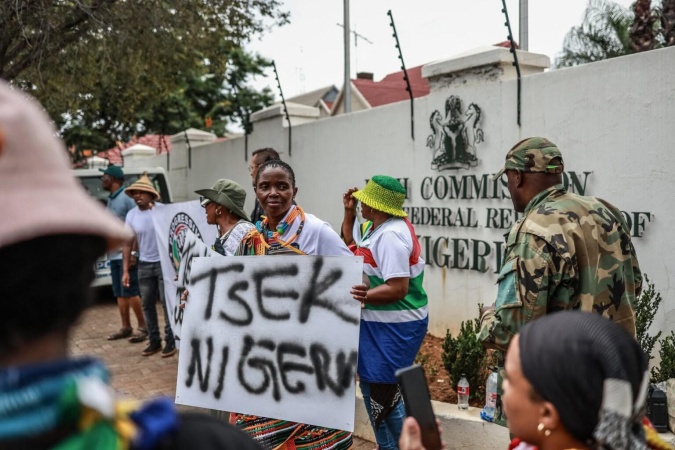
South Africans protesting against the installation of a Nigerian 'king' Solomon Eziko
Panic has gripped Nigerians in South Africa’s Eastern Cape following xenophobic attacks linked to the controversial installation of a Nigerian as Igwe Ndigbo.
Nigerians woke up to chaos on Monday morning as South Africans took to the streets of Albany and Buffalo under KuGombo, popularly known as East London, to protest against the coronation of a Nigerian Igbo chief, Solomon Eziko, which took place early March.
The installation was greeted with outrage from South Africans, who cited clashes of traditional values and disrespect to the sovereignty of their country.
Saturday PUNCH learnt that about 26 Nigerians were injured and hospitalised, while property, including cars and shops worth millions of rands (billions of naira) were destroyed.
Viral videos showed Nigerians being humiliated and battered by South African people and security operatives, who demanded their exit from the country.
In one of the videos, South African MKP Labour and Civic Organisation officials asked a Nigerian man to close his tent, pack his wares and leave their country.
Another video revealed how South Africans trooped out in their numbers to force Nigerians to close businesses and leave their country.
In another video, Nigerians ran helter-skelter, scampering for safety as their hosts dehumanised them.
An opportunity for attack
The President of the Nigerian Citizen Association South Africa, Rev Frank Onyekwelu, who spoke with Saturday PUNCH on the matter, said South Africans used the opportunity to launch xenophobic attacks.
According to him, before the demonstrations, South Africans had been threatening Nigerians and other foreigners.
“A number of them have been going with the agenda that they want to reclaim South Africa for South Africans. Hence they want all African foreigners, legally or illegally, to go. As a result of that, they have been pushing out hate speeches against foreigners in the public, social media, television, and radio,” Onyekwelu said.
The Nigerian community leader said South Africans marched to the streets in East London to hide under the guise of the coronation to destroy Nigerian businesses, loot their shops and burn their cars.
“They said even if the world sees it as xenophobic, they don’t care. They claimed that they fought against apartheid by themselves.
“Properties of Nigerians were damaged, cars were torched, and businesses were looted particularly in the provinces of KwaZulu-Natal and Eastern Cape.
“In other places where there were no attacks, they approached Nigerians, hauled their goods on the streets, told them to vacate the areas, and leave South Africa. There were threats to the lives and properties of Nigerians,” he added.
Saturday PUNCH gathered that the attacks had created tension among Nigerians.
Onyekwelu described it as “an act of stereotype, xenophobic attacks and prejudice against their own African brothers.”
“They cannot do this to Westerners like Chinese, Indians and Europeans living in their country. These people are occupying large places, properties, industries and farms in South Africa, and South Africans cannot do anything to them.
“It will interest you that there is a place in Northern Cape called Orania. It is a secluded area where these people live and have their own currency, bylaws, amenities, and South Africans are aware of it. But they (Westerners) strictly prohibit anyone who is not from their tribe or region from going.”
He decried the persistent attacks South Africans unleashed on Nigerians as “prejudiced and xenophobic.”
‘Most stupid thing’
However, another Nigerian who spoke with Saturday PUNCH, blamed the reported attacks on the coronation, describing it as a “most stupid thing.”
The source also said though the protests had subsided, there were reports of protesters regrouping to continue attacks on Nigerians.
“The crowning of the Igwe is the most stupid thing any African migrants could have done in South Africa in a Municipal election year, at a time when there is high anti-migrant sentiment.
“We received information about another planned protest and asked our members with businesses in the Central Business District to lock up their shops,” he said.
According to the source, Nigerians are not the only victims, though primarily the targets.
“Parts of Buffalo Street and Albany Street were affected by the violent protest. Somalians, Pakistanis, Ethiopians and some South African shops in that area were affected.”
The source said some Nigerians foresaw a problem and warned leaders of the Nigerian community before Eziko was installed as Igwe Ndigbo in early March.
He said some leaders attempted to speak against the inauguration of the Igbo chieftaincy title, but the majority turned a blind eye.
“Many of our leaders did not engage the tribal authority to explain the coronation to them. If they did, there would have been no riot. These rioters rode on the back of a party organisation, but our leaders should have told them that it was only a cultural thing,” the source said.
Defending the coronation, Onyekwelu said it was not created for the South Africans but for the Igbo people within the Nigerian community.
The NICASA president stated that many explanations had been offered to enlighten South Africans and the entire public about the title of Igwe Ndigbo.
“It is merely a ceremonial Igbo culture and tradition to preserve it among its people and transfer it to the other generation,” Onyekwelu said.
Nigerians panic, stay indoors
It was learnt that Nigerians living in the country had been in fear since the protests, forcing them to be indoors.
The President-General of the Nigerian Union South Africa, Mr Smart Nwobi, said many Nigerians had remained indoors, while several businesses were shut over safety concerns.
“Our people are still fearful. They are indoors. Many shops are still locked. Some of the shops were damaged and looted, and we are going to assess the damage.
“We are waiting for other stakeholders to come out and speak. The citizens are looking forward to hearing them speak, to say that this thing was misconstrued and blown out of proportion,” he added.
Nwobi, a human rights lawyer, noted that the situation stemmed from a misunderstanding of a cultural event, urging stakeholders to intervene.
He explained that Nigerian groups in South Africa regularly organised cultural exhibitions and ceremonies, stressing that such associations were legally registered under South African law.
According to him, the event in question is symbolic and does not seek to challenge or replicate South Africa’s traditional leadership structure.
He stated, “The Ohanaeze in South Africa just decided to honour the leader of Igbo extraction in that area, using language familiar to the Igbo people. It was not an attempt to create a parallel traditional authority.”
Nwobi added that a delegation comprising members of the Nigerian Union, Ohanaeze, and officials of the Nigerian mission in South Africa would engage the local royal authorities to douse tensions.
The President of Ohanaeze Ndigbo in South Africa, Dr ABC Okokoh, said the incident caused both physical and emotional damage to Nigerians.
Okokoh denied that any coronation took place, insisting that what happened was merely a symbolic decoration at a private event.
“Apart from physical damage, there is also emotional damage due to the incident. Ohanaeze never crowned anyone. What we did was to decorate. We were invited. South Africa has laws guiding traditional leadership, and such recognition must come from the government. This was not about kingship,” he said.
He added that those honoured at the event had no role in land administration or governance in South Africa.
“It was just a private event that was misinterpreted,” Okokoh emphasised.
‘No king in foreign land’
Meanwhile, President of the Association of Yorubas in Diaspora, South Africa, Dr Olusola Agbeniyi, said the incident was limited to a town and had not spread across the country.
He said, “The issue happened only in one town in East London, which is a medium-sized city. There is calm in other cities. It is not widespread across South Africa.
“The locals were very furious because it was a traditional institution matter, not politics. You cannot be king in another man’s land, and that was why they reacted.”
Agbeniyi, however, noted that the reaction by some locals was driven by concerns over traditional institutions, adding that stakeholders would meet to address the situation and prevent further escalation.
‘They are visitors’
A South African cabinet minister, Khumbudzo Ntshavheni, expressed displeasure at the unrest caused by the coronation, warning Nigerians to behave as “visitors”.
Ntshavheni spoke on behalf of the South African government and cautioned Nigerians in the country from undermining the country’s traditional authorities.
She disclosed this on Thursday while acknowledging an apology tendered by the Nigerian High Commission on behalf of Nigerians.
She said, “Our heritage and customs must be respected by all, particularly our visitors. The cabinet expressed disgust at the so-called coronation of a Nigerian national as an alleged chief in KuGompo City in the Eastern Cape. It is a mere kindergarten gimmick and has no legal effect.”
The 49-year-old minister said the recognition of traditional authorities in South Africa was strictly regulated by law.
Ntshavheni disclosed that the Cabinet acknowledged the apology from the Nigerian High Commission, while mandating the Department of International Relations and Cooperation to continue engagements over what it termed “unacceptable conduct.”
“It is deeply concerning that legitimate grievances over this matter have resulted in acts of violence and criminality. The right to protest comes with responsibility and must be exercised peacefully and within the confines of the law.
“Cabinet confirmed that any establishment and recognition of any traditional leadership structure are strictly governed by the Traditional and Consent Leadership Act, which provides clear and non-negotiable procedures for legitimacy and recognition,” she said.
Investigation ongoing
The Director of Media, Public Relations and Protocols of the Nigerians in Diaspora Commission, Abdur-Rahman Balogun, told Saturday PUNCH on Thursday that the commission was looking into the matter.
“We heard about what Nigerians in South Africa went through, but the matter will be investigated for us to decide,” Balogun said.
Earlier, the NiDCOM Chairman, Abike Dabiri-Erewa, advised Nigerians in South Africa to remain calm.
Her advice was contained in a statement by Balogun on Wednesday.
Dabiri-Erewa said the Nigerian High Commission in South Africa was looking into allegations of violence meted out to some Nigerians “celebrating a cultural festival” in the country.
The NiDCOM boss said it must have been a serious case of “misconception and misinterpretation”, urging both sides to remain calm. (Saturday PUNCH)




