ADAD

Updating your news feed...
NEWS EXPRESS is Nigeria’s leading online newspaper. Published by Africa’s international award-winning journalist, Mr. Isaac Umunna, NEWS EXPRESS is Nigeria’s first truly professional online daily newspaper. It is published from Lagos, Nigeria’s economic and media hub, and has a provision for occasional special print editions. Thanks to our vast network of sources and dedicated team of professional journalists and contributors spread across Nigeria and overseas, NEWS EXPRESS has become synonymous with newsbreaks and exclusive stories from around the world.

















Loading banners
Loading banners...

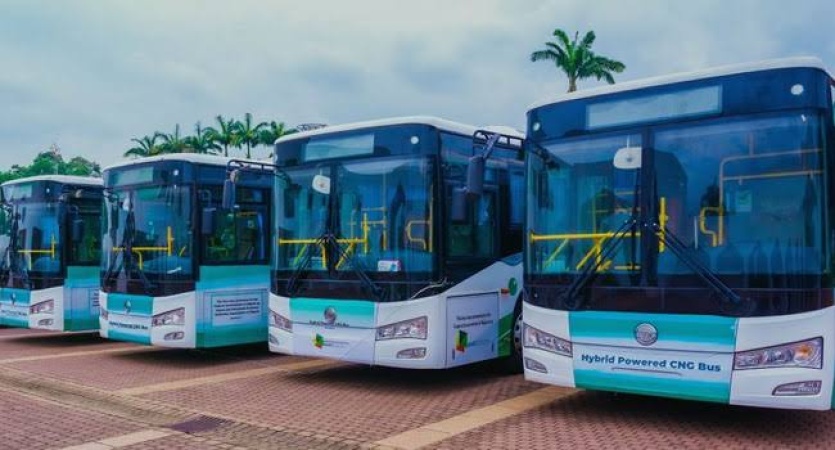
CNG busses
By UCHECHI AFONNE
Three commercial transport operators say Compressed Natural Gas (CNG) has cut their fuelling costs significantly, but long queues, inconsistent dispensing pressure and few fuelling stations are eroding the benefits.
The operators spoke in separate interviews with the News Agency of Nigeria (NAN) on Sunday in Lagos.
NAN reports that President Bola Tinubu had, in March 2026, directed the accelerated deployment of Mobile Refuelling Units to improve CNG accessibility pending the expansion of permanent infrastructure.
One of the operators, Mr Fatai Mohammed, who works as a driver for a corporate organisation, said his vehicle’s 75-litre CNG cylinder could hold up to 17 standard cubic metres (SCM) of gas.
According to him, it costs about N6, 460 at N380 per SCM compared to N30, 000 he will spend on petrol for the same daily office trips, a potential saving of N23, 540.
He said that the quantity dispensed, sometimes, fell to between seven SCM and 16 SCM, depending on the pressure available at the station.
He said that his daily trips covered 25 to 30 kilometres each way.
“The use of CNG is the only thing that has been saving us cost because using only fuel (premium motor spirit) increases our expenditure tremendously,” he said.
In spite of the savings, Mohammed identified long queues as a major challenge, saying motorists sometimes spent several hours waiting to refill.
He said that he usually dropped his passengers at the office before going to a filling station, where he sometimes spent most of the day waiting.
“Although sometimes I manage to refill before 4.00 p.m., there are occasions I leave without gas because of the long queues.
“If you go to the station by 9.00 a.m., you may still be there by 3.00 p.m.
“CNG itself is not expensive, but when you calculate the time spent waiting to refill, you realise that you are losing valuable working hours.
“The government should help us make more CNG fuelling stations available for ease of access,” he said.
Another operator, Chinedu Okpara, who drives a bus that uses both petrol and CNG, said that gas was a more economical option, but it was difficult accessing it.
Okpara said that long queues and alleged demands for tips by some filling station attendants had made fuelling frustrating.
“I prefer CNG because it saves me a lot of money. What I do not like is the time I waste trying to fuel and the lobbying that goes on at the filling stations.
“CNG is a good thing, but the circumstances surrounding access to it are discouraging,” he said.
Similarly, airport taxi operator Kennedy Briggs said that he converted his vehicle to CNG to reduce the rising cost of petrol and eventually make his services more affordable.
Briggs said that three months after the conversion, he had yet to reduce his fares because he was still recovering his investment and losing working hours while waiting to fuel.
“The delays have made it difficult to reduce fares, in spite of the intention to make airport taxi services more accessible.
“People complain that airport taxis are expensive, and I hoped to reduce my fares. However, I am still trying to recover the money spent on the conversion.
“On days that I need to refill, I sometimes end up not working at all because I spend several hours on the queue. After such a loss, I still have to maintain my prices to make some profit,” he said.
Briggs urged the authorities to address the difficulties facing CNG users and provide more accessible fuelling alternatives.
He said that returning to petrol would mean going back to the high fuelling costs he had sought to avoid.
“I cannot go back to buying petrol at an exorbitant price after all the sacrifices I have made so far. We need government intervention and alternatives to make fuelling easier,” he said. (NAN)