ADAD

Updating your news feed...
NEWS EXPRESS is Nigeria’s leading online newspaper. Published by Africa’s international award-winning journalist, Mr. Isaac Umunna, NEWS EXPRESS is Nigeria’s first truly professional online daily newspaper. It is published from Lagos, Nigeria’s economic and media hub, and has a provision for occasional special print editions. Thanks to our vast network of sources and dedicated team of professional journalists and contributors spread across Nigeria and overseas, NEWS EXPRESS has become synonymous with newsbreaks and exclusive stories from around the world.













Loading banners
Loading banners...

The Presidential Initiative on Compressed Natural Gas and Electric Vehicles (Pi-CNG & EV) on Friday launched a new daughter station in Abuja, revealing that Nigeria now has 106 such operational refuelling facilities nationwide, with another 170 in the pipeline.
The Executive Chairman of the Pi-CNG & EV secretariat, Ismaeel Ahmed, who disclosed this during the inauguration of the CNG Integrated Refuelling Unit (IRU) in collaboration with Rolling Energy, stressed that total funding mobilised by the private for the sub-sector has reached $2.6 billion.
Ahmed said the President Bola Ahmed Tinubu administration had also directed the deployment of additional 2,000 refuelling infrastructure units in two phases to accelerate the nationwide expansion of CNG facilities.
He said the President ordered the provision of 1,500 units in February and another 500 in August, adding that the facilities were expected to come on stream between this year and early next year.
According to him, the CNG initiative has moved beyond the proof-of-concept stage, with billions in private sector investments already committed to the sector.
“This is almost our 106th station across the country in less than two years. This is not beginning any longer. The market has been proven, and investors are trooping in,” he said.
According to Ahmed, about 170 additional stations were undergoing development or awaiting various licences from the Nigerian Midstream and Downstream Petroleum Regulatory Authority (NMDPRA).
He said the government was working to expand the facilities to commercial transport routes and high-traffic corridors across the country to ensure more Nigerians benefit from cheaper transportation.
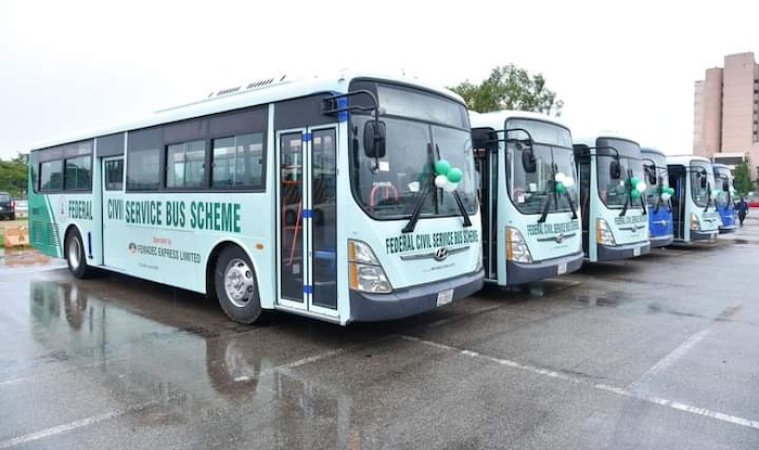
The Pi-CNG & EV office chairman said the adoption of CNG-powered buses had reduced transportation costs by between 30 and 40 per cent on routes where the vehicles were operating.
He cited the Kano-Katsina route, where commuters who previously paid between N3,000 and N4,000 could now travel for about N1,500 using CNG-powered buses.
Ahmed, however, acknowledged that the number of available buses remained inadequate, assuring that efforts were ongoing to increase their deployment.
According to the executive director, the expansion of the refuelling network is expected to improve access to CNG, strengthen public confidence in the transition and make cleaner and more affordable transportation fuel available to more Nigerians.
Earlier, the Permanent Secretary, State House, Temitope Fashedemi, said the inauguration of the facility demonstrated the commitment of the State House to the federal government’s alternative energy policy introduced following the removal of petrol subsidy.
Fashedemi described CNG as a viable and cheaper fuel alternative, noting that Nigeria had abundant natural gas resources that could be better harnessed for domestic consumption rather than wasted through gas flaring.
He explained that the State House partnered Pi-CNG & EV office and Rolling Energy to reactivate an abandoned fuel facility and convert it into a CNG refuelling and vehicle conversion centre.
According to him, the State House provided the facility, while the private sector partner handled its renovation and operational development without any financial contribution from the government.
“The State House hasn’t spent any naira in this space, but we made this place available for this purpose,” he said.
Fashedemi said the facility would not only dispense CNG but also provide conversion services for eligible vehicles, allowing motorists to switch to CNG-powered systems.
He disclosed that about 10 recently acquired State House vehicles were already hybrid vehicles capable of running on CNG, while some shuttle buses operating within the Presidential Villa also used the technology.
He added that State House workers would begin presenting eligible personal vehicles for conversion in the coming weeks.
The permanent secretary urged private investors and entrepreneurs to take advantage of the opportunities in the CNG market, stressing that the government was not expected to own or operate all refuelling stations.
He said the facility had already provided free CNG refuelling services to motorists in the surrounding communities during its testing phase for more than a week.
Fashedemi expressed optimism that its commercial operation would ease pressure on existing refuelling stations and improve access to alternative fuel for motorists in the area.
He urged more private sector operators to invest in CNG infrastructure to support the government’s drive to reduce transportation costs and expand the country’s energy options.
Also speaking, the Chief Executive Officer of Rolling Energy Limited, Mubarak Danbatta, described the project as an example of the benefits of collaboration between government and private investors, commending the State House for providing the abandoned facility for redevelopment.
Danbatta said the partnership demonstrated how the government could support private sector investment by making existing infrastructure available for commercial development.
“What you are seeing here is the power of partnership. When private entities and government come together, this is the result,” he said.
He disclosed that the facility, known as an integrated refuelling unit, combined the dispenser and compressor in a single system, with double-nozzle dispensers that allow vehicles to refuel from both sides.
According to him, the station has the capacity to serve about 150 vehicles daily, depending on cylinder size and pressure, while its vehicle conversion centre is projected to convert 12 vehicles daily. (BBC)