ADAD
Updating your news feed...

NEWS EXPRESS is Nigeria’s leading online newspaper. Published by Africa’s international award-winning journalist, Mr. Isaac Umunna, NEWS EXPRESS is Nigeria’s first truly professional online daily newspaper. It is published from Lagos, Nigeria’s economic and media hub, and has a provision for occasional special print editions. Thanks to our vast network of sources and dedicated team of professional journalists and contributors spread across Nigeria and overseas, NEWS EXPRESS has become synonymous with newsbreaks and exclusive stories from around the world.


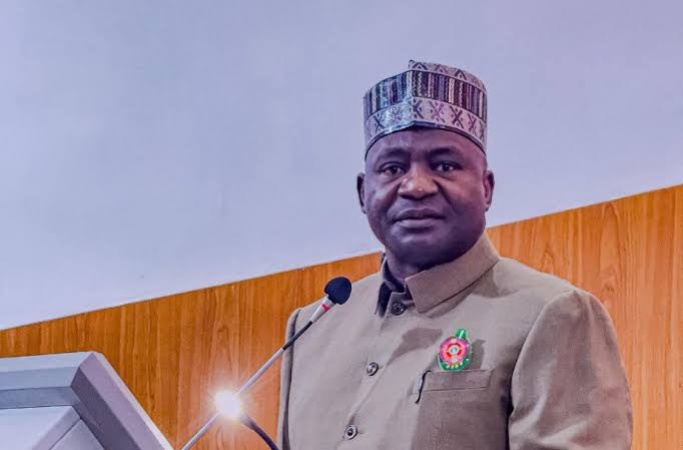
Defence Minister, Gen Christopher Musa rtd
The Minister of Defence, General Christopher Musa (rtd.), has said the military is working to gradually withdraw from internal security operations across the country as the Federal Government intensifies efforts to strengthen the Nigeria Police Force to assume its primary responsibilities.
Musa, who acknowledged that prolonged internal security deployments had overstretched the armed forces, said ongoing investments in police recruitment, training, equipment and institutional reforms were intended to restore the police’s capacity to effectively manage domestic security challenges.
The minister also advocated reintroducing tollgates on major highways, supported by modern surveillance and vehicle identification technology, to strengthen security and curb the movement of criminals.
He spoke at the Abuja Roundtable, “Promise to Proof: The Renewed Hope Conversation”, organised by the APC Progressive Strategy Roundtable and convened by Ismaeel Ahmed, Chairman and Chief Executive Officer of the Presidential CNG Initiative and Electric Vehicles (Pi-CNG & EV).
Addressing concerns about the military’s increasing involvement in internal security, Musa explained that soldiers were being deployed to confront threats that had overwhelmed conventional law enforcement agencies.
He stressed that such deployments should not become permanent substitutes for effective policing, noting that the government was strengthening the police to enable the armed forces to refocus on their core constitutional responsibilities.
He explained that military involvement had become necessary when security challenges exceeded police capacity, adding that the ultimate objective was to build a police institution capable of independently maintaining internal security.
Musa said improved collaboration among the armed forces, police and other security agencies was already yielding operational gains, describing the current level of interagency cooperation as unprecedented.
On the security situation nationwide, the minister disclosed that troops had killed more than 300 terrorists and bandits, including over 10 commanders, in operations conducted during the preceding week.
He attributed the gains to improved intelligence gathering, coordinated operations, increased defence spending and the acquisition of modern surveillance and combat equipment.
The minister said the Federal Government had allocated ₦5.4 trillion to defence in the 2026 budget and was recruiting an additional 12,000 military personnel to strengthen manpower and operational coverage.
He said the administration was investing in modern weapons, surveillance technology, and operational platforms to improve troops’ mobility, intelligence capabilities, firepower, and rapid response.
Turning to highway security, Musa described the proposed restoration of tollgates as a worthwhile initiative, suggesting that dismantling the facilities might have been a mistake.
He explained that modern electronic tolling systems could identify vehicles by registration number and process payments without requiring motorists to stop, while also providing information useful to security agencies.
According to him, integrating such systems with surveillance infrastructure would make it easier to identify suspicious vehicles and track criminal movements along major transport corridors.
The defence minister also advocated greater deployment of facial recognition, fingerprints and personal identification numbers to strengthen the country’s security architecture.
He maintained that modern technology had become indispensable to effective law enforcement, particularly in identifying suspects and tracking criminal activities.
On border security, Musa identified Nigeria’s extensive and porous frontiers, particularly with Niger Republic, as major vulnerabilities exploited by terrorists, bandits and arms traffickers.
He said the government was strengthening border surveillance and deepening intelligence-sharing arrangements with neighbouring countries and international partners.
Despite the withdrawal of Niger, Burkina Faso and Mali from the Economic Community of West African States (ECOWAS), Musa said Nigeria continued to maintain security cooperation and military training relationships with the three countries.
He warned that Instability in the Sahel posed serious threats to the wider West African region, stressing the need for sustained cooperation to prevent further deterioration.
The minister also urged Nigerians to support security agencies with credible intelligence, noting that criminal groups often operated within communities and relied on local networks for survival.
He highlighted the importance of civilian joint task forces, forest rangers and other community-based security structures in protecting vulnerable communities and agricultural settlements.
Responding to concerns about whistleblower safety, Musa acknowledged the need to protect citizens who volunteer sensitive information to security agencies.
He disclosed that the Defence Ministry and military service headquarters were exploring the establishment of an emergency reporting line to improve intelligence gathering and communication with the public.
On military welfare, the minister said the Federal Government had substantially improved soldiers’ remuneration and working conditions
He disclosed that the monthly salary of a private soldier, previously about ₦49,000, was first increased to approximately ₦100,000 and subsequently to nearly ₦200,000.
Musa said military personnel and their families enjoyed free medical treatment, while soldiers requiring specialised healthcare could be referred abroad.
He also explained that personnel underwent psychological preparation before deployment and post-operational assessments to identify trauma-related conditions, including post-traumatic stress disorder.
According to him, returning soldiers could spend between two and three weeks undergoing psychological assessment and support before rejoining their families or units.
He reaffirmed the government’s commitment to the welfare of injured personnel and families of fallen soldiers, including salaries, allowances, healthcare and educational support for their children through university.
On defence industrialisation, Musa disclosed that Nigeria was strengthening local military equipment manufacturing through legislative reforms and partnerships with international producers.
He said the country’s first African International Military Defence Exhibition attracted participation from 63 countries and created opportunities for domestic manufacturers to establish technology and investment partnerships.
He invited Nigerians with expertise in cybersecurity, drone technology and other defence-related innovations to collaborate with the Defence Industries Corporation of Nigeria.
Musa also welcomed proposals for stronger collaboration between security agencies and private electricity providers to address energy supply challenges facing local defence manufacturers.
Musa, however, urged Nigerians to rise above religious, ethnic and regional differences in confronting insecurity, stressing that national security required the collective commitment of government, security agencies and citizens.
He maintained that the ultimate evidence of progress in the security campaign would be farmers returning safely to their farms, motorists travelling without fear, markets reopening and businesses operating in secure environments.
Speaking at the roundtable, Executive Secretary of the Nigerian Police Trust Fund, Alhaji Mohamed Sheidu, said the Federal Government had approved about ₦100 billion to rehabilitate police training institutions nationwide.
Sheidu said years of inadequate funding had undermined police training, infrastructure, equipment and personnel welfare, weakening the force’s capacity to discharge its constitutional responsibilities.
He explained that the Trust Fund was implementing interventions covering training facilities, operational vehicles, protective equipment, police stations and welfare programmes.
According to him, improving police training institutions was critical to producing officers equipped with the professional skills and psychological preparation required for effective law enforcement.
On personnel welfare, Sheidu disclosed plans to provide 1,000 housing units per state for police officers through partnerships with relevant government institutions.
He said a groundbreaking ceremony had already been conducted for approximately 250 housing units in Nasarawa State.
The executive secretary explained that the Trust Fund was collaborating with Family Homes Funds and the Rural Electrification Agency (REA) to provide housing and electricity infrastructure for police personnel.
He added that some smart police stations had been equipped with off-grid solar systems to guarantee uninterrupted operations.
Sheidu also said the Fund introduced welfare buses to transport officers from communities, including Mararaba and Zuba, to their duty posts in Abuja.
He said the Initiative, supported by donations of 40-seater and 50-seater buses, was designed to reduce transportation expenses for police personnel.
The Fund, he added, was considering compressed natural gas (CNG) buses to lower operating costs and sustain the programme.
Sheidu further revealed a partnership with the National Agricultural Land Development Authority (NALDA) to provide agricultural opportunities for dependants of police officers.
He said preliminary discussions had commenced with the governors of Kano and Niger states to facilitate access to farmland and additional livelihood opportunities for police families.
On the proposed establishment of state police, Shaidou expressed support for the reform but stressed that it must be accompanied by sustained investment in the existing federal police structure.
He explained that countries operating decentralised policing systems also maintained strong federal police institutions, arguing that Nigeria must strengthen both levels of law enforcement. (The Nation)