 ADAD
Updating your news feed...

NEWS EXPRESS is Nigeria’s leading online newspaper. Published by Africa’s international award-winning journalist, Mr. Isaac Umunna, NEWS EXPRESS is Nigeria’s first truly professional online daily newspaper. It is published from Lagos, Nigeria’s economic and media hub, and has a provision for occasional special print editions. Thanks to our vast network of sources and dedicated team of professional journalists and contributors spread across Nigeria and overseas, NEWS EXPRESS has become synonymous with newsbreaks and exclusive stories from around the world.













.webp)

.webp)
Loading banners
Loading banners...

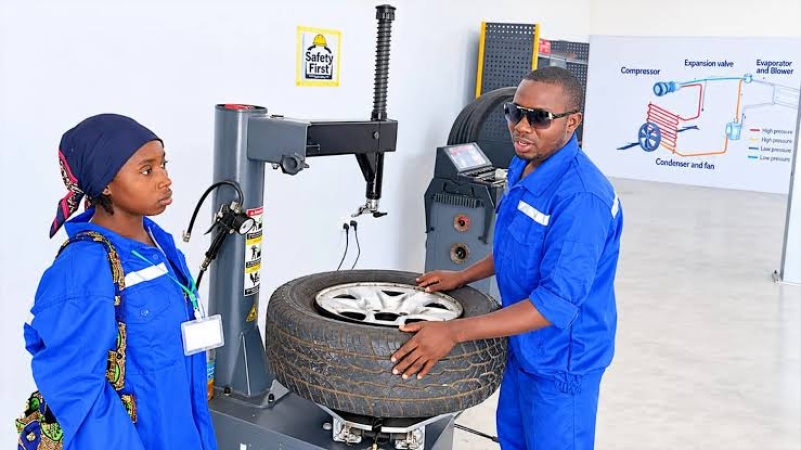
Sunday Abraham fixes a tyre at the IDEA Project workshop, Federal Technical College, Orozo, Abuja,
After losing his sight, Sunday Abraham turned tyre repairs into a means of funding his university education. But two degrees have yet to secure him a job. Now, at 38, he is back to vocational training through the Federal Government’s World Bank-supported IDEAS project, hoping to rebuild his livelihood. OWEDE AGBAJILEKE reports.
For Sunday Abraham, losing his sight could have marked the end of his dreams of becoming self-reliant. Instead, the 38-year-old turned what many would consider a devastating setback into a determination to prove that physical disability does not necessarily prevent a person from acquiring practical skills, earning a living and contributing to society.
Long before he obtained his first degree and master’s degree, Abraham had discovered a trade that would eventually sustain him through university: automobile tyre repairs.
His journey began at his father’s roadside workshop, where he developed an interest in repairing tyres and started learning the rudiments of the business. However, he lost his sight in the course of acquiring the skill.
Rather than abandon the trade, he continued practising, relying on experience, determination and his understanding of the work to overcome the challenges associated with his visual impairment.
“It is not magic. It is about training, determination and having a passion for what you love doing,” he said.
For Abraham, the workshop became more than a place to learn a trade. It became a source of livelihood and the means through which he pursued his academic ambitions.
He eventually enrolled at Nasarawa State University, where he studied Theatre Arts for his first degree before proceeding to obtain a master’s degree in Educational Psychology.
Throughout his university education, he relied on income from tyre repairs to support himself, demonstrating that his visual impairment had not diminished his capacity to work or pursue higher education.
However, after graduation, the prospect of securing formal employment proved difficult. The challenges became more complicated when he had to suspend his tyre repair business because of safety concerns.
According to him, the construction of a major road in his neighbourhood changed the working environment, making it increasingly dangerous for him to attend to customers.
Vehicles were often parked along the roadside, requiring him to cross the busy road to reach customers and carry out repairs. Concerned about the risks, he eventually stopped practising the trade.
With no formal employment despite his two academic qualifications, Abraham began looking for another opportunity to improve his skills and remain economically productive.
That opportunity came through the Federal Government’s World Bank-supported Innovation Development and Effectiveness in the Acquisition of Skills (IDEAS) and Technical and Vocational Education and Training (TVET) programme.
He is now one of the trainees at the Federal Technical College, Orozo, Abuja, where he is undergoing further training in automobile tyre repairs.
For him, returning to the workshop is not a step backwards but an opportunity to update his knowledge, acquire additional skills and possibly rebuild the business that once financed his education.
“Since graduating, I have not secured a job, so I saw the programme as an opportunity to develop myself and possibly return to the trade or teach others in the future,” he said.
He explained that although he had practised tyre repairs for years, the training had exposed him to modern techniques and equipment that could improve the quality of his services.
Among the skills he has acquired are proper tyre maintenance, wheel alignment, balancing, puncture repairs and tubeless tyre conversion.
During a practical demonstration, Abraham showed our correspondent how he could properly position a vehicle, wedge its tyres to prevent movement, loosen the wheel nuts and use a jack to lift the vehicle before removing and replacing a tyre.
He also demonstrated how to remove tyres, patch punctures, fix valves and convert conventional tyres to tubeless ones.
Although he admitted that he was still learning to operate some of the advanced machines used in modern tyre repairs, he said he could perform several tasks with traditional tools and methods without depending on machines.
He noted that proper tyre maintenance was essential for road safety, explaining that improperly maintained tyres could cause vehicle instability and accidents.
He also learnt the importance of wheel balancing after puncture repairs to prevent steering problems, vibrations and shaking, particularly when vehicles are driven at high speeds.
Beyond the technical knowledge, Abraham said the training had exposed him to creative ways of improving the business and advising customers on the benefits of tubeless tyres.
His determination to share knowledge also predates his participation in the programme. While practising the trade, he taught some of his younger siblings how to repair tyres, and they are now independently engaged in the business.
He hopes that the additional skills acquired will enable him to return to the trade and possibly train other young people, particularly persons with disabilities who may be discouraged from pursuing vocational careers.
His experience comes against the backdrop of persistent challenges confronting persons with disabilities in accessing employment and economic opportunities in Nigeria.
A 2025 World Bank study, Economic Cost of Excluding Young Persons with Disabilities in Nigeria, estimated that the country loses about N3.77 trillion annually through the exclusion of working-age persons with disabilities from economic activities.
The study, based on the 2023 Nigeria Living Standards Survey and covering 3,552 young persons with disabilities across the 36 states and the Federal Capital Territory, found that only 37.1 per cent were employed, while 51.5 per cent were outside the labour force.
It also found that employed respondents earned an average of N30,639 monthly, while about seven in 10 lived below the poverty line. Among persons with disabilities aged 15 to 24, nearly half were neither in education, employment nor training, compared with approximately one in 10 of their counterparts without disabilities.
The findings highlight the barriers facing many Nigerians with disabilities, including limited access to employment, inadequate support for entrepreneurship and difficulties obtaining the resources needed to translate vocational skills into sustainable businesses.
Although the Discrimination Against Persons with Disabilities (Prohibition) Act provides for at least five per cent employment of persons with disabilities in public organisations, concerns remain over implementation and the limited opportunities available to those seeking to establish businesses or work independently.
For Abraham, acquiring a skill is only part of the solution. He believes young people, particularly those with disabilities, must also develop the confidence to explore opportunities outside formal employment.
He urged young Nigerians not to rely exclusively on university qualifications when seeking employment, but to embrace vocational education and practical skills that could provide alternative sources of income.
His advice also extends to young people who have opportunities to acquire skills but fail to take advantage of them, preferring activities that do not contribute positively to their future.
“Education is not everything. You can also acquire practical skills and engage in handwork to improve your life and become a productive member of society,” he said.
He further encouraged persons with disabilities not to depend solely on securing formal employment after graduation, urging them to take advantage of vocational training opportunities and learn different trades that could make them self-reliant.
The IDEAS project, financed by the World Bank through the Federal Government and implemented by the Federal Ministry of Education, is designed to strengthen Nigeria’s technical and vocational education system by improving the quality of skills training and making it more responsive to labour market needs.
Its components include upgrading technical colleges, improving informal apprenticeship systems, strengthening the capacity of vocational instructors and expanding opportunities for persons with disabilities and other disadvantaged groups.
The programme’s emphasis on practical training and employment outcomes reflects the growing recognition that academic qualifications alone may not guarantee access to sustainable livelihoods.
The Nigerian Labour Force Survey for the second quarter of 2024 put youth unemployment at 6.5 per cent, while 85.6 per cent of employed Nigerians were engaged in self-employment. Informal employment accounted for 93 per cent of total employment, underscoring the importance of practical skills and small businesses in the country’s labour market.
The IDEAS programme has also expanded its reach. In October 2026, the Federal Government flagged off training for another 777 young people in Abuja under its third cohort, with approximately 80,000 beneficiaries being trained across the country under the project. The programme incorporates competency-based training, industry internships and employment support.
For Abraham, however, the impact of such opportunities goes beyond the number of beneficiaries trained. It is about whether people like him can translate acquired skills into sustainable livelihoods.
His wife, Peace Abraham, also a trainee at the centre, said her husband’s visual impairment had not stopped him from taking responsibility for his family.
Married for four years with two children, she explained that he could perform several daily activities independently, including going to the bathroom and moving around without assistance.
She said that even when they lived in their previous house, he could go out into town and return without requiring someone to accompany him.
Although he currently has no formal employment, she said he continues to make efforts to provide for the family.
“Please, when you see somebody with a disability, do not look down on him. It does not mean the person cannot do anything for himself. He can do many things,” she said.
She added that some people without disabilities were unable to provide for their families, whereas her husband continued to find ways to support his household despite the challenges he faces.
For Abraham, the return to vocational training represents another opportunity to reclaim his economic independence. Having once used tyre repairs to finance two university qualifications, he is now hoping that improved skills will help him overcome the employment barriers that have followed his graduation.
His journey also offers a reminder that disability should not be confused with inability, and that providing people with opportunities to acquire relevant skills could be an important step towards making them economically independent. (The Guardian)




