ADAD
Updating your news feed...

NEWS EXPRESS is Nigeria’s leading online newspaper. Published by Africa’s international award-winning journalist, Mr. Isaac Umunna, NEWS EXPRESS is Nigeria’s first truly professional online daily newspaper. It is published from Lagos, Nigeria’s economic and media hub, and has a provision for occasional special print editions. Thanks to our vast network of sources and dedicated team of professional journalists and contributors spread across Nigeria and overseas, NEWS EXPRESS has become synonymous with newsbreaks and exclusive stories from around the world.


















Loading banners
Loading banners...

Hundreds of people from an occupied town in southern Ukraine who survived months without basic supplies were evacuated on Friday under a ceasefire agreement negotiated by first lady Melania Trump.
The Russian Defense Ministry said Saturday the evacuees had reached the Belarus border. From there, they are expected to continue their journey by bus.
The town of Oleshky in the southern Ukrainian region of Kherson has been under continuous Russian occupation since April 2022. Some 2,000 people, including 50 children, have been stuck in the heavily destroyed city, Ukrainian authorities say.
All access routes were either heavily mined or swarming with drones, making an escape impossible – until the intervention from Trump helped to make the evacuations possible.
“The Ukrainian delegation, along with the evacuated residents of Oleshky, has set off,” the Ukrainian parliamentarian Davyd Arakhamia said on Telegram.
Here is what we know.
Teams of humanitarian workers and officials from both Russia and Ukraine were in Oleshky on Friday, accompanying those who wanted to leave and providing much-needed humanitarian help to people who chose to stay.
The temporary truce that has made the evacuation possible went into effect on Tuesday and has since expanded across the Kherson region. The ceasefire has also brought relief to Kherson, the Ukraine-controlled capital of the region, which has been under near-constant drone attacks from Russia.
Ukraine’s ombudsman Dmytro Lubinets traveled to Oleshky to personally escort the evacuees into Ukraine-controlled territory, becoming the first high-profile Ukrainian official to openly travel to occupied areas under Russian control and Russia since the start of the war.
The evacuation began on Friday afternoon local time. According to Lubinets, 25 buses with the capacity of 750 seats were part of the operation.
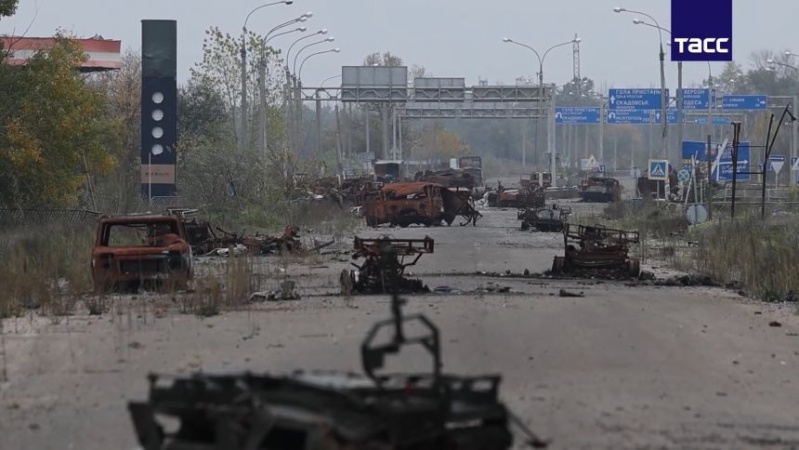
Access routes to Oleshky have been heavily mined and littered with drone and vehicle debris, making them virtually impassable. A demining operation began on Tuesday after the ceasefire came into effect, with both Russia and Ukraine announcing its completion on Thursday. Two people participating in the clearing operation were killed, according to the authorities.
Evacuation across the Dnipro River directly into Ukraine-controlled territory is not possible, so Arakhamia said the group would travel through the occupied Ukrainian peninsula of Crimea to Anapa in Russia’s Krasnodar region.
Oleshky evacuees flew from Anapa airport and arrived in Homel, Belarus, the Russian Defense Ministry said on Saturday.
“From there, they will fly to Belarus and then travel home by bus,” Arakhamia said ahead of their arrival. The evacuees are expected to arrive at the Ukrainian border later on Saturday.

Russia's human rights commissioner Yana Lantratova and Ukraine's ombudsman Dmytro Lubinets speak with journalists in a Russian-controlled area of Ukraine's Kherson region
The humanitarian situation has deteriorated in recent months. The town was reported by Ukrainian authorities to have ran out of food and other supplies in September, with no access to electricity, gas, medicine and other essentials.
“We ourselves are already exhausted. It’s very hard,” a woman in Oleshky who chose to remain anonymous told Ukrainian television. “Constantly in the dark. If we were in good health, maybe we would have stayed longer, but now that’s it. We want to be with our children.”
“People in temporarily occupied Oleshky are starving. There is almost nothing left to eat. Reports indicate that civilians are being forced to survive on grass and weeds, while medicines, clean water, electricity and medical care are increasingly out of reach. Children are trapped in these conditions too,” Andrii Sybiha, Ukraine’s foreign minister, said earlier this month.
The town was flooded when the Nova Kakhovka Dam collapsed in 2023. Several hundred people were reported to have died in the flooding. Evidence has pointed to Russia being responsible for an explosion that destroyed the dam, a charge Moscow has denied.
Further destruction came in the subsequent years of heavy fighting in the area.

Women walk through a local market beneath anti-drone nets stretched over a street in Oleshky.
Some 40% of the town’s prewar population of around 24,000 managed to flee to Ukraine-controlled territory when it was still possible early in the fighting, according to the Institute for the Study of War (ISW), a US-based conflict observer. Thousands of others have escaped since then, but many remained, either unable or unwilling to leave.
The town plays an important part in Russia’s military operations in the region. It sits near the banks of the Dnipro River, directly opposite Ukrainian positions along the front line of the war.
As the two sides fire at each other, the people in Oleshky are caught in the middle.
All escape routes toward Ukraine gradually disappeared as the Russian occupation intensified.
And while it had previously been possible to flee the city by going deeper into Russia-controlled territory, this has also become impossible in recent months, as fighting intensified and all routes out were either mined or swarming with drones.
Kyiv has made at least three attempts earlier this year to get Russia to allow evacuations into Ukraine, but Moscow has always rejected them.
Ukraine’s President Volodymyr Zelensky has accused Russia of mining the access routes to the town in an effort to stop people from leaving.
“It is important that Kherson has found this much-needed calm,” Zelensky said in his nightly address on Friday. “Russia must end this war of its own making.”
The exact number of people who are being evacuated has not been announced by neither Russian nor Ukrainian authorities, but it is clear that some people have decided to stay.
One woman — who did not give her name — told Ukrainian television that while she would love to leave, she cannot fly on a plane and will be staying in Oleshky with her husband.
Some older residents have been unwilling to leave their homes despite the dire humanitarian and security situation. For many, this is exasperated by the fact that they cannot take their animals with them.
“We are in Oleshky,” he said in a statement. “People who want to go to the territory of the Russian Federation are gathering here, and there are people who want to leave for the territory of Ukraine. Everyone will be provided with such an opportunity.”
Lubinets’ Russian counterpart, Yana Lantratova, was also present in Oleshky, and the two were seen in videos standing next to each other while talking to local residents.
Videos shared by Lubinets’ office show the ombudsman greeting groups of emotional residents in Oleshky, discussing their journey. In one, he is seen talking to people leaving about those who want to stay, telling them, “I was told that it’s their own choice. We will at least make sure that at least some humanitarian aid comes.”
This is a major worry for Ukrainian forces. The ceasefire set to expire on Sunday.
The ISW said in a report on Oleshky that the Russian military has embedded itself in Oleshky, using the town as a key forward position in the region.
Ukraine has been attacking the area with drones as it tries to disrupt Russian supply lines – but this has also impacted the civilians still left in the city.
Lubinets said last week that while Ukraine has been working to resolve the humanitarian crisis in Oleshky since late February, “things really started moving in September — thanks to Melania Trump.”
Ukrainian officials have stepped up their efforts to raise alarm over the situation in Oleshky in September and testimonies from the town raised alarm around the world, with international organizations, faith leaders and others calling for urgent action.
When she first announced the ceasefire last Friday, the first lady said she worked directly with Ukrainian and Russian leadership as the “exclusive intermediary” and initiated discussions to secure the terms of the ceasefire agreement.
Pope Leo also had a role in urging the Russian and Ukrainian leaders to cooperate on a ceasefire. Earlier this month, he expressed “deep concern” about the conditions in Oleshky in a phone call with Russian President Vladimir Putin, and shortly after, with Zelensky, and called for a local ceasefire to allow evacuations and aid deliveries.
Trump has been previously involved in securing the return to Ukraine of several Ukrainian children who were taken to Russia after the war started.
While the ceasefire appeared to be holding on Friday, chances of it turning into a wider peace agreement between Russia and Ukraine are slim – despite renewed push for diplomatic solution by the Trump administration.
US President Donald Trump’s envoy Steve Witkoff has recently held a meeting with Zelensky in Norway before flying to St. Petersburg to meet with the Russian President Vladimir Putin, negotiating among others on the possibility of holding tri-lateral meetings in the future.
However, Putin has since reiterated his maximalist demands, including on territory and Ukraine’s sovereignty – red lines for Kyiv and its allies.
But while a wider peace agreement is unlikely for now, Ukrainian officials have expressed some hope that similar localized ceasefires could happen elsewhere along the front line to provide some relieve the long-suffering civilian population. (CNN)