Updating your news feed...

NEWS EXPRESS is Nigeria’s leading online newspaper. Published by Africa’s international award-winning journalist, Mr. Isaac Umunna, NEWS EXPRESS is Nigeria’s first truly professional online daily newspaper. It is published from Lagos, Nigeria’s economic and media hub, and has a provision for occasional special print editions. Thanks to our vast network of sources and dedicated team of professional journalists and contributors spread across Nigeria and overseas, NEWS EXPRESS has become synonymous with newsbreaks and exclusive stories from around the world.

.webp)


.webp)
.webp)








.webp)
Loading banners
Loading banners...

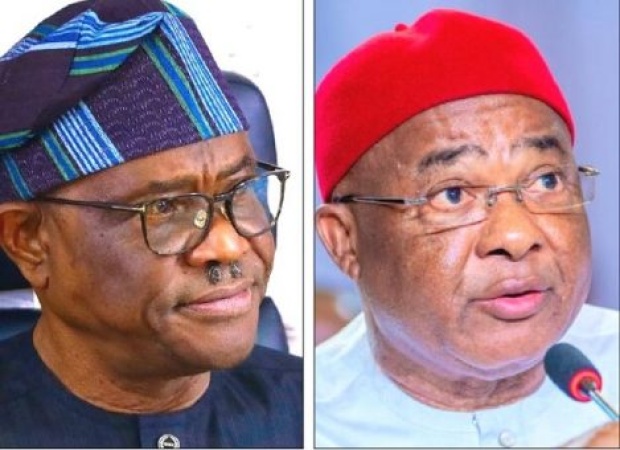
As the Federal Capital Territory (FCT) Minister Nyesom Wike’s cross-party alliance gathers momentum, its promise of wider support for Tinubu is colliding with fears within the APC that a parallel political structure could weaken the ruling party at governorship and legislative levels.
The political map ahead of the 2027 general elections is beginning to acquire an unusual colour.
It is the colour of the Rainbow Coalition — an emerging alliance of politicians from different political parties, united, at least at the presidential level, in support of President Bola Ahmed Tinubu’s re-election.
At the centre of the development is the Minister of the Federal Capital Territory, Nyesom Wike, whose political activities have increasingly become intertwined with the debate over how Tinubu should prosecute the 2027 presidential contest.
Wike has been emphatic: his support is for Tinubu, not necessarily for the APC. He has also maintained that politicians participating in the Rainbow Coalition can retain their party identities and support or contest on different platforms in governorship and legislative elections.
That position, however, has raised a fundamental question: Can a politician work for Tinubu’s presidential victory while simultaneously working against APC candidates in other elections without creating conflict within the ruling camp?
That question is now producing a political confrontation between Wike and some APC governors.
The stakes are considerable. For Wike and his supporters, the Rainbow Coalition could extend Tinubu’s reach beyond the APC’s formal structure and bring politicians from different parties and regions into the presidential campaign.
For sections of the APC leadership, however, the same arrangement could become a parallel political machine capable of helping Tinubu at the presidential level while weakening APC candidates below it.
That tension could make the Rainbow Coalition one of the most intriguing features of the 2027 election.
The most important thing about the Rainbow Coalition is what it is not. Wike has repeatedly said it is not an APC arrangement.
In September, he clarified that his support for Tinubu did not mean that the PDP, his party, would surrender its right to field candidates for governorship, National Assembly and State House of Assembly elections. He described the coalition as a platform for politicians from different parties who support Tinubu’s re-election.
That distinction is at the heart of the controversy.
The traditional electoral logic is straightforward: a party fields candidates at different levels and its members campaign for those candidates.
The Rainbow model potentially breaks that chain.
A PDP politician, for example, could support Tinubu for President while backing a PDP candidate for governor. An APC politician could support Tinubu while disagreeing with the APC candidate in a particular constituency.
In theory, this allows politicians to separate the presidential contest from state and legislative contests.
In practice, it creates competing interests. And Nigerian politics is rarely short of competing interests.
One obvious potential benefit is the opportunity to broaden the presidential campaign beyond the APC.
Wike has argued that political support does not have to follow rigid party boundaries. He has pointed to the experience of the 2023 election, when politicians who were not members of the APC supported Tinubu’s presidential bid.
He has also predicted a larger Rainbow Coalition, with politicians across party lines aligning with Tinubu.
The significance of such a structure is its potential access to political networks outside the APC.
A coalition that attracts serving and former governors, legislators, influential party figures and grassroots operators could provide the President with channels of mobilisation that do not depend entirely on the ruling party’s formal structures.
Some supporters of the arrangement have made this argument precisely.
Udengs Eradiri, former President of the Ijaw Youths Council Worldwide, described the coalition as an additional political asset capable of mobilising votes for Tinubu beyond the APC structure.
The attraction is therefore clear: why limit a presidential campaign to one party’s structure when politicians outside that party are willing to support the candidate?
But there is another side to the argument.
The APC is not simply a vehicle for Tinubu’s presidential ambition. It is also seeking victories in governorship, Senate, House of Representatives and state assembly elections.
This is where the Rainbow Coalition becomes complicated.
The APC Governors’ Forum has already drawn a line.
In September, the governors said they would not support any political arrangement capable of undermining Tinubu’s re-election, weakening the APC or adversely affecting its candidates.
Zamfara Governor Dauda Lawal subsequently argued that politicians could not simultaneously support the APC and other political parties, reflecting the concern among some APC leaders about the practical implications of Wike’s model.
The governors’ concern is understandable from an organisational perspective.
Suppose a politician mobilises voters for Tinubu at the presidential level but encourages those same voters to support an opposition candidate for governor or senator.
The presidential candidate could benefit while the party machinery suffers.
That is the paradox confronting the APC.
The Rainbow Coalition could potentially strengthen Tinubu’s presidential coalition while simultaneously complicating the APC’s down-ballot campaign.
The disagreement has consequently moved beyond personalities.
It is increasingly about who controls the machinery of the 2027 election.
Some analysts believe that the dispute between Wike and APC governors has developed into a contest over political structures for Tinubu’s re-election. Wike’s position is that politicians should retain freedom to support different candidates at other levels.
This presents a delicate situation for the President.
Tinubu needs the APC governors.
They control state structures, party organisations and significant political networks.
But the emergence of influential politicians operating across party lines could also provide additional support for the presidential campaign.
The challenge, therefore, is how to accommodate both structures without allowing them to become mutually antagonistic.
This is perhaps the most serious potential negative effect of the Rainbow Coalition.
Denge Josef Onoh, a former South-East spokesman for Tinubu, warned that the activities of the coalition could affect contests for governorship and National Assembly seats.
The concern is not necessarily that coalition members oppose Tinubu.
It is that their interests may differ from those of APC candidates.
Consider a state where an influential politician belongs to the Rainbow Coalition but has a longstanding dispute with the APC governor.
That politician could have every reason to support Tinubu for President while supporting an alternative candidate for governor.
The result could be a divided campaign: Tinubu above the line; different candidates below the line.
That possibility is precisely what makes some APC governors uncomfortable.
But Nigeria’s voters are not necessarily tied to one party.
Wike’s counterargument is that Nigerian voters have historically demonstrated the ability to vote across party lines.
He has rejected the suggestion that a presidential candidate’s supporters must automatically support every candidate on the same party platform.
This is an important dimension of the debate.
The ballot does not compel voters to reproduce the same political choice across every office.
A voter can support one party for President and another for governor or senator.
The Rainbow Coalition is therefore attempting to organise at the elite and political-structure level something Nigerian voters have long been capable of doing individually: splitting their votes.
Whether such a strategy can be effectively coordinated across several states, however, remains an open question.
Another challenge is ideological and organisational coherence.
What exactly binds the Rainbow Coalition together beyond support for Tinubu?
If politicians from the APC, PDP, Labour Party and other platforms can belong to the same presidential coalition while retaining separate interests elsewhere, disagreements are inevitable.
The coalition could contain politicians who want different things from the 2027 election.
Some may be interested primarily in Tinubu’s re-election. Others may be concerned with governorships. Others may have National Assembly ambitions.
Still, others may be positioning themselves for future political contests.
The broader the coalition becomes, the more difficult it could become to maintain a single political agenda.
That is the paradox of a rainbow: its strength lies in the number of colours, but the colours do not become identical.
The development in Rivers State offers an indication of how the model could work.
Wike previously said the Rainbow Coalition in Rivers involved several political parties and that the participating parties would collectively determine their governorship candidate rather than having one party simply impose its candidate.
That model is different from the current national presidential arrangement, but it demonstrates the coalition’s broader philosophy: political actors from different parties can negotiate a common electoral objective while retaining their separate identities.
The question is whether what can be negotiated in a state can be scaled up to a presidential election involving 36 states and the Federal Capital Territory.
The Rainbow Coalition is also developing against the background of continuing realignment among opposition politicians.
Wike has repeatedly argued that divisions within opposition parties have created room for a broad pro-Tinubu coalition. His assessment of the opposition is a political claim, rather than an independently established measurement of its electoral strength.
But there is a broader structural point.
The more fragmented the opposition becomes, the more attractive cross-party alliances can become to politicians seeking influence around the presidential contest.
At the same time, the emergence of a Rainbow Coalition could encourage opposition parties to intensify their own efforts to consolidate.
Thus, the coalition could have an effect beyond the politicians already inside it: it could become a catalyst for further realignment on both sides of the political divide.
The dispute also has implications beyond the presidency.
Wike has alleged that some APC governors are concerned about the coalition because of their interests in the composition and leadership of the next National Assembly. He specifically linked the issue to the future emergence of the Senate President and Speaker of the House of Representatives. Those are Wike’s allegations; the governors have not been established as pursuing those motives as a matter of fact. But the underlying issue is significant.
A presidential coalition that encourages politicians to vote independently in legislative contests could produce a National Assembly whose party composition does not perfectly mirror the presidential result.
That could make the post-election negotiations over National Assembly leadership particularly consequential.
The Rainbow Coalition therefore raises a fundamental question about Nigerian political alliances.
Are they built around ideology, policy or electoral arithmetic? The answer may vary from politician to politician.
The coalition’s supporters see its cross-party character as an advantage. Its critics see the same feature as a threat to party discipline.
Both perspectives point to the same reality: the traditional boundaries between party loyalty and presidential support are becoming increasingly fluid ahead of 2027.
And that fluidity could produce unexpected alliances.
The next phase will probably be determined by three developments.
First, whether more influential politicians outside the APC openly identify with the Rainbow Coalition.
Second, whether APC governors and party leaders can reconcile their concerns with Wike’s insistence that coalition members should retain freedom at state and legislative levels.
Third, whether the coalition develops a sufficiently coherent organisational structure to translate elite endorsements into votes at polling units.
This last point may prove crucial.
Political endorsements make headlines, but elections are ultimately decided through voter choices and electoral processes.
Wike himself has stressed the importance of genuine mobilisation at the polling-unit level rather than relying on assumptions about alliances.
For Tinubu, the Rainbow Coalition presents a political proposition with two sides.
On one side is expansion — the possibility of drawing support from politicians and networks outside the APC.
On the other is fragmentation — the possibility that those same cross-party relationships could complicate the ruling party’s efforts to protect its candidates in governorship and legislative elections.
For the APC governors, the issue is equally delicate.
Rejecting the coalition too aggressively could alienate politicians who are willing to work for Tinubu. Embracing it without conditions could weaken the party’s control over its own electoral machinery.
For Wike, the challenge is to demonstrate that a cross-party presidential coalition can operate without becoming an instrument of destructive intra-party competition.
That is why the Rainbow Coalition may become much more than another 2027 alliance.
It is shaping up as a test of whether Nigeria’s presidential politics can be separated from its party politics — and whether one presidential campaign can successfully operate through several political machines without those machines eventually turning against one another.
As the 2027 contest gathers momentum, the question may no longer be whether the Rainbow Coalition will have an impact. It is where that impact will be felt most — in Tinubu’s presidential campaign, in the APC’s internal politics, or in the fiercely contested governorship and National Assembly races below it. (The Nation)