Updating your news feed...
NEWS EXPRESS is Nigeria’s leading online newspaper. Published by Africa’s international award-winning journalist, Mr. Isaac Umunna, NEWS EXPRESS is Nigeria’s first truly professional online daily newspaper. It is published from Lagos, Nigeria’s economic and media hub, and has a provision for occasional special print editions. Thanks to our vast network of sources and dedicated team of professional journalists and contributors spread across Nigeria and overseas, NEWS EXPRESS has become synonymous with newsbreaks and exclusive stories from around the world.
.webp)
.webp)
.webp)
Loading banners
Loading banners...

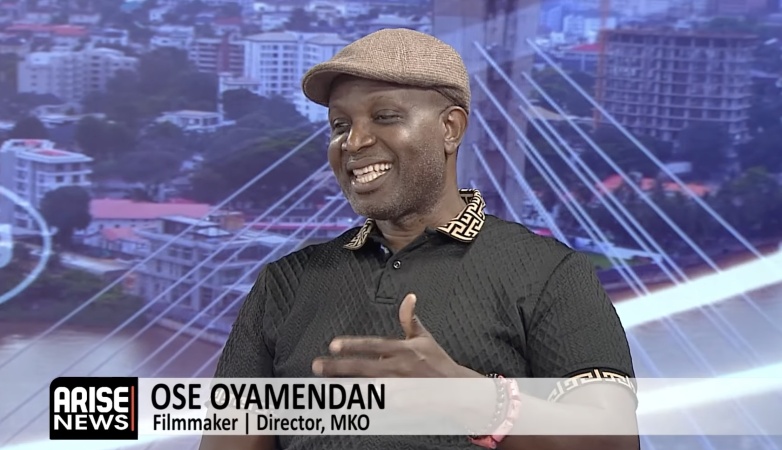
Filmmaker and Director of the MKO Abiola documentary, Ose Oyamendan, says the production cost more than one million dollars and took 13 years to complete, describing the project as an effort to preserve an important part of Nigeria’s history.
Oyamendan disclosed this in an interview with ARISE NEWS on Tuesday, saying the documentary involved extensive research and interviews with people who initially refused to discuss events surrounding the life and times of the late businessman and politician, Moshood Kashimawo Olawale Abiola.
He said, “The story, because it’s taken 13 years, cost us over a million dollars to make, right? Now, in terms of projection, I really don’t know. We’re still trying to figure it out. But we’re trying to do some dynamic screening stuff, screening in theatre, private screenings, and all this kind of stuff.”
Asked whether the amount covered only production or included advertising, Oyamendan said, “No, no, no. Just ad production is over a million, yeah. So that means you’re spending more than $1 million.”
He added, “We’re spending more than that, yeah. A couple of hundreds of thousands of dollars again. I think it’s about 10% threshold plus advertising fee.”
On what motivated him to spend more than a decade working on the documentary, Oyamendan said the project began almost casually after he mentioned it in film school, but later became an important effort to document Nigeria’s history.
“I always felt in us doing this, it was a very important story to tell. And the strange thing was, I didn’t even think I was going to do it because I just mentioned this in a class in film school, just to like look cool so they won’t ask me too much questions,” he said.
“And then my teacher then just latched onto it. So you have to, and I used to think of it as a feature. But as we dove into it, it just became clearer that there were actually people in Nigeria, in that era, that did not want you to tell that story.”
Oyamendan recalled that one of the former Nigerian heads of state he interviewed questioned his decision to continue investigating the subject.
“I remember I interviewed one of the former presidents or one of the former heads of state of Nigeria. And he told me, ‘Why are you digging this thing? It’s dead, let it die,’” he said.
According to him, the documentary became even more important because it was produced at a time when history was not being taught in Nigerian schools.
“And then I started digging. It was also at a period where they were not teaching history in school. And my whole thing is, if you don’t know where you’re coming from, you’re never going to get to wherever you dream you’re going to,” he said.
“And this is a very significant part of our history, a very significant part of how we got to where we are today. And how we probably got derailed from where we should go and lost our way.”
Speaking about what audiences should expect from the documentary, Oyamendan said it contains revelations that challenged what he and his team previously believed about some of the events and personalities they investigated.
“I think you’ll be surprised by a lot of the revelations. There’s stuff that I thought I knew, and then they just went a step further. And that’s the beauty of it, because some people did not want to talk to us initially,” he said.
“Then when they heard some people had talked, they had to come and talk. And what I found out is you hear a lot of lies. You hear a lot of misconceptions.”
According to him, some individuals’ public narratives about themselves were also challenged by information uncovered during the production.
“And there are some people that in this documentary, what they always thought, the way they’ve sold themselves to the Nigerian life or to the international life, it just changes,” he said.
Asked about an aspect of the production that particularly struck him, Oyamendan said the reluctance of some people to speak, as well as attempts to mislead the production team, were among the most challenging experiences.
“One thing, one of the big things that I kind of saw is just the reluctance of people to try to talk initially. And the drive by people to just confuse you and try to lie to you about stuff. And my trying to say, okay, we have to correct all this,” he said.
He also recalled the experience of taking his crew, which he said came from Los Angeles and Hollywood, to interview Professor Wole Soyinka.
“And one of the most striking things for us, at least for my crew, because I come with a crew from LA, from Hollywood, and is going to film to talk to Professor Wole Soyinka. And the whole environment of going there, if you trespass, you’ll be shot, all this kind of stuff. So that was very striking to me,” he said.
Oyamendan said the search for truth required examining conflicting accounts and allowing facts to challenge claims made by individuals.
“But generally, it’s a deception. It’s like finding the entry, because we talked to Thomas Pickering, who was the guy that was there on the final meeting with Ambassador Thomas Pickering, who was the person there at that final theatre meeting with Abiola. And the way he unspools things and starts mentioning names, people, and we got that because people would try to absolve themselves by naming names.”
“How do you find truth in a society of lies? Well, sometimes by just presenting the facts.”
“And when you present facts, because lies often precede the facts, so people can see it out. There’s actually a part in the documentary where somebody had made a very big claim, and another person just came out and said, ‘It’s lying.’”
Oyamendan said the composition of the interim government was one of the areas where the documentary uncovered conflicting accounts.
“And that has to do with the composition of the interim government. Because for the only interim thing, I was shocked at some names that I was hearing that had said they fought against that,” he said.
He also explained what kept him working on the documentary despite the difficulties and lack of support over the years.
“One of the reasons for me was, the first one was people trying to kill it without doing anything to support it. Because the thing normally is like, when you go to do a film like this, a lot of people in the local area come and support it to put the story out. I quickly found out here that a lot of people don’t really care if it’s not about them.”
“We talk to governors, I’m going to give you money, and they just stop talking to you later. And I thought it had died, actually, like it was in a coma once.”
Oyamendan said a conversation with his son while he was working on another film in Israel eventually renewed his determination to complete the project.
“I was doing another film in Israel. So there was a skirmish in Israel, and I had crews in Gaza, and they were telling me, you have to talk to the Israelis not to shoot and stuff like that.”
“And my phone kept ringing. It kept ringing. And I knew whoever was calling me, I had to talk to, because my phone never rings on the set. And I picked up the phone, and it was my son, he was nine years old then.”
He said his son had been researching Nigerian leaders for a school assignment but struggled to find information.
“And you know, some of these kids that are born outside Nigeria, they get too nationalistic. And he was doing an assignment on Nigerian leaders, and he couldn’t find anything on the Nigerian leader. So he called me, and then he said, just like a nine-year-old boy was like, ‘So where are you really?’”
“What are you doing? And I told him, and I remember that day, I drove back to my apartment in Ashkelon, and I just couldn’t get it out of my mind. And I knew, that was when I knew that I have to finish this.”
He said the project later received support from a co-producer in Canada.
“And it was very fortunate that after that, I came back, we were able to get a co-producer in Canada that helped be part of the way,” Oyamendan said.
On the planned premiere, Oyamendan confirmed that the documentary is scheduled to be screened for President Bola Tinubu on October 1, before its cinema release on October 2.
The premiere is scheduled to hold at the
“At the Wole Soyinka Centre for Creation.”, on October 1.
Oyamendan also confirmed that the documentary would open in cinemas across Nigeria on October 2.
“It’s out in the theatres on October 2nd, all over the country,” he said.
“So, go watch it.,”he said. (Arise News)