Updating your news feed...
NEWS EXPRESS is Nigeria’s leading online newspaper. Published by Africa’s international award-winning journalist, Mr. Isaac Umunna, NEWS EXPRESS is Nigeria’s first truly professional online daily newspaper. It is published from Lagos, Nigeria’s economic and media hub, and has a provision for occasional special print editions. Thanks to our vast network of sources and dedicated team of professional journalists and contributors spread across Nigeria and overseas, NEWS EXPRESS has become synonymous with newsbreaks and exclusive stories from around the world.















Loading banners
Loading banners...

“I’m so scared. I want to go outside, because I’m human. But I cannot go outside here.”
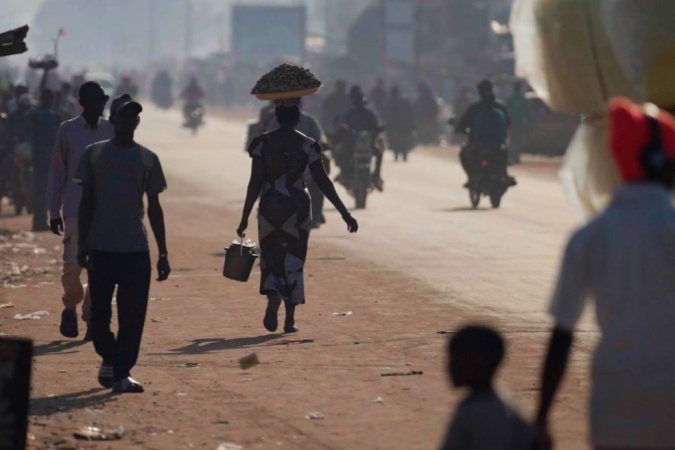
Aylin, age 28, was sitting in a quiet courtyard in the center of Bangui, the bustling capital of the Central African Republic. She recounted the improbable story that brought her here from her native Turkey – via the United States.
She is gay. To protect her from reprisals, CNN is using a pseudonym.
Aylin left her home country two years ago. After a religious group and a close family member threatened her life, she said she decided to seek refuge in the United States.
“I just hoped to be free. To live my life how I want to live, to take a breath. To have friends. A relationship. A good family. My own family. Justice.”
Soon after arriving in the US, a judge granted Aylin withholding of removal, a form of protection that implies it would be unsafe for her to return to Turkey due to her sexuality. She was denied asylum under a Biden-era border policy that restricted eligibility for many migrants who crossed the southern border outside official pathways. That policy has since been struck down by a federal judge.
But in July, after 18 months in US detention, she says she was handcuffed and shackled, then placed on a flight heading for the Central African Republic (CAR). She had never even heard of the country when she learned, mid-flight, that it was their destination.
Her case represents a dire example of an already distressing policy, immigration advocates say: The US is deporting scores of people who identify as LGBTQ to countries where that puts them at extreme risk.
For years, the US offered protection to people who convinced immigration judges that returning home could mean persecution, torture, or death. Now, some of those same people are finding themselves stranded in countries they have never visited, under a rapidly expanding American policy that legal experts say uses a loophole to deport migrants not to their countries of origin, but to third countries willing to receive them.
The Trump administration has signed at least 35 agreements with countries across Africa, Latin America and elsewhere, according to the nonprofit initiative Third Country Deportation Watch.
Among those caught up in the policy are LGBTQ asylum seekers, like Aylin, who had already won legal protections in US immigration courts.
Aylin spent several weeks cooped up in an apartment block in Bangui, the CAR capital, agonizing over her limited options. She was living a life in limbo: rejected by the US, aware that she could not live freely in the country she now found herself – hostility towards homosexuality is widespread in central Africa – and afraid for what might happen if she returned to the very place she’d fled.
Despite her fears, she ultimately chose to return to Turkey.
“I hope everything has changed for people like me in Turkey,” she told CNN the day before boarding her flight home. “But I’m so scared. Really, I’m so scared.”
In recent weeks, Turkey has launched one of its most sweeping crackdowns on LGBTQ rights groups in years. Though homosexuality is legal in Turkey, authorities have carried out coordinated raids targeting LGBTQ advocacy organizations and activists across multiple cities, leading to mass arrests and detentions.
Turkish officials have defended September’s operation as part of a campaign to protect traditional family values.
Though thousands of migrants have been deported to third countries this year, according to Third Country Deportation Watch, the US government does not provide data on how many of those had sought protection based on characteristics like sexuality.
But Bridget Crawford, from Immigration Equality, an NGO that provides legal services for LGBTQ migrants and asylum seekers in the US, believes the numbers have shot up.
“It’s terrible for any refugee to be put in that situation, being deported to a country where they have no connections, where they have no support system, where in so many cases, people are being arbitrarily detained where they don’t have a true opportunity for permanent status,” Crawford said.
“But if you’re queer or trans and you’re being sent to a country that persecutes queer and trans people, it is just unconscionable.”
Human rights groups are especially concerned that nearly half of the countries accepting deportees from the US are African nations, many of which criminalize homosexuality. Reports of a worsening climate for LGBTQ people are rising sharply across parts of the continent, and politicians have increasingly campaigned on anti-LGBTQ platforms.
Over several weeks, CNN spoke with several deportees who identify as LGBTQ scattered across Cameroon, Equatorial Guinea and CAR. They all expressed disbelief and terror at being sent to countries where they felt they were now at heightened risk.
Adwoa, a 21-year-old bisexual Ghanaian woman, tearfully describes fleeing years of hostility and violence linked to her sexuality when she sought refuge in the US. CNN is also using a pseudonym for her, because of her precarious position.
She says her sexuality meant that her neighbors ostracized her family and accused them of witchcraft. But after obtaining a guarantee from a US court that she would not be deported back to Ghana, she was instead sent to Cameroon, where same-sex relations are also illegal, and punishable by up to five years in prison.
In fact, Crawford said, her organization has represented several asylum cases for LGBTQ Cameroonian nationals claiming persecution due to their sexuality.
“It’s like you’re a criminal,” Adwoa said of her life in Cameroon, where she’s been staying at a government-run detention facility for the last few months. “It’s a terrifying feeling.” She believes she could be killed if she returned to Ghana.
Though homosexuality is not illegal in CAR, where Aylin was sent, societal norms mean that maintaining a homosexual relationship is “extraordinarily dangerous,” according to a 2023 report by the US State Department.
On the streets of Bangui, CNN encountered open hostility toward LGBTQ people. “We don’t like them. They should be killed,” one person said. Another called for security forces to arrest and punish them. “We don’t want them to live because they are men like us and, since they allow themselves to be penetrated from behind, we don’t like that.”
Human rights groups have noted that women in same-sex relationships across Africa can also often face so-called “corrective” sexual violence, assaults, harassment and discrimination.
The US Department of Homeland Security (DHS) has defended its deportation policy, arguing that migrants are receiving due process and that third-country agreements are lawful tools to carry out removal orders.
“These third-country agreements, which ensure due process under the U.S. Constitution, are essential to the safety of our homeland and the American people,” DHS said in a statement to CNN. “We are applying the law as written. If a judge finds an illegal alien has no right to be in this country, we are going to remove them. Period.”
Critics disagree.
“It’s an abdication of both our legal and our moral obligations. Under domestic law, and under international law,” said Crawford.
A federal appeals court this month upheld a February ruling that aspects of the administration’s third-country deportation policy were unlawful, raising questions about whether migrants are being given adequate opportunities to challenge transfers to unfamiliar countries. The case is likely headed to the Supreme Court, which has previously allowed deportations to continue by lifting temporary injunctions.
For those living in this reality, the political debate feels far away.
Aylin is now back in Turkey, where she has told her family that she’s changed her sexual orientation. But she is very far from the freedoms she dreamed of when she left for the US.
“I will find a job, I will get money, I will leave secretly for Europe or somewhere else,” she said. “I cannot feel like myself here.” (CNN)