Updating your news feed...
NEWS EXPRESS is Nigeria’s leading online newspaper. Published by Africa’s international award-winning journalist, Mr. Isaac Umunna, NEWS EXPRESS is Nigeria’s first truly professional online daily newspaper. It is published from Lagos, Nigeria’s economic and media hub, and has a provision for occasional special print editions. Thanks to our vast network of sources and dedicated team of professional journalists and contributors spread across Nigeria and overseas, NEWS EXPRESS has become synonymous with newsbreaks and exclusive stories from around the world.
.webp)



Loading banners
Loading banners...

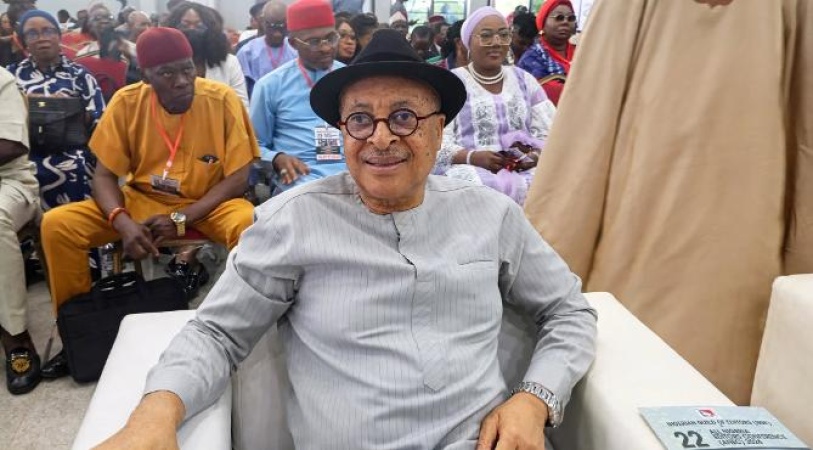
Ex-NBA President Afam Osigwe, SAN
By ALEX ENEBELI
Former Nigerian Bar Association (NBA) President, Mazi Afam Osigwe, SAN, says Nigeria has one of the highest numbers of electoral disputes globally, a situation, he said, undermines the country’s democracy.
Osigwe disclosed this while delivering a paper entitled, “Election Petition in a Digital Age: Independence, Evidence, BVAS and the Court,” at the 22nd Nigerian Guild of Editors (NGE) Conference in Enugu on Thursday.
“I see that Nigeria is one of the countries with the highest number of electoral disputes. The problem with Nigeria is simply and squarely the failure of leadership.
“This failure of leadership is not only found at the presidency. It’s not only found at the state level or the local government. It is found in the failure of leadership amongst all of us.
“Our courts should be less involved with electoral disputes
He said the increasing involvement of the courts in electoral matters was partly due to difficulties in proving electoral malpractices and non-compliance with electoral laws which had gradually led to the “judicialisation” of the electoral process.
According to him, the credibility of elections is closely linked to the independence of electoral management institutions, the quality of evidence presented before election tribunals and the ability of the courts to resolve disputes consistently and within the required timeframe.
Osigwe said the declining voter turnout was also connected to growing public concerns about whether votes would ultimately count, particularly amid allegations of violence, manipulation of results and other electoral irregularities.
He decried the appointment process of some electoral officials, saying that perceived political influence could undermine the independence of institutions responsible for conducting elections.
The senior advocate also expressed concern about the challenges lawyers and petitioners face in presenting electronic evidence, particularly evidence generated through the Bimodal Voter Accreditation System (BVAS).
He said that technology was expected to make electoral dispute resolution easier, noting that legal and procedural requirements had sometimes made it difficult to effectively present and rely on technological evidence.
Osigwe further called for reforms that would strengthen the independence of electoral institutions and improve the electoral justice system.
“An electoral process without credibility would undermine the legitimacy of those who emerge as leaders.
“Also, inconsistency in the interpretation and application of laws has created confusion and weakened accountability and transparency in Nigeria’s electoral and judicial processes.
“Such inconsistencies could allow judges or political actors to rely on questionable decisions to justify actions that might otherwise not withstand scrutiny,” he said.
He pointed out that this would make institutions to suffer whenever individuals compromised established principles because of personal relationships.
The former NBA president also expressed concern over the quality of people seeking elective positions.
“Many capable Nigerians were discouraged from contesting elections because of the financial and other demands involved.
“The law appeared to be increasingly used as a tool to frustrate political participation,” warning that uncertainty surrounding electoral and judicial processes could gradually weaken democratic institutions.
He urged journalists to continue holding leaders and institutions accountable, noting that the media had a responsibility to draw attention to weaknesses in the electoral and judicial systems.
“Can you not see that our electoral processes, the judicial processes concerning them, are headed for the rocks if they have not already hit the rocks?” he asked.
He warned that the emergence of people who might not ordinarily qualify for leadership positions into political power could make the country increasingly insecure and affect citizens’ ability to live freely and practise their professions.
Osigwe thanked the Nigerian Guild of Editors for inviting him to speak on the subject, saying that despite not being an expert on every aspect of the issue, he considered it important as a Nigerian to contribute to the discussion. (NAN)