ADAD
ADAD
Updating your news feed...
NEWS EXPRESS is Nigeria’s leading online newspaper. Published by Africa’s international award-winning journalist, Mr. Isaac Umunna, NEWS EXPRESS is Nigeria’s first truly professional online daily newspaper. It is published from Lagos, Nigeria’s economic and media hub, and has a provision for occasional special print editions. Thanks to our vast network of sources and dedicated team of professional journalists and contributors spread across Nigeria and overseas, NEWS EXPRESS has become synonymous with newsbreaks and exclusive stories from around the world.














.webp)




Loading banners
Loading banners...

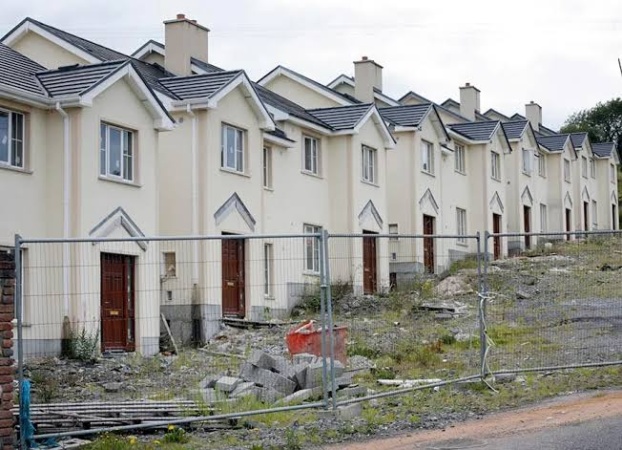
An estate under construction
For many Nigerian home buyers, the warning signs appear only after the sales banners come down.
The brochures were polished, the launch attracted a crowd, infrastructure plans sounded ambitious and buyers were assured that construction would proceed in phases. Plots were sold, deposits made and expectations set. Then the bulldozers slowed, roads remained unfinished and the promised community failed to take shape.
That pattern is increasingly raising questions about what happens between an estate launch and actual development and why some projects that begin with strong sales momentum eventually stall.
“The brochures looked convincing, the inspection day attracted a crowd, the infrastructure plan sounded ambitious, and buyers were told development would happen in phases, and many left believing they had secured land inside a future thriving community,” said Chijioke Adimike, an Abuja-based realtor and real estate educator who helps first-time buyers and investors assess property purchases.
“Months pass, sometimes years pass, and the estate still looks nothing like what buyers expected,” he said.
Experts say the distinction between launching an estate and developing one is fundamental.
A launch is primarily a sales milestone. Development requires capital, infrastructure, approvals, construction sequencing, buyer demand and the ability of the developer to execute over an extended period.
That gap between marketing and execution can determine whether a parcel of land eventually becomes part of a functioning neighbourhood or remains an isolated investment.
“Many people make the mistake of assuming that an estate launch and an estate development are the same thing, but they are not,” Adimike said.
The difference matters because buyers often assess estates through the lens of what is immediately visible, or what is promised, rather than the financial and operational machinery required to deliver the project.
Infrastructure, regulatory approvals, funding, construction sequencing, buyer uptake and long-term execution all influence whether an estate develops into a community.
That helps explain why two estates launched around the same time, selling plots at similar prices and making comparable promises, can produce dramatically different outcomes several years later.
The financing problem
Abolade Durowoju, a professional land surveyor and GIS expert, said hundreds of estates across Nigeria have been launched with ambitious plans, heavily marketed and sold on projections that have not always translated into completed communities.
On Why Some Estates Never Fully Develop and Investors Pay the Price, Durowoju said many such estates years later remain half-built, sparsely occupied or completely stagnant.
A master plan, he said, is not development.
“Development is capital, coordination, infrastructure sequencing, and sustained execution discipline,” Durowoju said.
One of the most important risks is how the project is financed.
“Many estates stall because their financial structure is weak from the start. Some rely entirely on off-plan subscriber payments to fund infrastructure with no adequate capital reserves,” he said.
“When sales slow down, development slows down. When development slows down, buyer confidence drops. It becomes a cycle of hesitation that is very difficult to reverse.”
The problem is effectively a feedback loop.
A developer needs sales to generate cash for construction. Buyers need evidence of construction to justify further purchases and sustain confidence. If either side loses momentum, the project can become trapped in a cycle of weak sales, limited construction and falling confidence.
For investors, that creates an execution risk, which is often overlooked during the buying process.
Infrastructure sequencing can compound the problem.
An estate may have an attractive master plan but remain difficult to access if its internal roads, drainage, electricity or other infrastructure are not delivered in the right order, or if the estate is located several kilometres from a major access road.
Durowoju said poor location logic can leave investors waiting for infrastructure expansion to catch up.
“If an estate is positioned too far ahead of infrastructure expansion without credible connectivity timelines, investors may hold land for years waiting for growth to reach them,” he said.
That waiting period has an economic cost.
Land can appreciate substantially when surrounding infrastructure, population and commercial activity increase. But where those catalysts fail to materialise, ownership alone does not guarantee appreciation.
The result can be capital locked into an illiquid asset with few buyers willing to pay a premium for a plot inside a stagnant development.
Governance can make or break an estate
The risks also extend beyond funding and physical infrastructure.
Durowoju identified governance problems, weak developer coordination, inconsistent communication, unresolved internal disputes and regulatory non-compliance as other factors that can quietly undermine an estate.
For buyers, these problems are particularly difficult to identify at launch because they may not be visible during the sales process.
A glossy brochure can show the final vision. It cannot necessarily show whether the developer has the capital, governance structure or regulatory readiness to deliver it.
That distinction becomes important as Nigeria’s property market continues to attract households and investors seeking alternatives to financial assets.
Buyers pay for stalled execution
The consequences of a stalled estate can extend well beyond disappointment.
According to Durowoju, investors can have capital tied up in underperforming locations, while liquidity deteriorates as resale demand weakens in partially developed environments.
Appreciation can also slow because the infrastructure momentum needed to support higher property values never arrives.
In some cases, investors may eventually sell at only marginal gains simply to recover their capital and exit the project.
The underlying lesson is straightforward: buying land is not necessarily buying into development.
The value of an estate ultimately depends on whether the infrastructure, population, connectivity and economic activity promised at launch actually materialise.
For prospective buyers, Adimike says the most important due diligence happens before payment.
“Buyers who ask the best questions before payment are often the ones who experience fewer surprises afterwards because they understand that the future value of an estate is influenced not only by what is promised, but also by what can realistically be delivered over time,” he said. (BusinessDay)