
Updating your news feed...
NEWS EXPRESS is Nigeria’s leading online newspaper. Published by Africa’s international award-winning journalist, Mr. Isaac Umunna, NEWS EXPRESS is Nigeria’s first truly professional online daily newspaper. It is published from Lagos, Nigeria’s economic and media hub, and has a provision for occasional special print editions. Thanks to our vast network of sources and dedicated team of professional journalists and contributors spread across Nigeria and overseas, NEWS EXPRESS has become synonymous with newsbreaks and exclusive stories from around the world.

















Loading banners
Loading banners...

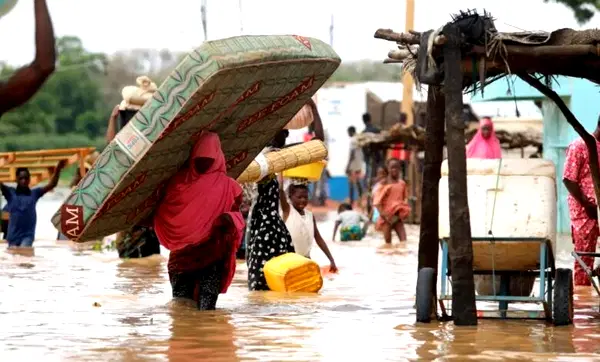
File image of houses submerged in flood
The Nigeria Hydrological Services Agency has issued a seven-day flood advisory, warning of a medium flood risk in 17 states between July 21 and July 27.
The agency said the alert followed rising water levels at key river monitoring stations, increasing the likelihood of localised flooding along river channels and floodplains.
NIHSA Director-General, Umar Mohammed, disclosed this in the National Flood Advisory (Alert No. NFA-2026-200) issued on Tuesday.
He said the affected states are “Adamawa, Bauchi, Benue, Borno, Edo, Gombe, Imo, Jigawa, Kaduna, Kano, Kebbi, Nasarawa, Niger, Plateau, Taraba, Yobe and Zamfara.”
According to Mohammed, “river levels at Saminaka on the Karam River, Waya Dam site on the Waya River and Amber on the Amber River had exceeded watch and warning thresholds.”
He said 16 gauging stations nationwide were recording elevated river levels, placing nearby communities at risk of localised flooding.
Mohammed urged state governments, local authorities and residents of flood-prone communities to take precautionary measures immediately.
NIHSA said Bauchi had the highest exposure, with 1,841 communities, 145 schools, 101 health facilities and eight markets identified as vulnerable.
The agency also identified vulnerable communities and public facilities in Edo, Imo, Kaduna, Plateau and Benue states.
Mohammed urged the National Emergency Management Agency, State Emergency Management Agencies, local governments and community leaders to activate emergency response plans.
He recommended relocating residents, livestock and valuables from floodplains to safer locations.
He also advised emergency agencies to pre-position food, medical supplies and water treatment materials in areas likely to be affected.
The NIHSA boss called for community mobilisation through early warning volunteers and local communication channels to ensure the timely dissemination of flood alerts.
He cautioned residents against walking, driving or riding through flooded roads, bridges and fast-flowing waterways.
Mohammed further urged authorities to clear blocked drains, culverts and waterways to improve water flow and reduce flooding.
He advised the public and relevant agencies to monitor daily flood updates and advisories issued by NIHSA. (Text, excluding headline: NAN)