ADAD
ADADUpdating your news feed...

NEWS EXPRESS is Nigeria’s leading online newspaper. Published by Africa’s international award-winning journalist, Mr. Isaac Umunna, NEWS EXPRESS is Nigeria’s first truly professional online daily newspaper. It is published from Lagos, Nigeria’s economic and media hub, and has a provision for occasional special print editions. Thanks to our vast network of sources and dedicated team of professional journalists and contributors spread across Nigeria and overseas, NEWS EXPRESS has become synonymous with newsbreaks and exclusive stories from around the world.


















Loading banners
Loading banners...

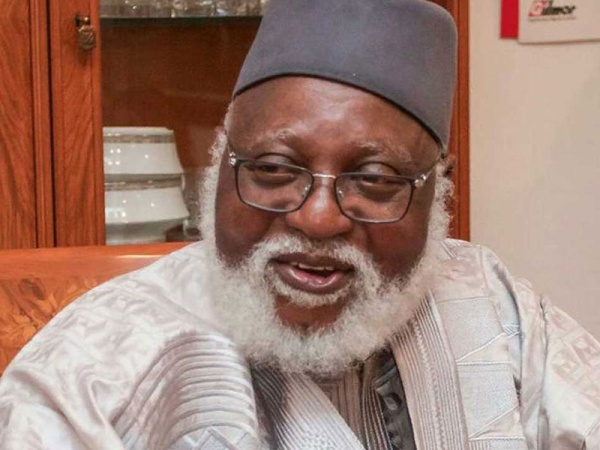
Former Head of State, Rtd Gen Abdulsalami Abubakar
Former Head of State, General Abdulsalami Abubakar (retd), has dismissed longstanding claims that the committee headed by late Justice Niki Tobi drafted Nigeria’s 1999 Constitution, insisting that the panel was only established to coordinate a nationwide debate on an existing constitutional draft.
Abdulsalami made the clarification in his autobiography, Call of Duty: My Autobiography, where he recounted the events that culminated in the adoption of the 1999 Constitution and Nigeria’s return to democratic rule.
In Chapter 23 of the book, titled “The Making of the 1999 Constitution”, the former military ruler said critics who alleged that the Constitution was written by the Justice Niki Tobi-led committee had misrepresented the role assigned to the panel.
“I need to re-emphasise here that their job was not to write a new Constitution but to co-ordinate a debate on the draft. I have heard many critics say the Niki Tobi Committee was set up to write a new Constitution. That is absolutely false,” he wrote.
Abdulsalami explained that upon assuming office in June 1998 following the death of General Sani Abacha, his overriding objective was to return Nigeria to democratic rule as quickly as possible and end decades of military involvement in politics.
He said his administration was confronted with several options, including continuing with Abacha’s transition programme, commencing an entirely new constitutional process, or modifying the existing constitutional draft produced by the 1994/95 National Constitutional Conference.
According to him, continuing with Abacha’s transition programme was problematic because it lacked broad national acceptance, particularly among pro-democracy groups and key political actors in the South-West who viewed the process as designed to perpetuate military rule.
He also rejected suggestions that another constitutional conference be convened, arguing that such a process could have prolonged military rule by several years and created opportunities for anti-democratic forces within the armed forces to frustrate the transition programme.
“I reasoned that the longer the Military stayed in power after Abacha’s death, the bleaker the prospects of a genuine transition to democracy would be,” he stated.
The former Head of State said his administration eventually settled for what he described as a middle-ground option by discarding Abacha’s transition programme while subjecting the Draft 1995 Constitution to extensive public scrutiny.
To achieve this, the government established a 25-member Constitution Debate Coordinating Committee (CDCC) headed by Justice Niki Tobi, with Dr. Suleiman Kumo serving as deputy chairman.
Abdulsalami explained that the committee’s mandate was to coordinate debates, collect memoranda and collate recommendations from Nigerians using the 1995 draft as a working document.
The panel subsequently organised public hearings across the country, including in Benin, Enugu, Jos, Port Harcourt, Maiduguri, Kaduna, Kano, Ibadan, Lagos and Sokoto, while the text of the draft constitution was published in national newspapers to encourage public participation.
According to him, the committee received 405 memoranda from individuals, professional bodies, political groups, ethnic organisations and Nigerians in the diaspora.
He said opinions differed sharply, with some groups demanding that the draft be discarded entirely, while others insisted it should remain untouched.
Abdulsalami noted that after reviewing submissions from Nigerians at home and abroad, the committee reached a conclusion that fundamentally shaped the eventual constitution.
Quoting Justice Tobi’s report, he said Nigerians overwhelmingly favoured a return to the 1979 Constitution with relevant amendments rather than the wholesale adoption of the 1995 draft.
“The common denominator in the mouths of Nigerians the world over is the 1979 Constitution with relevant amendments,” the report stated.
The former military leader said the recommendation came as a relief because it offered a pathway that could command broader national acceptance and avert another political crisis.
He acknowledged that the idea of reverting to the 1979 Constitution had not initially occurred to him but became attractive after studying the committee’s findings.
According to him, the 1979 Constitution had emerged from extensive deliberations by the 1977/78 Constituent Assembly and was generally regarded as a credible and widely accepted constitutional framework.
Abdulsalami further argued that many of those who currently criticise the 1999 Constitution had actively participated in the debates surrounding the 1979 Constitution and even contested elections conducted under it.
“It is ironic that many of those vociferously campaigning against the 1999 Constitution participated in the debate over the 1979 Constitution and even ran for various elections under it,” he wrote.
He disclosed that the Provisional Ruling Council adopted the committee’s recommendation and updated the 1979 Constitution to reflect developments that had occurred since the Second Republic.
Among the modifications introduced were adjustments to accommodate the increased number of states and local government areas, as well as the creation of the National Judicial Council to strengthen judicial independence.
The former Head of State also revealed that the 13 per cent derivation principle for oil-producing states, which became one of the defining provisions of the 1999 Constitution, was drawn from proposals contained in the 1995 draft constitution.
Abdulsalami maintained that the constitutional process adopted by his administration helped avoid fresh political tensions while ensuring that the transition to civilian rule was completed within the shortest possible time.
He reiterated that his government never intended to draft an entirely new constitution but rather sought to provide Nigerians with an opportunity to debate and improve upon existing constitutional proposals before the return to democratic governance in 1999. (The Nation)