Updating your news feed...
NEWS EXPRESS is Nigeria’s leading online newspaper. Published by Africa’s international award-winning journalist, Mr. Isaac Umunna, NEWS EXPRESS is Nigeria’s first truly professional online daily newspaper. It is published from Lagos, Nigeria’s economic and media hub, and has a provision for occasional special print editions. Thanks to our vast network of sources and dedicated team of professional journalists and contributors spread across Nigeria and overseas, NEWS EXPRESS has become synonymous with newsbreaks and exclusive stories from around the world.

























Loading banners
Loading banners...


Families of the victims
For 18 agonising days, the people of Ahoro-Esienle have lived in a world suspended between hope and heartbreak.
Every sunrise arrived carrying the same unanswered questions. Every sunset deepens the uncertainty. Will the children come home? Are they safe? When will the nightmare end?
Deep inside the forests surrounding the Old Oyo National Park, in Oriire Local Government Area of Oyo State, toddlers barely old enough to speak in complete sentences, schoolchildren with unfinished lessons and teachers dedicated to shaping young minds remain in captivity.
Back home, an entire community continued its painful vigil, wondering when — or if — their loved ones will finally walk through the village paths again.
What remained is a kind of suspended existence, where grief and expectation sit side by side at every doorstep, and where silence has become more eloquent than speech.
In the absence of certainty, imagination has become both comfort and torment. Families pictured their children in different states of being hungry, frightened, alive, injured, safe and then immediately regret every thought that might stray too far into possibility. The mind, under such strain, became a place of constant negotiation between fear and faith.
Yet even this fragile balance is tested daily, because more than three weeks after armed men stormed the community and disappeared into the forest with dozens of students and teachers, there has been no definitive word on their whereabouts or condition.
Each passing day stretched the emotional distance between those taken and those left behind, until even hope began to feel like an act of endurance rather than optimism.
Among the abducted are children as young as two and four years old, children who should still be learning the rhythms of speech, still learning the warmth of familiar arms, still learning the world through play rather than peril.
Instead, they are caught in an ordeal no child should ever encounter, held somewhere within the dense wilderness that surrounded the Old Oyo National Park, a vast reserve that has become, for many nearby communities, a symbol of both natural grandeur and growing insecurity.
The park itself was established in 1991 as a protected area for wildlife conservation and eco-tourism. Spanning approximately 2,512 square kilometres, it cuts across Oriire, Irepo, Atiba, Atisbo, Iseyin, Itesiwaju, Ogo-Oluwa, Oorelope, Oyo West and Saki East Local Government Areas.
It was conceived as a national asset, a place where nature could be preserved and shared, a space meant to draw visitors from across Nigeria and beyond.
But for communities on its fringes, that promise has gradually given way to something far more troubling. Residents now speak of a forest that shelters not only wildlife but also criminal elements who exploit its size, thickness and difficult terrain. Over time, what was meant to be a sanctuary has, in their telling, become a cover for danger.
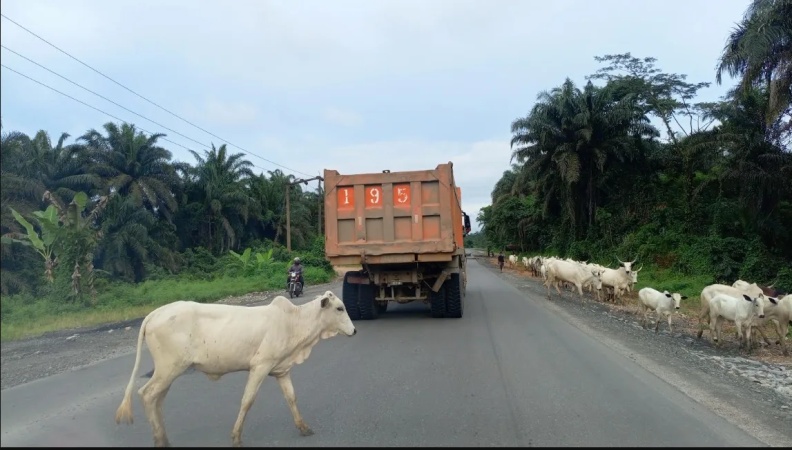
The consequences of living beside such an expansive and porous reserve are visible in everyday life. Roads leading into Ahoro-Esienle are poorly maintained, often forcing long and difficult journeys that would be routine elsewhere.
Communication networks are unreliable, leaving residents intermittently disconnected from the wider world. In moments of crisis, this isolation becomes not just inconvenient but dangerous, deepening the sense of abandonment already felt by many.
Transportation has become another burden entirely. Motorcycle riders, who now dominate local movement due to the state of the roads, have imposed steep fares that reflect both risk and scarcity.
A journey from Odo-Oba to Ahoro-Esienle now costs between N12,000 and N15,000, a figure that placed daily movement beyond the reach of many households already struggling with hardship.
The cumulative effect of these challenges has been to hollow out community life. Farmers, who once depended on daily access to their fields, now hesitate to venture out.
Fear has become a silent companion, dictating decisions that were once made with ease. In some cases, families have begun to leave entirely, seeking safety in neighbouring towns and cities, leaving behind homes that now stand increasingly empty.
Education has been perhaps the most visible casualty. Schools across the area have been emptied not only by the abduction but by the climate of fear that preceded it.
Classrooms sit silent, their chalkboards still bearing the last recorded date: May 15, 2026. The writing has not changed because nothing has moved forward since that day.
Inside some of those classrooms, scattered sandals and slippers remain exactly where they fell. They are small, ordinary objects, yet they carry an unbearable emotional weight.
To visiting parents and relatives, they are not just belongings but evidence of a moment when childhood collided violently with terror.
Each abandoned item speaks of confusion, of hurried escape, of children who did not have time to understand what was happening before they were swept away.
Long before the abduction that has now drawn national attention, however, residents insisted that warning signs had already emerged.
In January 2026, at least five guards were reportedly killed in Oloka village, a settlement not far from Ahoro-Esienle. The incident, though shocking, did not bring lasting relief or structural change. Instead, it became another entry in a growing list of violent episodes associated with the forested region.
Then came May 15, 2026.
It began like any other school day. Students arrived for lessons, teachers prepared for examinations, and parents went about their routines with no indication that the day would end in catastrophe. The ordinary rhythm of life held briefly, as it often does before disruption, creating the illusion that nothing unusual lay ahead.
That illusion shattered just before 9.30am.
Eyewitnesses stated armed men, dressed in military-style uniforms and riding eight motorcycles, entered the community. Their appearance initially caused confusion. Some residents believed they were security personnel deployed to the area, a perception that only collapsed when gunfire erupted.
The attack unfolded with disturbing speed and coordination. The gunmen moved directly towards the schools, firing shots that sent residents scrambling for cover.
Panic spread instantly. Parents grabbed children and ran. Others fled into nearby bushes, unsure of what was unfolding but certain that danger had arrived.
Inside the school compounds, the situation deteriorated rapidly. The attackers entered classrooms one after another, rounding up students and teachers.
The operation, according to witnesses, felt deliberate and methodical, as though every movement had been planned in advance. Amid the chaos, the cries of children and pleas of teachers filled the air, but nothing halted the advance of the armed men.
Those who were present describe the abduction as a scene of overwhelming helplessness. One resident later said it felt as though the attackers were “harvesting children like mangoes”, a metaphor that captured both the speed and the brutality of what occurred.
By the time the gunmen retreated into the forest, dozens of students and teachers had been taken. Two people had been killed. The attackers vanished into the same vast wilderness that now holds the missing.
For those left behind, the aftermath was immediate and devastating. Families emerged from hiding to discover an emptiness that was not just physical but emotional. The absence of their children was not abstract; it was present in every corner, every room, every silence.
Among those carrying this burden is Mrs Jacob Agnes Ojo, whose daughter Testimony is among the abducted.
Speaking through grief, she recalled the morning with painful clarity. “I am the mother of Testimony who is among the 47 teachers and students who were kidnapped by bandits in Ahoro-Esienle.”
“We had a prayer session in church at 10am that day, but my daughter insisted she wanted to go to school first. She did not know danger was waiting around the corner,” she said.
She explained that the attackers arrived around 9.30am, adding, “They were fully armed. At first, we thought they were security operatives. We later realised they were bandits.”
“The attack was carried out in a commando style. Gunshots filled the air and one youth in the village was killed.”
Her memory turned repeatedly to the same moment.
“We were forced to hide in the bush. We watched them take our children away and there was nothing we could do.”
Her appeal is directed at the highest levels of government, noting, “We are appealing to President Bola Tinubu and Governor Seyi Makinde to intensify efforts to secure the release of our children and their teachers.”
For Mrs Funmilayo Ojo, the crisis has shattered her family structure. Her sister-in-law and four children are among those abducted.
“I have been stripped naked. I don’t know what to do.”
Video
She recalled seeing a distressing video of her sister-in-law carrying a baby in captivity, adding, “She is a class mistress.”
On the day of the attack, she had been working at a garri processing factory, saying, “I left everything and rushed home. That was when I was told my sister-in-law and my four children had been taken.”
Her fear is simple and urgent, pointing out, “No medication. No food. We are begging the government to come to our aid.”
For Ojo Adekunle, the trauma is equally personal. His six-year-old child is among those held.
“This has never happened in the history of our community,” he said, recalling previous killings in the forest, including a farmer who was killed for resisting cattle grazing on his farmland.
In his words lay a sense of escalation, from isolated violence to mass abduction.
Even those outside the immediate affected families are struggling. Professor Wole Alamu, whose wife Mrs Fola Alamu is the principal of one of the attacked schools, spoke with restrained anguish.
“She always arrived before 8am,” he said, describing her routine commute from Ogbomoso, adding, “That day, students were writing examinations.”
“Her vehicle was destroyed during the attack. “She was abducted and the car was razed. Thank God she was not inside it.”
More than 18 days later, his suffering remained unchanged.
“The only thing I see are videos with guns pointed at her. The pain is unbearable. She is 56 years old.”
He insisted their commitment to public service remained intact despite everything, adding, “We are community people. That is why she stayed.”
Traditional leaders have also weighed in. The Olugbon of Orile-Igbon, Oba Francis Olusola Alao, acknowledged government efforts, including a high-level delegation led by the President’s Chief of Staff, Femi Gbajabiamila, but stressed that infrastructure remains a critical issue. Roads are bad, he said, and communication networks poor.
He also recommended a stronger military presence, including a brigade within the area.
The Soun of Ogbomoso, Oba Afolabi Ghandi Olaoye, echoed the call for a military base, citing the vastness of Oriire Local Government Area and the need for a more permanent security structure.
Messages of hope
Government officials have, in turn, maintained that efforts are ongoing.
Speaking on behalf of Governor Seyi Makinde, Commissioner for Education Segun Olayiwola described the incident as devastating and highlighted the scale of the challenge posed by the forest reserve, which spans multiple local government areas and shares boundaries with Kwara State.
At the federal level, a delegation led by Chief of Staff Femi Gbajabiamila visited the community. The team included National Security Adviser Nuhu Ribadu, Defence Minister General Christopher Musa (rtd), and other senior officials.
Delivering President Bola Tinubu’s message, Gbajabiamila assured families that “no stone will be left unturned” and that all options, both kinetic and non-kinetic, were on the table to ensure the safe return of the abducted.
Defence and security chiefs reinforced this message, while also urging communities to report suspicious activity.
The National Security Adviser described the incident as “pure evil” and announced the recruitment of 1,000 forest guards in Oyo State.
Yet despite these assurances, life in Ahoro-Esienle remained suspended in uncertainty. The classrooms remained empty.
The forest remained silent. And more than twenty days after the attack, an entire community continued to live in the fragile space between hope and heartbreak, waiting for a return that has not yet come.
Ban
This unfortunate development further pressed Governor Makinde to impose a statewide night-time ban on commercial motorcycle operations in the state, barring okada riders from operating between 10:30 p.m. and 5:30 a.m. as part of a broader security crackdown aimed at curbing criminal activities and enhancing public safety.
The restriction formed a key component of Executive Order No. 002 of 2026, signed by the governor on Friday to strengthen security, enforce vehicle registration regulations and improve traffic management across the state.
Speaking during the signing ceremony, Makinde said the measures were designed to address emerging security threats and ensure stricter compliance with existing traffic and vehicle registration laws.
According to the governor, unregistered vehicles, motorcycles and tricycles have increasingly been used to facilitate criminal activities, making it difficult for security agencies to track suspects and investigate crimes due to the absence of identifiable registration details.
He explained that the executive order established a legal framework for the rigorous enforcement of vehicle registration requirements and other traffic regulations.
These included measures targeting offences such as driving against traffic and other violations that posed risks to public safety.
Makinde disclosed that designated enforcement authorities have been empowered to arrest offenders and impound vehicles, motorcycles and tricycles found to be in breach of the provisions of the order.
The governor further stated that individuals apprehended under the executive order would be prosecuted in accordance with the law, while any seized assets and properties would be managed through established legal procedures.
“We are living through very trying times. For over 20 days, our teachers and pupils have remained in captivity in the hands of terrorists. Our thoughts and prayers remain with them and with their families who continue to endure unimaginable pain and uncertainty,” he said.
He assured residents that his administration remained fully committed to securing the safe return of all abducted victims and was working tirelessly with relevant security agencies to achieve that objective.
“As a government, we share in their anxiety and their hope, and we remain committed to doing everything within our power to secure the safe return of every one of them,” the governor added.
Makinde acknowledged the anguish being experienced by the affected families and communities, stressing that the abducted teachers and pupils had neither been forgotten nor abandoned.
While declining to disclose operational details for security reasons, he maintained that extensive efforts were ongoing behind the scenes and urged residents not to interpret the government’s silence as inaction.
A major highlight of the executive order is the restriction placed on commercial motorcycle operations across Oyo State.
The governor said the restriction became necessary as part of broader strategies to curb criminal activities, strengthen surveillance and deny criminal elements opportunities to exploit the cover of darkness.
He appealed to residents to support security agencies by providing timely and credible information on suspicious movements and activities within their communities.
According to him, security remained a collective responsibility that required the active participation and cooperation of all citizens.
“If you see something, say something, and authorities will do something,” he said, while reminding residents of the state’s toll-free emergency number, 615, for reporting security threats and emergencies.
Vigilant
Makinde also urged residents to remain vigilant, united and resilient despite prevailing security challenges, warning against allowing fear to erode communal harmony and public confidence.
He commended security agencies and personnel of the Amotekun Corps for their commitment, sacrifice and professionalism in responding to security threats across Oyo State.
The governor expressed confidence that sustained collaboration among security agencies, community stakeholders and residents would not only lead to the safe rescue of the abducted teachers and pupils but also further strengthen security across the state.
Yet despite the promises, assurances and high-level visits, the reality in Ahoro-Esienle remains unchanged.
Parents still wake up without their children. Teachers’ families still wait for their return. The classrooms remains empty. The forest remains silent.
Until the missing children and teachers walk back through those village paths, the vigil will continue. So too will the questions.
And so too will the longing for the day when Ahoro-Esienle can finally exchange tears for celebration and uncertainty for peace. (Sunday Vanguard)