ADAD
ADAD
Updating your news feed...
NEWS EXPRESS is Nigeria’s leading online newspaper. Published by Africa’s international award-winning journalist, Mr. Isaac Umunna, NEWS EXPRESS is Nigeria’s first truly professional online daily newspaper. It is published from Lagos, Nigeria’s economic and media hub, and has a provision for occasional special print editions. Thanks to our vast network of sources and dedicated team of professional journalists and contributors spread across Nigeria and overseas, NEWS EXPRESS has become synonymous with newsbreaks and exclusive stories from around the world.




Loading banners
Loading banners...

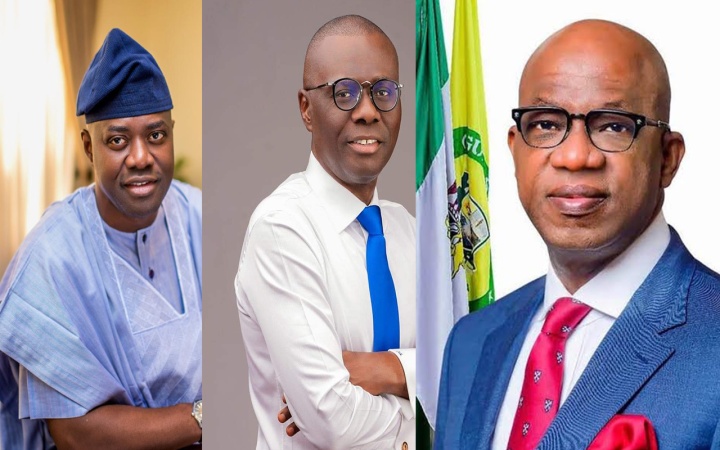
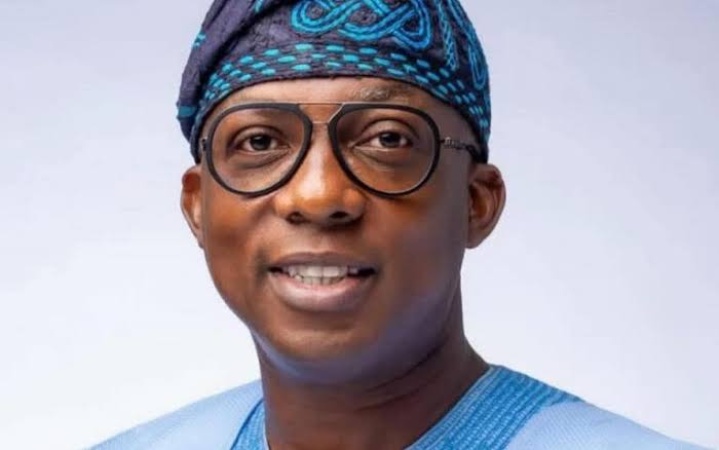
Lagos Gov Sanwo-Olu, Ogun Gov Dapo Abiodun and Oyo Gov Seyi Makinde
As Nigeria inches closer to the 2027 general elections, the political atmosphere in the South-West is already heating up — and in some states, the race has quietly begun in earnest.
The real battlegrounds are in Lagos, Ogun, and Oyo, where incumbent governors will be completing their constitutionally allowed two terms by May 29, 2027. In these South-West states, succession politics is no longer a distant conversation — it is unfolding in real time.
Beyond the South-West states, the wider picture also matters. President Bola Ahmed Tinubu is expected to seek re-election, and his influence over the region (long considered his political base) is shaping calculations within the ruling All Progressives Congress (APC).
At the same time, opposition parties are struggling to find cohesion, while local factors such as zoning, religion, indigene-settler tensions, and equity continue to influence who stands a real chance.
Lagos: Quiet Moves Toward Consensus
In Lagos, the signs point to a familiar APC strategy — consensus. Deputy Governor Obafemi Hamzat has steadily emerged as the leading figure within the party. His chances appear strengthened by endorsements from key stakeholders, including former governor Akinwunmi Ambode, as well as support within the powerful Governor’s Advisory Council (GAC).
Other names had been mentioned: Senator Tokunbo Abiru and presidential aide, Hakeem Muri-Okunola, but much of the momentum recently appears to be tilting in Hamzat’s direction.
Still, Lagos politics is rarely straightforward. Questions around indigene status and representation have resurfaced in some quarters, showing that even within a dominant party, consensus is never entirely without friction.
The opposition, particularly the Peoples Democratic Party (PDP), remains active but fragmented, with limited grassroots strength to seriously challenge the APC dominance.
Ogun: A Crowded Field, Familiar Power Brokers
The contest in Ogun is shaping up to be one of the most crowded in the region. Within the APC, Senator Solomon Olamilekan Adeola (popularly known as Yayi) appears to have gained an early advantage, backed by Governor Dapo Abiodun and a coalition of influential former governors, including Olusegun Osoba, Ibikunle Amosun, and Gbenga Daniel.
But the field is still not completely settled.
Heavyweights like Gboyega Nasir Isiaka, Sarafa Tunji Isola, and Tunde Lemo are also in the mix, reflecting both the depth of ambition and the complexity of the race.
Zoning remains a major talking point, with Ogun West pushing strongly for its turn, an argument that could ultimately shape the party’s final decision and ‘forced’ major stakeholders to queue behind the man currently representing Ogun West in the 10th Senate.
On the opposition side, familiar figures like Segun Showunmi and 2023 PDP governorship candidate, Ladi Adebutu are still in play, though internal divisions continue to weaken the PDP’s overall position.
Oyo: Open Race, High Stakes
In Oyo, the departure of Governor Seyi Makinde after eight years sets the stage for perhaps the most unpredictable contest in the South-West.
Unlike Lagos, there is no clear frontrunner yet. And unlike Ogun, there is no overwhelming consensus — at least not yet.
Within the APC, names like the 2023 governorship candidate, Senator Teslim Folarin; former Minister of Power, Adebayo Adelabu; and Oyo South Senator, Sharafadeen Alli, are being mentioned prominently. Each represents a different bloc within the party, and reconciling those interests will be key. While the party at the state and center appears to be in bed with Sharafadeen Alli as consensus candidate, the former Power Minister seems ready to fight on, while former Senate Majority Leader has been silent.
There is also growing agitation for zoning the governorship to Oke-Ogun, a region that has long argued it deserves a shot at power. Ignoring that sentiment could come at a political cost. However, voting strength and other influential undertones have further empowered Ibadan political dominance over possible zoning for 2027.
On the opposition side, Makinde is expected to play a decisive role in picking his successor. Though the idea of PDP as a formidable platform for 2027 is fast fading out of the discourse amid protracted leadership crisis at the center and amid wave of defections to the Allied Peoples Movement (APM). Several loyalists and technocrats, including one-time Commissioner of Finance and technocrat, Abimbola Adekanmbi; Oyo State Assembly Speaker, Adebo Ogundoyin; and House of Representatives member, Adedeji Olajide, were the top names assessed.
With Adekanmbi emerged the governor’s choice and consensus candidate to succeed the incumbent, his adoption could either consolidate the PDP-APM’s hold or open the door for the return of APC.
Osun and Ekiti: Testing Grounds Before 2027
While attention is fixed on 2027, the off-cycle elections in Ekiti and Osun in 2026 will serve as early indicators of what lies ahead.
Ekiti appears more settled, with Governor Biodun Oyebanji’s populist posture and political inclusivity have attracted support former political opponents of the ruling party and major stakeholders across party lines like former Governor Ayodele Fayose and former Governor Segun Oni.
Also, with the PDP currently in entangled, the governor enjoys relative stability which may culminate into his smooth re-election in July 2026.
In Osun, Governor Ademola Adeleke who was elected in 2022 on the platform of the PDP but now in Accord Party faces a re-election battle against a former Commissioner of Finance and candidate of the APC, Bola Oyebamiji.
With the APC and President Tinubu’s readiness to hold on to power at the center beyond 2027, the outcome could reshape political alignments across the region.
Expert Perspective
A public affairs analyst and human rights lawyer, Monday Ubani (SAN), says the unfolding political realignments in the South-West must be understood within the broader context of evolving party structures, elite control of internal processes, and the uncertain impact of emerging political movements such as the Nigeria Democratic Congress (NDC).
According to him, the rise of what is increasingly described as a “third force” — driven by political momentum around figures like Peter Obi and Rabiu Kwankwaso — may influence voter sentiment, but its actual effect on election outcomes remains uncertain.
Ubani noted that while such movements could reshape voter enthusiasm, especially among younger demographics and urban voters, they are still operating within a fluid political environment where party structures and alliances are not fully settled.
“The political space is still very hazy. We don’t yet know how alignments will finally crystallise across the APC, PDP and emerging platforms. So any projection now is subject to variables that may still change before the election,” he said.
He added that while a third force could redistribute votes, particularly in southern Nigeria, it does not automatically translate into electoral victory.
“There is no doubt that a third force will likely affect vote distribution in the South, but whether it changes the overall outcome is another matter. The established parties still have strong structures,” he explained.
Ubani also pointed out that much of the current political calculation is still speculative because realignments, defections and coalition talks are ongoing.
Beyond the third-force debate, Ubani raised concerns about internal democracy within political parties, particularly the increasing reliance on consensus arrangements in candidate selection.
He explained that consensus candidacy often reflects decisions taken by party leadership rather than the broader membership base.
“Consensus is essentially what party leaders decide. It does not always reflect the input of the wider membership. In many cases, it is top-down rather than bottom-up,” he said.
According to him, while consensus arrangements are sometimes used to prevent internal crises and manage competition, they can also create dissatisfaction among aspirants who feel excluded from the process.
Ubani added that the practice raises questions about how democratic internal party processes truly are, especially in highly competitive states like Lagos, Ogun and Oyo.
He, however, noted that Nigeria’s electoral framework has reduced political fluidity compared to the past, making it harder for politicians to freely move between parties.
He further explained that under current electoral rules, party switching is more regulated, and aspirants are often required to remain within a party’s register before participating in primaries.
“In the past, politicians could move from one party to another multiple times without restriction. That era is largely gone,” he said.
Ubani concluded that the key issue going into 2027 is not just the number of political actors or parties emerging, but whether internal party processes will reflect genuine democratic participation or remain controlled by elite consensus. (Nigerian Tribune)