ADAD
ADADUpdating your news feed...

NEWS EXPRESS is Nigeria’s leading online newspaper. Published by Africa’s international award-winning journalist, Mr. Isaac Umunna, NEWS EXPRESS is Nigeria’s first truly professional online daily newspaper. It is published from Lagos, Nigeria’s economic and media hub, and has a provision for occasional special print editions. Thanks to our vast network of sources and dedicated team of professional journalists and contributors spread across Nigeria and overseas, NEWS EXPRESS has become synonymous with newsbreaks and exclusive stories from around the world.























Loading banners
Loading banners...

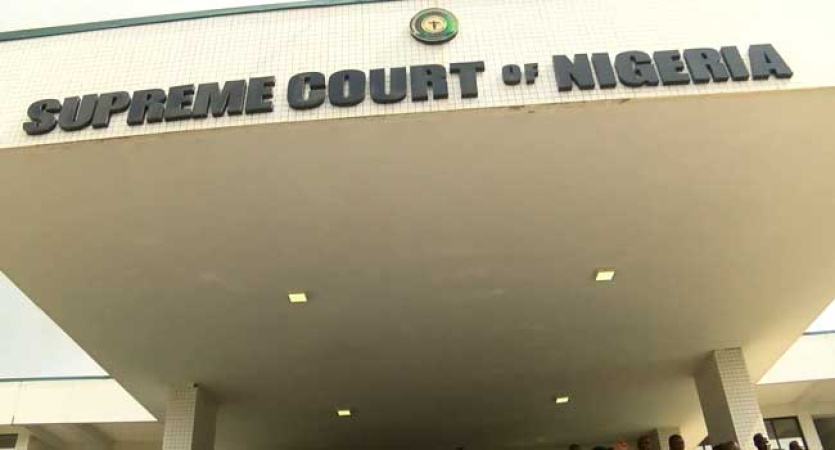
All eyes are on the Supreme Court as Nigeria awaits today’s ruling on the legitimate leadership of prominent opposition political parties in the lead-up to next year’s general election.
The apex court, in respect to the timelines set by the Independent National Electoral Commission (INEC) for the election, had last week elected to undertake an accelerated hearing of the leadership and structural disputes rocking the Peoples Democratic Party (PDP), Labour Party (LP) and African Democratic Congress (ADC).
At the core of the cases are questions of legitimate leadership, party control and compliance with constitutional processes, issues that directly affect each party’s ability to organise congresses, conduct primaries and submit candidates to the Independent National Electoral Commission (INEC).
Party stakeholders have expressed apprehension that the Supreme Court’s ruling in those cases would have far-reaching implications for the major opposition parties, stressing that the parties need backup plans to ensure that an adverse pronouncement does not shut them out of crucial preparations to participate in the poll.
Recall that INEC had fixed the timetable for the 2027 general elections. The Presidential and National Assembly elections will be held on Saturday, January 16, 2027, while the Governorship and State Houses of Assembly elections will follow on February 6, 2027.
Perhaps, in anticipation of possible litigation, the electoral umpire set out a tight sequence of activities and clear deadlines for party activities, which stipulated that political parties are to conduct their primaries, including the resolution of likely disputes, from April 23 through May 30, 2026.
Opposition in chaos, at a crossroads
For the PDP, the dispute centres on the national secretaryship tussle and questions of leadership legitimacy, with factions contesting who holds lawful authority to act on behalf of the party. The outcome will determine control of party machinery, including the issuance of notices for congresses and primaries.
For the ADC, the issue is tied to internal leadership and structural authority, particularly disputes over recognised executives and decision-making powers within the party hierarchy, matters that have implications for its growing role as a potential coalition platform.
Whichever way the apex court rules, the opposition faces an immediate race against time.
If the court affirms current leadership, attention will shift to rapid reconciliation and consolidation. Recognised executives would be expected to move quickly to unify factions, conduct credible congresses and organise primaries within INEC timelines. However, unresolved grievances could still trigger defections, weakening party cohesion.
A contrary verdict that nullifies or reshapes leadership structures may plunge the parties into emergency reorganisation, including the formation of caretaker committees and the convening of fresh conventions. The challenge would be compressing nationwide exercises into a narrow window without breaching electoral guidelines.
An ambiguous ruling could prove most destabilising, potentially leading to parallel claims to legitimacy, conflicting primaries and further litigation, scenarios that have historically undermined opposition parties in Nigeria.
Beyond legal outcomes, stakeholders are already weighing strategic options. These include internal concessions to placate aggrieved blocs, accelerated coalition talks and tactical defections by aspirants seeking stable platforms.
While public statements from coalition leaders have projected confidence and calm, insider conversations indicate that several stakeholders are quietly positioning for life beyond the ADC and PDP should the apex court fail to deliver a clear verdict in favour of the David Mark-led faction or the PDP-led Governor Seyi Makinde and the FCT Minister, Nyesom Wike.
The legal outcome is widely expected as a defining moment not only for the ADC but also for the broader anti-APC coalition involving former Vice President Atiku Abubakar, Labour Party presidential candidate Peter Obi, former Osun State Governor Rauf Aregbesola, erstwhile Transport Minister, Rotimi Amaechi and other opposition figures seeking a common platform for the next general election.
Time constraints
Stakeholders who spoke to The Guardian expressed concerns about the commission’s constricted electoral timeline, warning that opposition actors may have limited legal and political options as the clock ticks toward key deadlines.
A legal expert and Convener of the Vanguard for the Independence of the Judiciary, Douglas Ogbankwa, said affected political actors may have to explore alternative survival strategies outside ongoing litigation.
He stated that the only option open to them is to enter into other smaller parties and take over the structures if they are to beat the deadlines, since the timeline has begun and the clock is ticking.
Speaking on the intrusion of the judicial outlook, Akintayo Balogun, a legal practitioner based in Abuja, noted that the Supreme Court may be constrained by the electoral timetable in determining pending disputes.
On the implications of a delayed ruling, he noted that “if the decision of the Supreme Court comes outside the timeline granted by INEC, such a decision might become academic and of no valuable effect to the victorious party.”
Conversely, Balogun added that the apex court could make pronouncements that may necessitate adjustments to INEC’s timetable, depending on the circumstances of the cases, even as he emphasised the long-standing position of the Supreme Court that courts lack jurisdiction to entertain internal affairs of political parties.
A political analyst, Jide Oseme, said an unfavourable pronouncement from the Supreme Court could weaken the opposition’s bargaining power within the political landscape, arguing that legal setbacks of that magnitude often translate into weakened authority, particularly in alliances, power-sharing arrangements, and internal party control.
He noted that when opposition figures lose at the apex court, it not only settles legal disputes but also reshapes perceptions of legitimacy among party members and the wider electorate.
Political leaders affected by such judgments, he stated, may struggle to command loyalty, as rival factions could use the verdict to challenge their influence, push for leadership changes. This, he stated, can deepen internal fractures and complicate efforts to present a united front.
Another legal practitioner, Ibrahim Suleiman, held that an unfavourable ruling by the Supreme Court would not lead to the dissolution of opposition parties but could trigger internal challenges within their ranks.
On the possible implications of the judgment, Suleiman noted that parties such as the PDP and ADC would continue to exist as legally recognised entities regardless of the court’s decision, even as he warned that the outcome could unsettle internal structures, especially in cases involving leadership disputes.
“Factions that lose out in the legal battle may be compelled to relinquish control, a development that could intensify existing divisions within the parties. Such situations often create openings for rival groups to assert dominance, thereby deepening internal rifts.
“The aftermath of the ruling could lead to defections, as aggrieved members may choose to align with opposing factions or defect to other political platforms ahead of future elections.
“How party leaders manage the fallout would be crucial in determining their stability and electoral prospects ahead of the upcoming general elections,” he declared.
Calm outlook, private calculus
In a message posted on X on April 20, ADC National Publicity Secretary, Bolaji Abdullahi, insisted that the coalition leadership was not in talks with any political party and remained focused solely on the legal battle to overturn the Independent National Electoral Commission’s actions.
However, multiple reports between April 11 and April 20 indicate that the Mark-led bloc has explored fallback options, with the People’s Redemption Party (PRP) emerging as one of the most attractive alternatives. Sources familiar with the discussions disclosed that quiet meetings were held between loyalists of the former Senate President and PRP leaders.
Political observers say the PRP offers what the embattled coalition urgently needs: an already registered party structure, historical name recognition and, most importantly, freedom from the crippling internal litigations currently paralysing the ADC.
For many in the coalition, the key question is no longer whether alternatives exist, but how quickly they can be activated if Wednesday’s verdict goes against them.
While PRP discussions are gathering momentum, another option is also being aggressively marketed.
Former Bayelsa State Governor, Senator Seriake Dickson, is pushing the Nigeria Democratic Congress (NDC) as a fresh destination for politicians displaced by crises in both ADC and PDP.
On April 4 in Abuja, Dickson reportedly received some ADC defectors, including Barrister Amanda Pam, a former ADC senatorial aspirant. Sources within the NDC say the party is deliberately presenting itself as a refuge for ambitious politicians frustrated by instability in their current parties.
For Dickson, the current turbulence in opposition politics offers an opening to build relevance ahead of 2027.
At the heart of the uncertainty is the fractured state of the ADC itself. The party now effectively has three power centres. The first is the David Mark-Aregbesola tendency, which has become the face of the opposition coalition and is backed by figures such as Atiku and Obi.
The second is the Gombe faction, which insists it remains the party’s constitutional leadership and has relied on court pronouncements to preserve the status quo after INEC reportedly withdrew recognition from rival camps.
The third bloc is led by Dumebi Kachikwu and Temitope Ogah, who reject both the Mark and Gombe tendencies as illegitimate and insist the party cannot be hijacked through elite arrangements.
The result is a party carrying the hopes of a national coalition while battling severe internal fragmentation that threatens its legal identity.
The renewed interest in PRP is not accidental. The party, founded on the legacy of the late Mallam Aminu Kano, retains symbolic value across parts of Northern Nigeria and has avoided the factional implosion afflicting larger opposition parties.
Its National Chairman, Falalu Bello, had earlier confirmed merger discussions with ADC in 2025 before the current crisis deepened. Since then, overtures have reportedly intensified.
Even more revealing was the open invitation by the Lagos State PRP chairman to Atiku, Obi, Rabiu Kwankwaso, and Aregbesola to consider joining the party, citing unresolved crises in both the PDP and ADC.
Speaking on their expectations ahead of the judgment, a former National Vice Chairman of the PDP South-West zone, Eddy Olafeso, said that if the facts of the law in Nigeria are considered, the Taminu Turaki-led PDP has nothing to fear, as it is a clear case of some dissidents organising themselves to usurp the power of a legitimate party structure.
He said it was unfortunate that the group, having been expelled, has continued to rely on external support to create problems for the PDP.
He also dismissed fears that the PDP may not be able to meet the INEC timetable for 2027 if the apex court’s judgment favours it tomorrow.
He said, “Twenty-four hours in politics is a long time. We will not only meet up but also go ahead to win the election. The PDP is well-grounded and popular in Nigeria to achieve something cogent within 24 hours.”
On the other hand, he said that if the judgment is ambiguous, the party’s leadership, to which he belongs, will take appropriate decisions.
Former National Chairman of ADC, Ralph Nwosu, on his part, said he expects the court to rule that political parties should go to Nigerians to seek electoral victory, rather than run to the courts to secure it.
He also blamed the electoral commission for the crisis in the ADC, noting that the law clearly states that courts should not intervene in the internal leadership matters of political parties, but alleged that INEC’s interference was meant to derail the ADC.
While he expressed optimism that the apex court’s judgment would favour his side, Nwosu said it would not be a problem for the party to meet the electoral timetable, even as he added that the decision to be taken if the judgment goes otherwise rests with the party, instead of him alone. (The Guardian)