ADAD
ADAD
Updating your news feed...
NEWS EXPRESS is Nigeria’s leading online newspaper. Published by Africa’s international award-winning journalist, Mr. Isaac Umunna, NEWS EXPRESS is Nigeria’s first truly professional online daily newspaper. It is published from Lagos, Nigeria’s economic and media hub, and has a provision for occasional special print editions. Thanks to our vast network of sources and dedicated team of professional journalists and contributors spread across Nigeria and overseas, NEWS EXPRESS has become synonymous with newsbreaks and exclusive stories from around the world.








Loading banners
Loading banners...

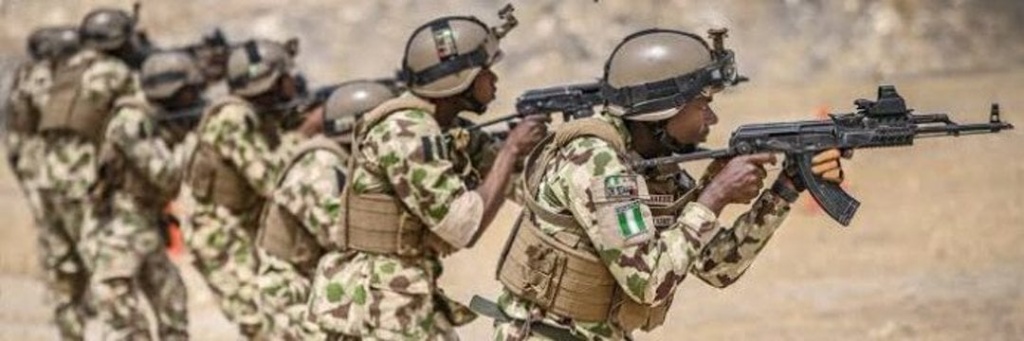
Military and paramilitary agencies received a total of N2.3tn in special intervention funding between October 2023 and September 2025, according to the latest Federation Account Allocation Committee documents obtained by The PUNCH on Monday.
The ledger shows the money was released in 23 equal tranches of N100bn each under the “Ledger of Special Intervention Programme for Nigerian Military February, 2026.”
The records from the Office of the Accountant-General of the Federation, Federation Account Department, indicate that the intervention fund operated as a transit account, with each N100bn receipt followed by a matching N100bn disbursement, leaving no balance after payments were made.
The document opened with a brought-forward balance of N100bn as of October 19, 2023. On the same date, the account recorded the first transfer, described as “Transfer from September, 2023 Allocation 1/10,” worth N100bn. That inflow was followed on November 8, 2023 by a payment of N100bn to the military.
A second N100bn tranche, marked “Transfer from October, 2023 Allocation 2/10,” was received on November 20, 2023, and was paid out on December 20, 2023.
The first phase continued with “Transfer from November, 2023 Allocation 3/10” on December 20, 2023, after which the description of the beneficiary widened from the military alone to “Military and Para Military Agencies.” That same N100bn was paid out on December 20, 2023.
The fourth tranche, from December 2023 allocation, came in on January 17, 2024 and was disbursed on February 2, 2024.
The fifth tranche, from January 2024 allocation, was received on February 27, 2024 and paid on March 1, 2024.
Further entries show that the sixth tranche, from February 2024 allocation, was received on March 20, 2024 and paid on April 12, 2024.
The seventh tranche, from March 2024 allocation, came in on April 16, 2024 and was disbursed on April 25, 2024.
The eighth tranche, from April 2024 allocation, was received on May 13, 2024 and paid on May 25, 2024.
The ninth tranche, from May 2024 allocation, was credited on June 10, 2024 and paid on June 13, 2024.
The 10th tranche in the first phase, from June 2024 allocation, was received on July 16, 2024 and paid on July 27, 2024.
This means the first phase alone accounted for N1tn, covering 10 allocations from September 2023 to June 2024.
The ledger then moved to a second phase, beginning with “Second Phase, Transfer from July, 2024 Allocation 1/10” on August 16, 2024. That tranche was paid out on August 27, 2024. The second phase continued with another N100bn from August 2024 allocation on September 16, 2024, paid on September 26, 2024. A third N100bn from September 2024 allocation was received on October 11, 2024 and paid on October 21, 2024.
A fourth, from October 2024 allocation, was received on November 20, 2024 and paid on November 27, 2024. A fifth, from November 2024 allocation, was recorded on December 13, 2024 and disbursed on December 17, 2024.
The second phase extended into 2025. The sixth tranche, from December 2024 allocation, was received on January 17, 2025 and paid on February 17, 2025. The seventh, from January 2025 allocation, came in on February 19, 2025. The corresponding payment was recorded on March 10, 2025.
The eighth tranche, from February 2025 allocation, was received on March 19, 2025 and paid on March 28, 2025.
The ninth, from March 2025 allocation, was received on April 15, 2025 and disbursed on April 24, 2025.
The 10th and final tranche in the second phase, from April 2025 allocation, was received on May 16, 2025 and paid on June 3, 2025.
Like the first phase, the second phase also amounted to N1tn, again built on 10 equal tranches of N100bn each.
By the end of that phase, cumulative receipts and payments under the special intervention programme had reached N2tn.
A third phase began shortly after. The ledger shows “Third Phase, Transfer from May, 2025 Allocation 01/10” on June 17, 2025, followed by payment on June 19, 2025. “Third Phase, Transfer from June, 2025 Allocation 02/10” was received on July 16, 2025 and paid the same day. “Third Phase, Transfer from July, 2025 Allocation 03/10” came in on August 21, 2025 and was paid on September 1, 2025. Those three entries added another N300bn, bringing the total special intervention funding to N2.3tn.
The documents did not provide a breakdown of how the N2.3tn was shared among the armed forces and the various paramilitary agencies, nor did the ledger state the projects, operations or expenditure heads the intervention funding was meant to support.
However, the scale and regularity of the disbursements show that the programme became a major financing line outside the routine monthly statutory allocations, with the special fund running continuously across three phases over nearly two years.
In a related development, the documents also showed that the Federal Government allocated N450bn as non-regular allowances for the armed forces over a three-month period in 2025, drawn from non-oil revenues.
Under a separate ledger titled “Ledger of Savings on Part Funding of Military and Para Military Non-Regular Allowances,” the funds were released in three tranches of N150bn each for April, May and June 2025.
The records indicated that on May 16, 2025, N150bn was received as “Transfer from Non-Oil on Part Funding of Military and Para Military Non-Regular Allowances for the month of April, 2025,” bringing the cumulative balance to N150bn. This was subsequently transferred in full to the sub-recurrent account on May 27, 2025.
A similar pattern was observed in June, when another N150bn for May 2025 was received on June 17, 2025 and completely transferred out to the sub-recurrent account on June 26, 2025.
For June 2025, the ledger showed that N150bn was received on July 16, 2025 and fully disbursed on July 23, 2025.
The documents further revealed that the Federal Government released N40bn for security funding in September 2025, channelled through the Office of the National Security Adviser.
Under a separate entry titled, ‘Ledger of Funding Security: February, 2026,’ the records showed that the sum of N40bn was received on September 17, 2025 as the “First tranche of Funding Security: August, 2025,” bringing the cumulative balance to N40bn.
The amount was subsequently paid out in full on September 30, 2025, with the entry described as “Payment of Funding of Security to Office of the National Security Adviser.”
The pattern is consistent with other intervention accounts captured in the FAAC documents, where funds are received and immediately transferred to designated security agencies for operational use.
The high security spending comes amid mounting concerns from businesses over rising insecurity across the country, which has emerged as the most pressing constraint to operations despite the scale of government intervention funding.
Findings from the Central Bank of Nigeria’s Business Expectations Survey for February 2026 showed that insecurity ranked as the top business constraint with an index score of 71.1, ahead of high or multiple taxes at 70.7 and insufficient power supply at 70.0.
According to the report, “Respondents identified Insecurity (71.1), High/Multiple Taxes (70.7), Insufficient Power Supply (70.0), High Interest Rate (68.6), and High Bank Charges (65.5) as the top five (5) business constraints in February 2026, highlighting factors that directly impact on operational stability and profitability.”
The ranking places insecurity above all other macroeconomic and structural challenges facing businesses, reinforcing concerns that security conditions continue to weigh heavily on economic activity, investment decisions, and expansion plans.
Outrage over killings
In a related development, outrage has continued to trail the latest wave of killings in Plateau and Kaduna states, with fresh details from multiple incidents painting a grim picture of escalating insecurity despite heavy government spending on defence and security operations.
In Plateau, accounts from residents, a youth leader, the police, the state government and the University of Jos all confirmed a deadly attack on Angwan Rukuba in Jos North on Sunday night.
In Kaduna, residents, church leaders and police sources confirmed another deadly attack on a wedding gathering in Kahir community in Kagarko Local Government Area.
The casualty figures from Plateau differed sharply. Residents first told The PUNCH that six persons had been confirmed dead after gunmen invaded Angwan Rukuba on motorbikes and opened fire on people in the area. But the President of the Berom Youth Moulders-Association, Dalyop Solomon Mwantiri, later said the death toll had risen to 27, with 14 killed instantly and 13 others dying in hospital.
The Plateau State Police Command, however, confirmed 12 deaths and said the victims included 10 men and two women, while adding that two more corpses were later found during search operations.
A resident, John Caleb, described the first moments after the Jos attack, saying, “We have been badly hit in Angwa in by unknown gunmen. So far, six people have been confirmed dead and several other casualties are at the Luna Hospital by New Road. It’s very unfortunate.”
Another resident, Janet Pam, said, “I was in my house at Angwa Rukuba when I heard the first gun shot. At first, I ignored the sound but when I heard it the second time, I came outside only to find out that it was gunmen on bike shooting at people.” She added, “They targeted those moving on the road and those selling by the roadside… I have never seen anything like this before. This is pure terrorism.”
Mwantiri, who gave the higher death toll from the Jos attack, said the community was angry that the attackers were able to strike a densely populated area. (The PUNCH)