
Updating your news feed...
NEWS EXPRESS is Nigeria’s leading online newspaper. Published by Africa’s international award-winning journalist, Mr. Isaac Umunna, NEWS EXPRESS is Nigeria’s first truly professional online daily newspaper. It is published from Lagos, Nigeria’s economic and media hub, and has a provision for occasional special print editions. Thanks to our vast network of sources and dedicated team of professional journalists and contributors spread across Nigeria and overseas, NEWS EXPRESS has become synonymous with newsbreaks and exclusive stories from around the world.


























Loading banners
Loading banners...

For the first time in more than 50 years, humanity is returning to the Moon – travelling further from Earth than anyone has ever been before.
Four astronauts will take a trip of more than half a million miles around our celestial neighbour and back home in a mission filled with wonderment, but also danger.
Nasa’s Artemis II mission – which is scheduled to launch as soon as 1 April – will bring us stunning views of the Moon and a new understanding of the lunar environment.
It will also pave the way for a landing and, eventually, a Moon base – our first step in learning how to live on another world.
But the voyage comes with serious risks – the crew will fly in a spacecraft never used by humans before.
And there will be personal challenges: the astronauts will spend 10 days cramped together in a spacecraft the size of a minibus.
So how will this high-stakes mission work?
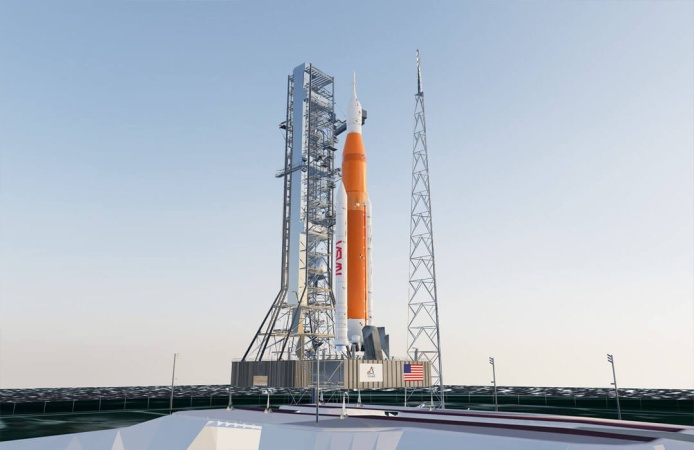
The astronauts will start their journey on Nasa’s mega Moon rocket, the Space Launch System.
It is the most powerful rocket the US space agency has ever built and will blast off from the Kennedy Space Center in Cape Canaveral, Florida.
Standing 98m tall (322ft) the SLS has flown only once before, launching in 2022 for Artemis I without astronauts onboard.
It has two huge rocket boosters and four engines that provide the power to get off the ground.
The orange core stage is essentially a giant fuel tank – containing more than three million litres of liquid hydrogen and liquid oxygen.
The job of the SLS Is to carry the Orion spacecraft – which sits at the top of the rocket with the astronauts onboard – to space.
If anything did go wrong during the early stages of the launch, the Launch Abort System, at the very top of the rocket, would propel the astronauts to safety.
The launch is one of the most dangerous parts of the mission – everything has to go perfectly.
All of the astronauts say they sat down with their families to talk about the risks involved.
“We’ve all got someone, an astronaut, that is going to be with our family members when they’re watching launch, which can be this terrific and terrifying moment all at the same time.”
Glover is one of four astronauts – three Americans and one Canadian – who have been training for Artemis II for more than two years. They have decades of experience between them – although one has never been to space before.
Reid says he has a lifelong love of flying, but on the ground he is afraid of heights.
While in the military, Victor’s call-sign was IKE, which stands for I Know Everything.
Christina made history taking part in the first all-female spacewalk while on the International Space Station.
Official Nasa portrait of Jeremy Hansen in his orange spacesuit showing him from mid-waist. With short hair and a cleft chin, he is clearly a big man and, perhaps, looks a little uncomfortable having his photo taken.
The Canadian will be taking maple syrup and maple cookies on his lunar voyage.
When you see them together, it is clear how well they know – and like – each other. Commander Reid Wiseman has said the quartet have spent so much time with each other, they are now totally in sync.
The four Artemis II astronauts in their orange spacesuits stand together in a circle next to an indoor pool. Victor Glover and Reid Wiseman look at each other in the foreground with Jeremy Hansen and Christina Koch behind them. They look as if they are having a debrief after some aspect of training has maybe not gone quite as expected. Other people stand in the background, looking on but not part of the discussion between the astronauts.
“You get to that point where you do not have to communicate any longer – you’re just listening to everything happening, and all four of us are watching each other and the mission, and we do not need to speak – we just know.”
To get used to living in such a confined space, the crew has been spending as much time in each others’ company as possible. There have even been some Artemis sleepovers.
The crew module has similarities to the ones used for the Apollo missions 50 years ago, but the interior is very different.
Inside this compact living space, the four will work, exercise, eat and sleep.
There are four seats for the launch – once in orbit the crew will pack them away to make more room.
The weightless environment means all surfaces are accessible, so this control panel can be on the ‘ceiling’.
There is a water dispenser, for drinking water and to rehydrate food.
Each astronaut has chosen their favourite meals for the journey.
A step, just beneath the hatch, doubles up as a flywheel exercise machine.
The astronauts pull on the cable for 30 minutes of cardiovascular and resistance training each day.
But possibly the most important piece of equipment is tucked away under the floor.
It is a toilet – something the Apollo astronauts didn’t have 50 years ago.
It has been specially designed to overcome the challenges of going to the bathroom in space.
But it’s not very private.
“On the International Space Station, the loo is much more separated. Our loo… it’s in the floor. We’re all cramped in there, so any noise that it makes, everyone’s going to be hearing. So, yeah, it's different."
The mission to the Moon and back will last 10-ish days – the “ish” is because it depends on the exact timing of the launch, and the relative positions of the Earth and the Moon.
For the first day of the mission, the astronauts will orbit the Earth. They will be high above it – about 70,000km (45,000 miles) up. To put that into perspective the International Space Station is about 400km (250 miles) above our planet.
They will have to get used to the weightless environment, and for space rookie Jeremy Hansen it will be a steep learning curve.
“I do think it is going to be a bit of an adjustment for us when we get up there… I’ll be learning how to float and fly – and bumping into stuff. And I’ll need a little help, probably,” Hansen says.
The astronauts will also be checking the spacecraft’s vital life-support systems – and this includes the onboard toilet.
The astronauts will also have the chance to take Orion for its first test drive.
About three hours into the flight, the upper stage of the rocket – called the Interim Cryogenic Propulsion Stage (ICPS) – will detach from the Orion spacecraft.
The crew will then manually fly Orion, approaching and backing away from the ICPS, to see how Orion handles. It is a chance to practise for docking in future missions.
Now the Artemis team has to make a major decision.
While the astronauts are close to Earth, getting back is relatively straightforward if there are any issues that cannot be fixed.
So mission control has to be absolutely certain before they give the go-ahead for a critical manoeuvre called the trans-lunar injection burn.
This is when Orion fires its main engine to blast free of Earth’s gravity and set a path to the Moon.
The outward journey takes four days, travelling about 370,000km (230,000 miles) from Earth.
The astronauts will fly around the Moon’s far side, with several hours dedicated to lunar observation.
Once they are on their way, coming home will not be easy or quick – the astronauts are now committed to their long journey around the Moon and back.
During this time, the crew will continue to evaluate the spacecraft systems, but the astronauts themselves will also be evaluated and monitored.
It is an opportunity to use the crew as guinea pigs – experiments on board will reveal how their bodies are affected this far out in space.
Radiation is a key concern, as the Sun can hurl out damaging, high-energy particles.
The astronauts will carry a device called a dosimeter to see how much radiation they are exposed to. They will also practise using their radiation shelter, which is under the floor of the spacecraft.
The crew need to know how to get into it quickly if a solar storm is detected.
Another practice session to help prepare for the unexpected will involve the astronauts climbing into their bright orange spacesuits, called the Orion Crew Survival System (OCSS).
These suits are worn to protect the crew during launch and re-entry, and also act as vital protection if there is a problem with the capsule.
The suit is like a mini-wearable spacecraft, pressurised with inbuilt life-support systems.
The zip has been specially designed to allow the suit to be pulled on quickly.
Isolated image of the orange Orion spacesuit with the helmet, gloves and life support connectors at the waist highlighted and labels pointing to each.
Other features include the lighter, stronger helmet, which is easy to connect to the comms system.
The life support system supplies air and removes exhaled carbon dioxide, and the new durable gloves can work touchscreens.
In the event of an emergency on their way to or from the Moon, the astronauts would quickly suit up – the spacesuit is designed to keep them alive for up to six days as they make their way back to Earth.
The crew will also take part in tests to study their balance and muscle performance and changes in their microbiome, as well as eye and brain health.
Samples of their saliva, blotted on to special paper, will also be taken before, during and after the mission to analyse their immune systems, which can become weakened in space.
“A fascinating thing about the space environment is it actually changes the immune systems of our bodies, and that’s really important to us and our friends. Many of us have experienced those things when we went to the ISS, and we’re going to really have to have a handle on that for long duration missions.”
Now is the moment that the world has waited more than half a century for: humanity’s return to the Moon.
The astronauts will fly around its far side – the side we cannot see from Earth – at a distance of between 6,500 and 9,500km (4,000-6,000 miles) from the lunar surface.
Orion will point towards the Moon for the best views. The crew will have three full hours devoted to lunar observation – to look, take images, and learn more about its geology, which will help to plan and prepare for a future landing.
“Depending on the time that we launch, depending on the illumination of the far side of the Moon… we could see parts of the Moon that never have had human eyes laid upon them before. And believe it or not, human eyes are one of the best scientific instruments that we have.”
From this vantage point, they will be able to see the Earth and the Moon together from Orion’s windows, with the Moon close up in the foreground and the Earth distant in the background.
Each astronaut has been allowed to bring special items on board for this special moment in their mission. For Victor Glover, it is a Bible and some family heirlooms; for Christina Koch, it is handwritten notes from loved ones, and Jeremy Hansen is bringing some Moon pendants that belong to his wife and three daughters.
Reid Wiseman has chosen something very simple.
“I have a blank piece of paper and a pen and pencil, and I can’t wait to write some thoughts on that. I don’t know what to expect, and I don’t want to go in with any preconceived notions,” he says.
Computer-generate image of Orion orbiting the Moon. Orion has its four solar arrays extended in a cross and is sideways to the Moon Itself which is shown behind with the light from the Sun coming from the right and casting deep shadows in the craters on the surface. The left side of the Moon – where Orion is heading – falls into complete darkness.
But while the astronauts get to stare in awe and wonder during their lunar fly-by, it will be a tense time for mission control as well as everyone following the mission at home.
As the astronauts fly behind the Moon, they will lose communication with the Earth for between 30 and 50 minutes.
“While we cannot talk to the planet and our friends that are even in space on the International Space Station, I would love it if the entire world, those eight billion people, could come together and just be hoping and praying for us to get that acquisition of signal and be back in touch with everybody,” Victor Glover, says.
Once mission control can breathe a collective sigh of relief and when contact is re-established, it will be time for the astronauts to begin their journey back home.
The risky return
The return will take another four days. But this last part of the mission is one of the riskiest.
For this final manoeuvre, the crew module will separate from the rest of the spacecraft, and the capsule will turn so its heat shield can bear the brunt of the fiery temperatures generated on re-entry and keep the astronauts safe inside.
The spacecraft will hurtle through Earth’s atmosphere at 25,000mph, enduring temperatures of about 2,700C – that is half as hot as the surface of the Sun.
Artists impression of the Orion crew module re-entering the Earth’s atmosphere. The conical capsule is high above the surface of the planet and surrounded in a fiery glow as it descends. A pressure wave can be seen curving out from just in front of the heat shield. Orange sparks trail behind the capsule. (BBC)
•Standing 98m tall (322ft) the SLS has flown only once before, launching in 2022 for Artemis I without astronauts onboard.




