Updating your news feed...
NEWS EXPRESS is Nigeria’s leading online newspaper. Published by Africa’s international award-winning journalist, Mr. Isaac Umunna, NEWS EXPRESS is Nigeria’s first truly professional online daily newspaper. It is published from Lagos, Nigeria’s economic and media hub, and has a provision for occasional special print editions. Thanks to our vast network of sources and dedicated team of professional journalists and contributors spread across Nigeria and overseas, NEWS EXPRESS has become synonymous with newsbreaks and exclusive stories from around the world.

























Loading banners
Loading banners...

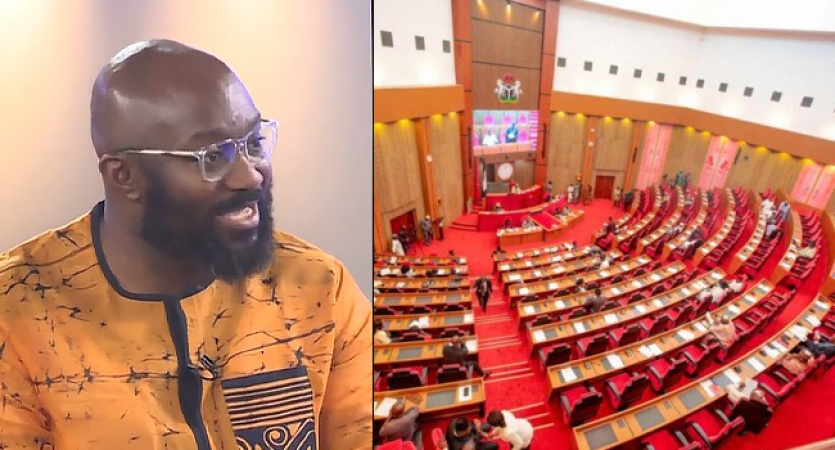
The Executive Director of Yiaga Africa, Samson Itodo, has faulted the assent to the amended electoral bill, saying that it contains provisions that are at variance with the aspirations of Nigerians.
“I think that Nigerians need to know that, yes, whilst there might be progressive provisions in the 2026 Act, the cardinal issues that are central to the integrity of elections are those contentious provisions that the Senate or the National Assembly decided to enact provisions that are in variance with the desires of Nigerians.
“And so when you look at some of those provisions, let’s take Section 63, which is one of the most contentious. On the one hand, the Act says that there shall be an electronic transmission of results,” Itodo said on Channels Television’s Sunday Politics.
He explained that the inclusion of the former EC8A in the amended law — now the Electoral Act 2026 — had legitimise its use in general elections, a decision he said the electorate had kicked due to its use as a tool for results manipulation
“So there is mandatory electronic transmission of results based on this particular drafting, but it’s that proviso that it introduces, and you know what they have now said that in all cases, it is the form EC8A that shall be the primary source of collating results as well as declaring results.
“What they have done to a large extent is just legitimising the current practise, which is that any result on the IREV has no legal effect; it’s only for verification because there’s a superior legal recognition that has been given to the form EC8A,” Itodo said.
“And what Nigerians are saying is the primary instrument of election rigging, the primary instrument of election manipulation is the form EC8A. So if you place primacy on the form EC8A, and that form EC8A becomes falsified, it then renders the electronically transmitted results a nullity, of no effect, and that’s what Nigerians are saying that, ‘No, you cannot place primacy on EC8As because we know that EC8As are often used and historically they are used as tools for results manipulation’.
“And they decided on their own accord, at variance with what Nigerians said, and I think the point needs to be made that the way the National Assembly voted on that particular provision is against the will of the people, and no one should attempt to deceive Nigerians that this was in line with what Nigerians wanted,” he added.
The Electoral Act, 2022 (Repeal and Re-Enactment) Bill 2026 was made law by President Bola Tinubu after it was passed by the National Assembly.
The bill has generated heated debates in the last one week, with lawmakers and prominent Nigerians disagreeing over the method for the transmission of results, ahead of the 2027 general elections.
The Senate had on Tuesday passed the Electoral Act, 2022 (Repeal and Re-Enactment) Bill 2026, but not without a rowdy session as the upper chamber resumed proceedings.
The situation was not different at the House of Representatives as lawmakers disagreed over a motion seeking to rescind the passage of the amendment bill, which contained real-time electronic transmission of results.
The Chairman of the House of Representatives Committee on Rules and Business, Francis Waive, had moved a motion for the House to rescind its decision on the bill, which was passed on December 23, in line with the Senate’s position on real-time electronic transmission of election results.
When the Speaker of the House, Tajudeen Abbas, put the motion to a voice vote, the “nays” were louder than the “ayes,” but he ruled that the ayes had it.
This triggered protests from lawmakers, who began shouting in objection, prompting the speaker to call for an executive session. (Channels)