Updating your news feed...
NEWS EXPRESS is Nigeria’s leading online newspaper. Published by Africa’s international award-winning journalist, Mr. Isaac Umunna, NEWS EXPRESS is Nigeria’s first truly professional online daily newspaper. It is published from Lagos, Nigeria’s economic and media hub, and has a provision for occasional special print editions. Thanks to our vast network of sources and dedicated team of professional journalists and contributors spread across Nigeria and overseas, NEWS EXPRESS has become synonymous with newsbreaks and exclusive stories from around the world.







Loading banners
Loading banners...

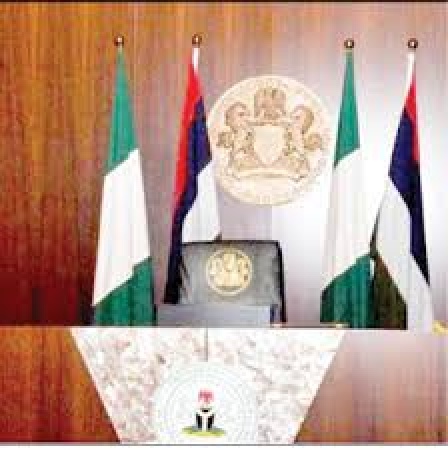
Presidency seat
In recent times, there has been renewed push for the entrenchment of rotational presidency in the constitution as a measure aimed at ensuring balance and equity in power sharing between the North and South.
Weekend Trust reports that currently, there are no constitutional provisions mandating power sharing between the North and South, a development that has seen some regions of the country spending longer years in power, to the detriment of the other.
At the moment, power sharing is done informally by various political parties through zoning arrangements, which are most times not adhered to.
Prominent serving and former federal lawmakers, including the Deputy President of the Senate, Barau I. Jibrin; former Speaker of the House of Representatives and Chief of Staff to the President, Femi Gbajabiamila, and former Senate President Anyim Pius Anyim, have called for the entrenchment of rotational presidency in Nigeria’s constitution to promote equity and balance in power sharing between the North and South.
The call is coming as the National Assembly gears up to vote on the 2025 constitution amendment bills upon resumption from their recess.
They made their positions known recently at the 2026 National Summit of Former Legislators, themed, “National Unity and Nation Building: Beyond 2031,” held in Abuja.
The summit was organised by the National Forum of Former Legislators (NFFL), with Gbajabiamila as convener, and attracted former lawmakers across party lines, including former Senate presidents Pius: Anyim and Ken Nnamani, as well as former speakers of the House of Representatives: Patricia Etteh and Yakubu Dogara, among others.
Speaking at the event, Gbajabiamila endorsed the principle of rotational presidency between the North and South, describing it as a wise and principled compromise designed to manage Nigeria’s diversity, ease political tensions and preserve national stability.
He cautioned that personal ambition should not be allowed to undermine arrangements that sustain unity and peace.
Gbajabiamila called on Nigerians across political, ethnic and regional divides to recommit to national unity, describing it as a strategic necessity for the country’s survival and progress in an increasingly volatile global environment.
He noted that the summit was held at a time of global uncertainty when long-standing assumptions were being challenged and international stability weakened, stressing that such moments demanded experienced leadership and reflective national dialogue.
In the same vein, former Senate President Anyim Pius Anyim supported the call for constitutional entrenchment of rotational presidency.
“If we all agree that rotation is good, why should it not be constitutionalised?” he asked.
Also speaking, Deputy Senate President Barau I. Jibrin backed the calls for rotational presidency, noting that the arrangement had brought stability since the advent of the Fourth Republic.
“I appeal that we should abide by the principle of rotation, which has brought sanity and equality since the beginning of the Fourth Republic. Of course, now President Bola Ahmed Tinubu is in his first term, and as noted by other speakers, let’s not reinvent the wheel.
“We have seen that the rotational system is working. We shall allow it to work. So, as said by Tunji Ojo, the president is doing well. He has said a few of the things the president is doing to bring prosperity to our nation. President Bola Ahmed Tinubu should be allowed to serve two full terms,” Barau said.
Responding to requests from the Forum’s leadership, Barau pledged to forward the proposal for embedding rotational presidency in the constitution to the National Assembly. “I will certainly do that,” he assured.
Earlier, the national coordinator of the 2026 NFFL Summit, Raphael Igbokwe, said the Forum supported rotational presidency as a means of ensuring unity, a sense of belonging and balance in power sharing among the country’s regions.
He recalled that resolutions from previous northern and southern dialogue sessions of the forum affirmed that in the interest of unity and peace, the South should complete its eight-year tenure, stressing that the current President Bola Ahmed Tinubu should be supported to conclude the southern presidency.
Igbokwe argued that struggles over power remained one of the root causes of conflicts in Nigeria, adding that constitutionalising rotational presidency would foster trust, reduce suspicion and promote fairness among the country’s diverse groups.
How bill on rotational presidency was killed at House of Reps
Weekend Trust reports that an earlier attempt to introduce a constitution amendment bill on rotational presidency in the 10th House of Representatives was rejected by lawmakers.
The bill, which was sponsored by the Deputy Speaker of the House, Benjamin Okezie Kalu, was titled: “A Bill for an Act to Alter the Constitution of the Federal Republic of Nigeria, Cap. C23, Laws of the Federation of Nigeria, 2004 to Provide for the Principle of Rotation of the Offices of the President and the Vice President of the Federal Republic of Nigeria among the Six Geopolitical Zones of the Country, namely: North-Central, North-East, North-West, South-East, South-South, and South-West and for Related Matters (HB. 2291).”
After the House Leader, Prof Julius Ihonbvere read the title of the bill to the House, the Deputy Speaker, who presided over the plenary, opened the floor for lawmakers to make their contributions on the bills.
Contributing, Rep Aliyu Madaki (NNPP, Kano), opposed the bill, saying the issue the bill was trying to address had been adequately covered by the constitution under the principle of federal character
Madaki argued that the issue of zoning of presidency should be left to individual political parties to decide, saying there was no need to enshrine such provision in the constitution.
Rep Ali Isah (PDP, Gombe), however, disagreed with the position of Madaki. He said enshrining rotational presidency in the constitution would engender fairness and sense of belonging for all the geopolitical zones of the country.
While opposing the bill, Rep Sada Soli (APC, Katsina), said the proposed legislation “is very injurious to the unity of the country.”
He said enshrining the principle of rotational presidency in the constitution would lead to the enthronement of mediocrity over competence.
“It could play up regional and ethnic interests over competence. It will encourage limited choice of people that can vie for office; and it will encourage regional rivalry, which negates the spirit of unity,” Soli said.
But Kalu, while responding to Soli’s position, dismissed the argument on the enthronement of mediocrity, adding that every geopolitical zone of the country has competent and capable people that can occupy the offices of president and vice president.
He said the essence of the bill was to ensure that every part of the country got the opportunity to contribute to the governance and development of the country.
Rep Shina Oyedeji, in his contribution, opposed the bill, noting that the essence of democracy is all about healthy competition. He added that including clauses of zoning and regional sentiments negated democratic principles.
“Everybody should be given the chance to stand and contest an election in any given opportunity,” he said.
Rep Bello El-Rufai (APC, Kaduna), while opposing the bill, said enshrining the principle of rotational presidency in the constitution would lead to regional and ethnic rivalry given the multiplicity of ethnicities in the country.
The bill was eventually shutd own at the end of the day.
Experts warn against enshrining rotational presidency in constitution
Speaking on the issue, the national president of the Nigeria Political Science Association (NPSA), Prof Hassan Saliu, warned against overloading the constitution with evolving political conventions. He said such thinking and clamour was not progressive.
According to him, sensitive arrangements such as zoning and power rotation are better managed within political parties rather than being rigidly entrenched in the country’s grundnorm.
“We should define things with courage, but we must also understand that not everything is put in the constitution; otherwise the document becomes too heavy and difficult to manage,” Prof Saliu said.
He explained that permanently embedding rotational presidency in the constitution risked locking Nigeria into identity-based politics at a time the country needs leaders chosen on competence and vision.
“Are we saying we are not going to outgrow where we are now? Are we saying we will not outgrow this nativity and identity factor? I believe that in the course of development, we will reach a stage where all these regressive things would no longer be necessary,” he said.
Prof Saliu emphasised that what Nigerians truly seek is effective leadership capable of delivering good governance rather than leaders emerging from predetermined regions.
“All the people really want is who can deliver the goods. The fact that we are not yet there does not mean that we should foreclose the possibility of getting there,” he added.
The NPSA president further pointed to Nigeria’s poor adherence to constitutional provisions and legal rulings as a warning against assuming that formalising rotation will guarantee compliance.
“There is a provision that 10 per cent of internally generated revenue should go to local governments. Who has ever complied with that? There are laws regulating campaign spending. Have they been respected? Even court judgements are disobeyed,” Prof Saliu noted.
He described Nigeria as a transitional democracy, where weak adherence to the rule of law and selective enforcement undermines trust in formal institutions.
“We are not yet a country of rules. Even aspects of the constitution that are clearly spelt out are being flagrantly disobeyed,” he said, stressing that formalising rotational presidency could reinforce rather than resolve existing political tensions.
Supporting similar arguments, Dr Edun Abdulkareem, the head of the Department of Political Science at the University of Ilorin, expressed strong reservation over the idea of constitutional rotation.
He argued that the proposal would disenfranchise citizens from certain regions at different times, contradicting the core principles of democracy.
“Introducing rotational presidency between the North and South is antithetical to democratic principles. It creates more division for the country and reinforces the idea that the North is different from the South,” Dr Abdulkareem said.
He noted that formal rotation could prevent citizens from freely electing candidates of their choice.
“Are we saying that because it is the turn of one region, people from the other region should be barred from contesting? That means you are denying them their democratic right to be elected and denying voters their right to choose,” he said.
Dr Abdulkareem also challenged the notion that Nigeria’s ethnic and regional diversity necessitates constitutional zoning, pointing to other diverse democracies that operate without such mechanisms.
“In the United States, there was a civil war between the North and South, yet they do not practise rotational presidency. In Britain, you have different nationalities, but there is no rotation of prime ministership among them,” he said.
He stressed that Nigeria’s leadership challenges should be addressed through merit-based competition rather than rigid, regionally defined constitutional arrangements.
“It is not about where you come from or your religion. We should vote for the best candidate and allow that choice to reflect in the final result. That is what will improve governance in Nigeria,” Dr Abdulkareem said.
Adding historical context, Gbade Ojo, a professor of Political Science in the University of Ilorin, highlighted the origins of the rotational presidency idea, noting that it was first suggested during the Abacha regime.
However, Prof Ojo argued that Nigeria’s complex ethnic and religious composition made formal rotation highly problematic.
“The North is not monolithic. The South is not monolithic. In the North, you have Christian communities, Muslim communities, majorities and minorities. In the South, there are easterners, the Igbo and westerners, the Yoruba. If a Yoruba man is president, the Igbo may not consider the South represented, and vice versa,” he said.
He criticised framing leadership around North versus South as reflecting an underdeveloped democratic system.
“In countries like the United States, the UK, Canada and India, diversity does not necessitate rotational leadership. Here, however, we are petty. What matters should be a competent president, a leader with vision for the country,” Prof Ojo explained.
Prof Ojo further advocated informal arrangements based on consensus among ethnic and political coalitions rather than formal constitutional mandates.
“When Buhari served two terms, it was widely understood that power rested with the North. Later, the APC agreed to rotate power, and elections reflected that informal arrangement. That is the way informal arrangements work, common sense and negotiation among stakeholders,” he said.
He also cautioned that formal rotation could undermine national integration.
“If power oscillates formally from one zone to another, new leaders often recruit from their ethnic group, which undermines integration. But if a president is competent, fair and impartial, he will earn respect across the country.
“Leadership should focus on ability, vision and fairness. A president who demonstrates these qualities will be respected by all regions, regardless of ethnicity or religion,” Prof Ojo said. (Weekend Trust)