
Updating your news feed...
NEWS EXPRESS is Nigeria’s leading online newspaper. Published by Africa’s international award-winning journalist, Mr. Isaac Umunna, NEWS EXPRESS is Nigeria’s first truly professional online daily newspaper. It is published from Lagos, Nigeria’s economic and media hub, and has a provision for occasional special print editions. Thanks to our vast network of sources and dedicated team of professional journalists and contributors spread across Nigeria and overseas, NEWS EXPRESS has become synonymous with newsbreaks and exclusive stories from around the world.



















Loading banners
Loading banners...

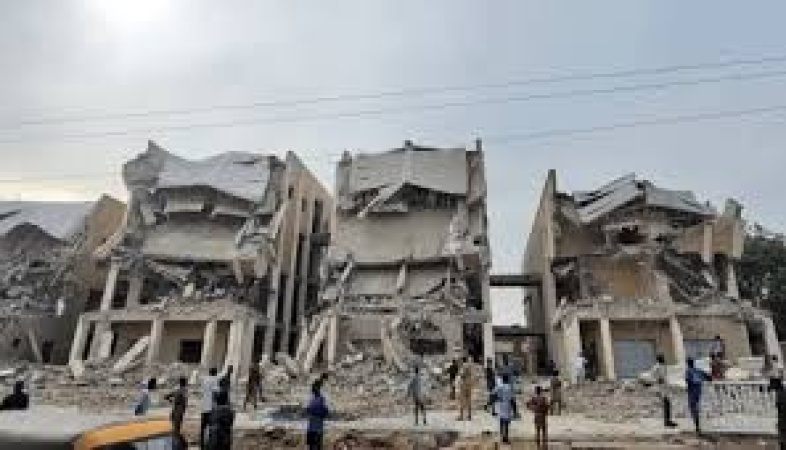
File photo of a collapsed building
When Festac Town was commissioned in 1977, it was the most glamorous estate that even those in highbrow Ikoyi, Victoria Island and Ikeja GRA desired to live in.
“I have never seen this level of beauty and organised living in any part of the country. The town is alluring,” Pa Isibor Ehimen, a young artist with the then Bendel State contingent, said.
The octogenarian, who Is now retired and lives in Ekpoma, would cry if he visited Festac Town today because the beauty has not just faded, but gone.
There are many who witnessed the town at its peak, when it was still an organised and decent place to live, when the trees offered shape from the scorching sun to the residents and also welcomed visitors to the largest green estate in Africa.
But considering the chaos that has enveloped the once beautiful and peaceful town, the few who witnessed its glory find it difficult to recall the past, because it is truly gone, and sadly for long.
From banks and businesses taking over empty spaces and green areas designed for relaxation, to street trading and markets springing up everywhere and to gutters being blocked and to overpopulation, the residential estate designed to house the participants of the Second World Festival of Black Arts and Culture of 1977 (Festac77), is an eyesore and far from decent living to say the least.
Sadly, from its original 5,000 contemporary dwelling units and seven major avenues, meant to accommodate 45,000 people, the town’s original residencies are competing with makeshift accommodations and shanties, all outside the masterplan.
However, a disaster waiting to happen is the current building on buffer zones that have saved the town from environmental impacts since 1977.
Aside from being a windbreaker, protecting the town from environmental impacts, the buffer zone has taken a lot from the residents, with all the waste water from the town, rain water, and all manner of things being emptied in the zone.
Today, churches and mosques have taken over the once lush buffer zone, motor parks, mechanic workshops, gas refilling plants and petrol stations, markets and refuse dumps have taken over, exposing the town to harm.
“Before, you cannot see Mazamaza, Agboju and Alakija from Festac Town, no matter how tall the building is because the trees in the buffer zone offered enough covering,” Ademola Onitiri, a concerned old resident lamented.
Considering the exploitation of the buffer zone, Onitiri decried the ugly development, describing it as “a disaster waiting to happen”.
Onitiri, who spoke for other helpless residents, said: “We original allottees are helpless. We have complained to the Federal Housing Authority, which supervises the town, we have complained to the Lagos State government and asked them to stop issuing C-of-Os to the people in the buffer zone, yet more buildings are springing up.”
In the same vein, Yinka Shonibare, a concerned resident of Festac, noted that having the buffer zones across Festac built-up is like a disaster waiting to happen.
According to him, the buffer zones were intended to serve several purposes aimed at limiting the effect of flooding and other environmental challenges in Festac Town.
“Well, the green zone serves a lot of purposes. It retains and absorbs water that would have flooded Festac.
“It is designed with drainage that collects water and human waste from Festac for onward discharge into the canal,” he said.
According to him, the green zones were meant to supply oxygen and absorb carbon dioxide, and also help to improve the ecosystem balance.
“The greens help filter the atmospheric air in Festac, limiting harmful air (plants have such ability),” he said.
Shonibare also added that it does not seem that any remedial action can be taken by the government or is in sight based on the level of construction currently going on in the area.
“Anyone in Festac would have noticed that virtually all the roads are bad because the drainages are blocked by the constructions along the buffer zones. Also, little rain causes floods in Festac now,” he said.
Chimezie Agumbah, another resident, lamented that residents are tired of complaining about the environmental effects of building within the buffer zones around Festac built-up because those involved are adults with children.
According to him, residents have dug the drainages leading into 23 Road from Second Avenue multiple times, yet the road gets flooded whenever it rains.
“They have dug that place countless times. People don’t throw trash in it or anything, yet it clogs once it rains,” he said.
His concern highlights the environmental consequences of having the buffer zones and other ‘green zones’ across Festac either built-up or occupied by other activities that do not serve the primary purpose for which the zones were created.
But, another person familiar with the situation who pleaded anonymity told BusinessDay that Amuwo-Odofin Local Government Area, where Festac is situated, raised a concern sometime last year by writing to the Federal Housing Authority (FHA) on the environmental effects of having the buffer zones built-up.
According to him, the Local Government is addressing the issue on an inter-agency level, and is waiting for FHA to take necessary actions on the matter.
“Last year, we wrote to FHA on this same issue. They told us they will look into their books to ascertain if the people there are building illegally or not. However, we are yet to receive any correspondence on the matter from FHA since then,” he said.
He also told BusinessDay that the two major roads leading into Festac Town will be rehabilitated very soon by the Lagos State government and that many of the structures along the buffer zones might have to go.
“You know, the Lagos State government did a groundbreaking flag-off of the reconstruction of the 2nd Avenue and 7th Avenue roads and I believe some of these structures will have to give way for free flow of water when the road is rehabilitated,” he said.
While the rehabilitation of the two major roads connecting Festac Town with other parts of Lagos is expected to significantly improve mobility, reduce vehicle damage, boost economic activities and enhance the overall quality of life, residents are also optimistic that the reconstruction will also bring some level of restoration along the already built-up buffer zones.
On its part, the FHA has intermittently engaged in demolishing illegal, makeshift shops and structures within the zone, such as in 2021, to reclaim the area, though encroachment persists.
Also, during the tenure of Gbenga Ashafa as the managing director/CEO, Federal Housing Authority (FHA), over 500 illegal makeshift shops were demolished in Festac Town.
Then, Ashafa insisted that the measure was to ensure a proper survey in line with the FESTAC master plan, and also giving possession to the real allottees as several quit notices were served on the illegal occupants before the actual demolition was carried out.
In the same vein, Akintola Olagbemiro, the then South-West zonal manager of FHA, said that the authority started the Implementation of the second phase of the consent judgment, which was for clearing the illegal structures within the buffer zones along the 2nd Avenue as well as the expressway.
“Before then, we had earlier implemented the first phase of the judgment, which was to dredge the canal along the buffer. This will allow the clearance for the proper survey and development of parcels of land along this axis in accordance with the master plan,”
But despite all the efforts to sanitise the town and preserve the masterplan, more shanties, shops, worship centres and mechanic workshops are still spring up, even in the buffer zones.
The development counters the assurance of past FHA leadership that promised to continue the demolition exercise until Festac Town wears its original look.
Many concerned residents, especially original allottees, are calling out Oyetunde Oladimeji Ojo, the current managing director/CEO of the Federal Housing Authority of Nigeria.
For them, Ojo, who was appointed in February 2024, has not done enough to sanitise the town as illegal structures are still springing up across the town, amid massive encroachment in the buffer zone.
“He is focused only in Abuja. The FHA is doing little or nothing to checkmate recent encroachments in the buffer zone,” Yakubu Inuwa, a resident and serving immigration officer said.
For Uche Okpe, another angry resident, the FHA cannot deny involvement in the illegal structures, especially within the buffer zones because nobody will dare build anything there without, at least, seeking FHA’s approval.
“Nobody can build anything in the buffer zones or any empty space without FHA’s approval. So, who gives these illegal occupants approval? Can FHA deny knowing they exist? I think, it is time to get serious with the issue because Festac is being exposed now to a potential weather threat, crime, and pollution,” he said.
Again, Inuwa, who inherited his two-bedroom apartment in 21 Road, from his late father, who was also an immigration officer, blamed the sad development on FHA, saying that if the authority had not given any approval, people will not dare build anywhere near the buffer zones or empty lands in Festac.
“The green lawn in my area, which we used to play in as teenagers is gone. A hotel is standing in its place, with noise, unknown faces and exotic cars that disrupt the peace of our estate.
“FHA should continue the demolition, charge offenders to court, and leave its double standard that has seen some illegal structures still standing after every demolition exercise,” he said.
But Abidemi Olayemi, an agronomist and environmentalist, pointed to the danger ahead if the buffer zone in gone.
“Festac will be submerged by flood if the buffer zones are gone.
“The water outlets along 1st Avenue and 21 Road empty into the canal, while those in 2nd, 3rd, 5th and 7th Avenues empty into the buffer zones. Imagine what will happen when there is no place to contain the water. Festac will definitely be submerged,” he warned.
Also, Esther Obeya, an Abuja-based environmentalist, noted that Festac is swampy and was heavily sand filled before construction, and that with human waste and rain water finding no place to go, they would be retained within, amid potential danger, especially houses sinking, roads caving in and erosion every.
“We are inviting building collapse, underground erosion, pollution and pulling down of roofs by strong winds because the buffer zones with the trees, which serve as windbreakers are gone.
The government cannot build another Festac, even if the money is there. So, let us preserve this one. It is still the largest estate in Africa and no government has taken it upon itself to rival that project. It is a shame,” she concluded. (BusinessDay)