
Updating your news feed...
NEWS EXPRESS is Nigeria’s leading online newspaper. Published by Africa’s international award-winning journalist, Mr. Isaac Umunna, NEWS EXPRESS is Nigeria’s first truly professional online daily newspaper. It is published from Lagos, Nigeria’s economic and media hub, and has a provision for occasional special print editions. Thanks to our vast network of sources and dedicated team of professional journalists and contributors spread across Nigeria and overseas, NEWS EXPRESS has become synonymous with newsbreaks and exclusive stories from around the world.


























Loading banners
Loading banners...

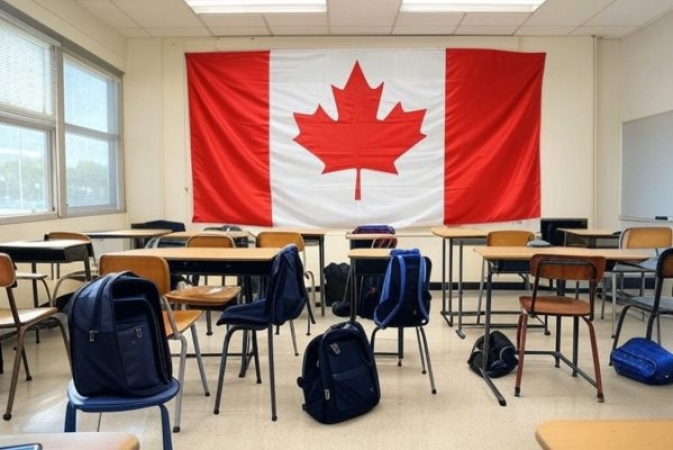
Canada’s higher institutions are facing unprecedented disruption as new federal policies sharply curtail international student enrolment, with direct implications for Nigerian students having been the top-four source country for international students in Canada till 2023.
One of the country’s largest institutions, Conestoga College in Ontario has experienced a dramatic drop in foreign enrolment. Last spring, just over 8,500 international students registered, a decline of 62 percent compared with the same period last year.
“Just over 8,500 international students are enrolled this semester, a drastic drop from more than 22,600 last spring,” said Vicki Poirier, president of the Support Staff Union. “We can see the difference in the number of students on site. I’m not surprised. Around 180 jobs were slashed earlier this year”.
Poirier highlighted the broader consequences of staffing cuts on student support. “The college is moving backwards by cutting back in areas that need the most support: writing consultants, scheduling, student success advisors. These are roles that provide direct support to students. I don’t think students are going to get the same quality or quantity of services that were available previously”.
Similar pressures are emerging in Manitoba Institute of Trades and Technology (MIT), which previously trained more than 4,500 students annually, is set to close following a 61 percent drop in international enrolment.
Renée Cable, minister of Advanced Education, Manitoba placed responsibility on federal policy. “When the federal government unilaterally decided to cut international students, it was devastating. From day one, we have been telling the federal government that this policy change would have real-world effects on real people,” she said.
However, scepticism persists. Wayne Ewasko, education critic, questioned whether the transition could be managed effectively. “I am doubtful that the minister is going to be able to pull this off,” he said. Meanwhile, Chris Lorenc of the Manitoba Heavy Construction Association criticised the closure for contradicting government statements about the importance of training for the construction sector.
Lena Metlege Diab, Immigration minister, recently confirmed that Canada’s international student population fell from over one million in early 2024 to roughly 700,000 by November 2025. The reduction follows policy changes including a national cap on international student enrolment, tighter post-study work rules, and higher study permit refusal rates.
Figures from Immigration, Refugees and Citizenship Canada (IRCC) indicate that study permit holders fell from 673,970 in December 2023 to 476,330 in November 2025. Those holding both study and work permits dropped from 320,830 to 244,900, a total decline of 27.5 percent, or 273,570 students. New student arrivals between January and November 2025 were down 60 percent compared with the same period in 2024.
Why this matters
International students contribute significantly to Canadian institutions’ revenue and fill labour gaps in service sectors such as retail, hospitality, and care services. Nigerian students, historically among the top cohorts studying in Canada, now face higher visa rejection risks, fewer post-study work opportunities, and greater financial uncertainty. Families funding overseas education and Nigerian education consultants and recruitment agencies are also affected.
Nigerian students had over 53,000 active permit holders by late 2023. There was a rapid, 1,397 percent increase in study permits between 2017 and 2023, tightened federal restrictions, including a 30 percent drop in permits by late 2024 and plummeting approval rates of about 30–33 percent in 2025.
Municipalities and policymakers may benefit from reduced pressure on housing and public services, while colleges who are reliant on tuition fees, local employers using student labour, and prospective international students including Nigerians bear the cost.
Analysts will monitor whether colleges can stabilise operations amid falling foreign enrolment, how domestic recruitment strategies evolve, and whether Canada revises its approach if skills shortages persist. For Nigerian students, attention will focus on alternative study destinations, adjusted admission strategies, and the future accessibility of Canada as a study and work pathway. (Business Day)



