
Updating your news feed...
NEWS EXPRESS is Nigeria’s leading online newspaper. Published by Africa’s international award-winning journalist, Mr. Isaac Umunna, NEWS EXPRESS is Nigeria’s first truly professional online daily newspaper. It is published from Lagos, Nigeria’s economic and media hub, and has a provision for occasional special print editions. Thanks to our vast network of sources and dedicated team of professional journalists and contributors spread across Nigeria and overseas, NEWS EXPRESS has become synonymous with newsbreaks and exclusive stories from around the world.

.webp)

.webp)

.webp)








Loading banners
Loading banners...

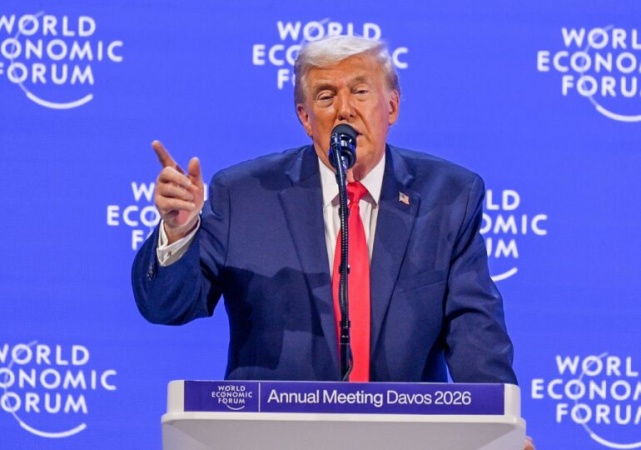
US President Trump
It took Donald Trump six days to build a new world. On the seventh, his erstwhile allies in Europe could have been forgiven for hoping that he would rest.
Since he threatened tariffs to seize Greenland last Saturday, Trump’s taboo-shattering behavior has left the West in no doubt that the norms of the old world order have been swept aside – “a rupture, not a transition,” in the stark words of Canadian Prime Minister Mark Carney.
In its place: a more brutal, more lawless arena, where the loudest and strongest wins and a rock of the old world – the seemingly unbreakable transatlantic trust – is no more.
As early as 2019, Trump made clear his desire for Denmark’s ice-bound territory of Greenland. But it’s the past week’s descent into bullying threats against a NATO ally that has left Europe in shock.
“One way or the other, we’re going to have Greenland,” Trump promised, even if we, “do it the hard way.”
“It’s a new reality that was created. A reality that is very often volatile,” a senior EU diplomat told journalists on Thursday, citing the “very unorthodox rhetoric from the US administration.”
Trump has stretched and strained ties with Europe since last January, frequently appearing to echo talking points with Russian President Vladimir Putin and withdrawing aid to Ukraine – Europe’s current front line against Moscow – leveling tariffs at close partners and launching spiteful barrages of insults online and in person.
Addressing journalists after a late-night meeting of EU leaders Thursday, EU Council President Antonio Costa said all agreed relations with partners must be managed in a “cordial and respectful way,” (a sharp contrast to the brash assaults of the Trump White House.)
For some, this realization has been a long time coming, given warning signs from the first days of this latest Trump administration.
“The transatlantic relations have definitely taken a big blow over the last week,” EU foreign policy chief Kaja Kallas said Thursday.
For former EU Council chief Charles Michel, it’s even starker: the transatlantic relationship “as we’ve known it for decades is dead,” he told CNN.
After a year of Trump disrespecting European allies, many had wondered how much of the old transatlantic ties remained. Trump’s Greenland threats answered that clearly.
“If you’re pushing ahead on Greenland, no one would believe that US would be willing to defend Estonia,” one EU diplomat told CNN.
Faced with Trump’s ambitions, the choice for Europe was stark: defiance or subservience.
“Appeasement means no results, only humiliation,” Poland’s Tusk said this week, while Belgian Prime Minister Bart De Wever in Davos spoke of preferring being a “happy vassal” to a “miserable slave” of the US.
Discussions with EU diplomats highlighted how Europeans have finally coalesced around a need for independence from the whims of the White House, especially on matters of defense. And for some that also means a break from the flattery and attempts at “Trumpwhispering” that defined Europe’s approach to the US in 2025.
The red lines breached by Trump were too profound it seemed. “Fundamentally unacceptable” was how Macron slammed America’s trigger-happy tariffs at Davos. And in another unambiguous swipe at Trump: “We do prefer respect to bullies.”
Last year saw European convergence around coordinated funding for European defense, with a focus on buying European, a clause essential to European industrial progress, leaders like Macron have long said.
The EU looks set to continue down that path into 2026, boosting Europe’s growing industrial base as much as its capacity will allow. And while one EU commissioner broached the idea of an official EU army or security council – surely a sign that Trump is forcing taboos onto the table – there was little appetite for that level of integration yet.
For all Trump’s bluster, Europe faces all the same threats that it faced last weekend. On Monday, Russia launched one of its largest-ever bombardments of Kyiv. This week, Finnish military intelligence warned of Moscow’s threats to underwater infrastructure in the Baltic Sea, a favorite target of Russian-linked saboteurs. And the risks from hostile actors in the Middle East and China haven’t disappeared either.
Talking to EU diplomats across the bloc, none suggested Europe should submit to the White House’s coveting of an ally’s sovereign territory. In public though, their resistance wasn’t universally brash.
Even as Trump stepped back from potential confrontation over Greenland, after Europe lofted the threat of its “trade bazooka” to block US access to European markets, Germany’s Chancellor Friedrich Merz spoke of being “grateful” for Trump’s change of heart.
Baltic countries, usually some of the most outspoken in Europe, were notably quiet faced with a cantankerous Trump.
“Instead of focusing on the emotional side of the dilemmas presented by the White House, we should rather focus on the military, the technical side, identify mutual pragmatic issues and resolve them,” Lithuania’s former defense minister Dovile Šakaliene told CNN, adding that it would take five to 10 years for Europe to be able to match US military power on the continent.
“Cooperation should be the keyword instead of confrontation,” Lithuania’s President Gitanas Nauseda told journalists, “The US is still our closest friend.” (CNN)



