Updating your news feed...
NEWS EXPRESS is Nigeria’s leading online newspaper. Published by Africa’s international award-winning journalist, Mr. Isaac Umunna, NEWS EXPRESS is Nigeria’s first truly professional online daily newspaper. It is published from Lagos, Nigeria’s economic and media hub, and has a provision for occasional special print editions. Thanks to our vast network of sources and dedicated team of professional journalists and contributors spread across Nigeria and overseas, NEWS EXPRESS has become synonymous with newsbreaks and exclusive stories from around the world.





















Loading banners
Loading banners...

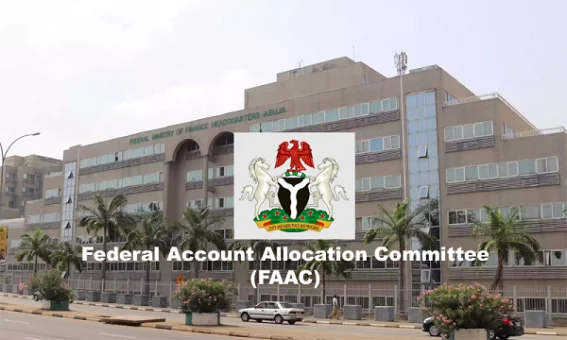
Nigeria’s Federation Account recorded its highest quarterly disbursement in the third quarter of 2025, with a total of N6 trillion shared among the three tiers of government, according to the Nigerian Extractive Industries Transparency Initiative (NEITI).
The figures, released in NEITI’s Quarterly Review for Q3 2025, showed a 55.6 per cent year-on-year increase compared with the same period in 2024 and more than a twofold rise in allocations over the past two years, underscoring the sharp surge in shared revenues.
NEITI disclosed that a total of N9.62 trillion was disbursed by the Federation Account Allocation Committee (FAAC) between September and November 2025.
Reacting, Delta Governor, Sheriff Oborevwori, urged Governors across the federation to improve the welfare of their people, noting that states were now receiving more money from the federation account.
The N6 trillion disbursement included 13 per cent derivation payments to oil-producing states, highlighting the significant contribution of oil-related revenues to the federation account.
A breakdown of the allocation showed that the Federal Government received N2.19 trillion, State Governments N1.97 trillion while local governments got N1.45 trillion, reflecting increased statutory transfers to all tiers of government.
Oborevwori, who spoke during the flag-off of the N39.3 billion Otovwodo flyover project in Ughelli North Local Government Area, said there was no justification for claims that there was no money, insisting that state governments now had sufficient resources to deliver development projects.
NEITI’s analysis revealed that statutory revenue accounted for 62 per cent of the shared receipts, while Value Added Tax (VAT) contributed 34 per cent. The Electronic Money Transfer Levy (EMTL) and augmentation from non-oil excess revenue each contributed two per cent, indicating the continued dominance of oil and tax revenues.
The distribution to the 36 states, drawn from statutory revenue, VAT, EMTL and the Ecological Fund, also included an additional N100 billion augmentation from the non-oil excess revenue account.
State-by-state data showed wide disparities in allocations, with Lagos State receiving the highest share of N179.3 billion in the quarter, translating to an average monthly inflow of N59.76 billion. Kano followed with N79.2 billion, while Rivers State received N78.8 billion.
At the lower end, Nasarawa received N42.5 billion, Ebonyi N42.9 billion and Ekiti N43 billion. NEITI noted that the gap between the highest and lowest state allocations stood at N136.8 billion in the quarter.
Among oil-producing states, Delta recorded the highest gross allocation of N180.68 billion, alongside Akwa Ibom, Bayelsa and Rivers as major beneficiaries of derivation inflows during the period. Oil-producing states collectively received about N424 billion.
On debt obligations, NEITI disclosed that deductions from states’ allocations to service debts and other obligations totalled N225.89 billion, representing a 6.5 per cent decline from the previous quarter. The average debt service ratio stood at 9.4 per cent, with more than two-thirds of states recording ratios below 10 per cent, suggesting improving subnational debt sustainability.
Despite the record inflows, NEITI warned of mounting fiscal risks in the fourth quarter of 2025, citing lower average oil prices and a decline in crude oil production from 1.64 million barrels per day in Q3 to 1.59 million barrels per day in the first month of Q4. (The Nation)