ADVERTISEMENT

ADVERTISEMENT










Loading banners


NEWS EXPRESS is Nigeria’s leading online newspaper. Published by Africa’s international award-winning journalist, Mr. Isaac Umunna, NEWS EXPRESS is Nigeria’s first truly professional online daily newspaper. It is published from Lagos, Nigeria’s economic and media hub, and has a provision for occasional special print editions. Thanks to our vast network of sources and dedicated team of professional journalists and contributors spread across Nigeria and overseas, NEWS EXPRESS has become synonymous with newsbreaks and exclusive stories from around the world.
By Fr. OKHUELEIGBE OSEMHANTIE ÃMOS
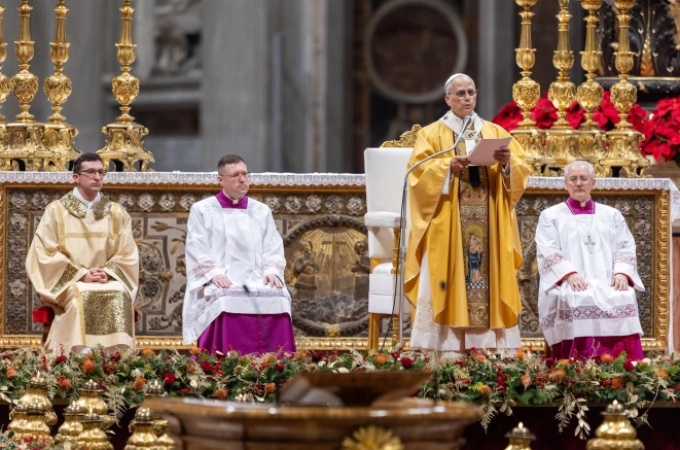
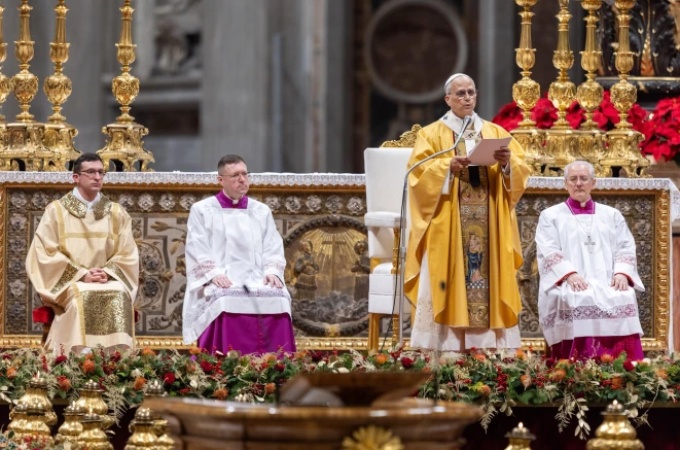
Pope Leo XVI on Wednesday night presided at his first Christmas Vigil Mass as Supreme Pontiff at St. Peter’s Basilica, imprinting the celebration with a clear and deliberate signal of the universal breadth of the Catholic Church. In a gesture both symbolic and historic, the Igbo language of Nigeria was included in the Prayers of the Faithful, marking a rare moment of African linguistic presence within a principal papal liturgy at the very heart of Christendom.
As the Basilica resounded with the ancient proclamation, _“Gloria in excelsis Deo, et in terra pax hominibus bonae voluntatis,”_ the inclusion of Igbo among the intercessory prayers quietly but firmly affirmed the Church’s catholicity—not as an abstraction, but as a lived linguistic and cultural reality. It recalled earlier moments in modern papal history when non-European languages, once absent from major papal liturgies, were gradually welcomed as expressions of the Church’s post-conciliar universality.
The Pope’s Christmas Vigil followed the classical Roman rite with scrupulous fidelity, yet allowed carefully measured signs of openness. The Prayer of the Faithful, traditionally rendered in a selection of world languages, featured Igbo alongside more customary tongues, situating the Nigerian linguistic heritage within one of the Church’s most solemn nights.
The prayer, offered from the ambo with dignified restraint, echoed the Church’s perennial intercession “for the needs of the whole world, for peace among nations, and for the salvation of all.” Its Igbo rendition drew particular attention from African pilgrims and Vatican observers alike, many of whom described the moment as both understated and profoundly affirming. Africa—now home to one of the fastest-growing Catholic populations in the world—continues to shape the Church’s liturgical and pastoral imagination.
An African couple, widely identified in circulating footage as Igbo, also participated in the offertory procession, reinforcing the embodied presence of the African Church within the liturgical action and adding a visual complement to the linguistic inclusion.
On Christmas morning, Pope Leo XVI appeared at the central loggia of St. Peter’s Basilica to deliver the traditional “Urbi et Orbi” blessing—to the City and to the World. In continuity with older papal custom, he greeted the global faithful in multiple languages, reviving a practice long associated with the pontificates of St. John Paul II and Benedict XVI.
The greetings, offered after the solemn Latin formula “Urbi et Orbi,” were delivered in Italian, French, English, German, Spanish, Portuguese, Polish, Arabic, Chinese, and Latin, a linguistic arc spanning Europe, the Americas, Africa, Asia, and the Middle East. The gesture was widely interpreted as an intentional reaffirmation of the Church’s global address at a time of fractured geopolitics and deepening cultural polarisation.
In his Christmas address, Pope Leo XVI returned insistently to the mystery of the Incarnation as God’s response to human fragility. Echoing the Lucan infancy narrative, he recalled that Christ was born not amid power, but poverty:
“And this shall be a sign unto you: Ye shall find the babe wrapped in swaddling clothes, lying in a manger.” (Lk 2:12)
Without naming specific governments, the Pope alluded to ongoing wars, displaced populations, economic anxieties, and the erosion of human dignity, urging the world not to grow numb to suffering. The Nativity, he stressed, is not escapism, but a divine intervention into history.
Observers at the Vatican noted that Pope Leo XVI’s first Christmas celebrations reveal a pontificate keenly attentive to continuity with tradition, while deliberately widening the Church’s audible and visible horizons. The careful insertion of Igbo into the Vigil liturgy was neither accidental nor decorative; it stood as a theological statement rendered through language.
In a world often tempted to confuse universality with uniformity, the Christmas liturgies of Pope Leo XVI offered another grammar—one in which unity speaks in many tongues, and Bethlehem still gathers the nations.
As the Basilica emptied under the winter Roman night, the words of the angelic hymn lingered, now heard through a broader human choir:
“Glory to God in the highest, and on earth peace to people of good will.”
•Fr. Okhueleigbe Osemhantie Amos, PhD, is of the Catholic Institute of West Africa (CIWA), Port Harcourt, Nigeria.
PHOTO CAPTION: •Pope Leo XVI presiding at his first Christmas Vigil Mass as Supreme Pontiff at St. Peter’s Basilica on Wednesday night