
ADVERTISEMENT

ADVERTISEMENT

















Loading banners


NEWS EXPRESS is Nigeria’s leading online newspaper. Published by Africa’s international award-winning journalist, Mr. Isaac Umunna, NEWS EXPRESS is Nigeria’s first truly professional online daily newspaper. It is published from Lagos, Nigeria’s economic and media hub, and has a provision for occasional special print editions. Thanks to our vast network of sources and dedicated team of professional journalists and contributors spread across Nigeria and overseas, NEWS EXPRESS has become synonymous with newsbreaks and exclusive stories from around the world.
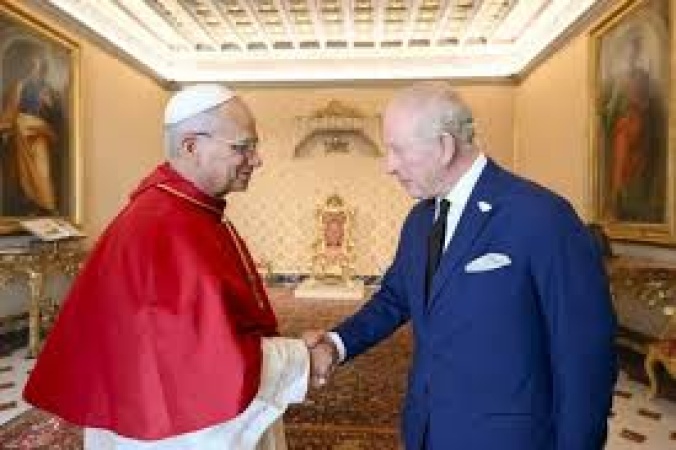
Pope Leo XIV and King Charles III
By Fr. OKHUELEIGBE OSEMHANTIE ÃMOS
In a moment heavy with history and quiet symbolism, Britain’s King Charles III and Pope Leo XIV prayed together in the Sistine Chapel on Thursday, 23 October 2025, marking the first public shared prayer between a British monarch and a Roman Catholic pontiff in nearly five centuries. Beneath Michelangelo’s frescoes, the brief but deliberate act drew global attention, not for what was said, but for what it represented: a visible thaw in a relationship frozen since the English Reformation of the 16th century.
The prayer service took place during King Charles’s official visit to the Vatican and unfolded with restrained solemnity. Anglican and Catholic liturgical elements were carefully interwoven, with readings and chants drawn from both traditions. Choirs from the Sistine Chapel and Britain’s royal chapels provided music that echoed a shared Christian heritage older than the divisions that later hardened into doctrine and law. Queen Camilla joined the service, seated among senior clerics and ecumenical representatives, reinforcing the public and diplomatic character of the moment.
The historical weight of the event lies in the long shadow cast by 1534, when King Henry VIII severed England’s ties with Rome after Pope Clement VII refused to annul his marriage. That rupture led to the establishment of the Church of England and inaugurated centuries of estrangement marked by political hostility, religious persecution, and competing claims of ecclesiastical authority. For nearly 500 years, no reigning English or British monarch had publicly prayed alongside a pope, making the Sistine Chapel encounter an unmistakable departure from precedent.
The service was framed not as a theological breakthrough but as a gesture of shared Christian responsibility. The prayers focused on themes of peace, moral responsibility, and care for creation—an issue long associated with King Charles’s public advocacy and embraced by the Catholic Church in recent decades. Vatican officials described the event as an affirmation of closeness and cooperation rather than a step toward institutional reunion, a distinction echoed by Anglican leaders present at the service.
Earlier in the day, King Charles and Pope Leo XIV held a private audience in the Apostolic Palace, where discussions reportedly centered on global challenges facing humanity and the role of religious leadership in a fractured world. The pontiff, elected only months earlier, has signaled a pastoral approach that emphasizes encounter, symbolism, and moral witness over doctrinal confrontation. For the British monarch, constitutionally the Supreme Governor of the Church of England, the visit underscored a personal and institutional commitment to dialogue without compromising ecclesial identity.
Religious scholars and ecumenical observers were quick to stress that centuries-old theological differences remain intact. Yet many also noted that history often turns not on documents alone but on images and gestures that reframe what is possible. A monarch and a pope kneeling in prayer together, in one of Christianity’s most symbol-laden spaces, offers a powerful counter-narrative to inherited antagonisms.
The broader significance of the moment lies in its potential ripple effects. For Christian communities worldwide, particularly in societies where religious division still fuels suspicion, the image provides moral leverage for cooperation at local and national levels. For diplomats and global observers, it illustrates the enduring soft power of religious symbolism in an era of political polarization and cultural fragmentation.
Whether this moment becomes a turning point or a luminous footnote will depend on what follows. Sustained dialogue, joint social action, and patient theological engagement will determine its lasting impact. What is certain is that on 23 October 2025, in the silence of the Sistine Chapel, a five-century rift was acknowledged not with declarations or decrees, but with a shared act of prayer—simple, historic, and profoundly resonant.
•Fr. Okhueleigbe Osemhantie Amos, PhD, is of the Catholic Institute of West Africa (CIWA), Port Harcourt, Nigeria.




