ADAD
ADAD
Updating your news feed...
NEWS EXPRESS is Nigeria’s leading online newspaper. Published by Africa’s international award-winning journalist, Mr. Isaac Umunna, NEWS EXPRESS is Nigeria’s first truly professional online daily newspaper. It is published from Lagos, Nigeria’s economic and media hub, and has a provision for occasional special print editions. Thanks to our vast network of sources and dedicated team of professional journalists and contributors spread across Nigeria and overseas, NEWS EXPRESS has become synonymous with newsbreaks and exclusive stories from around the world.
















Loading banners
Loading banners...


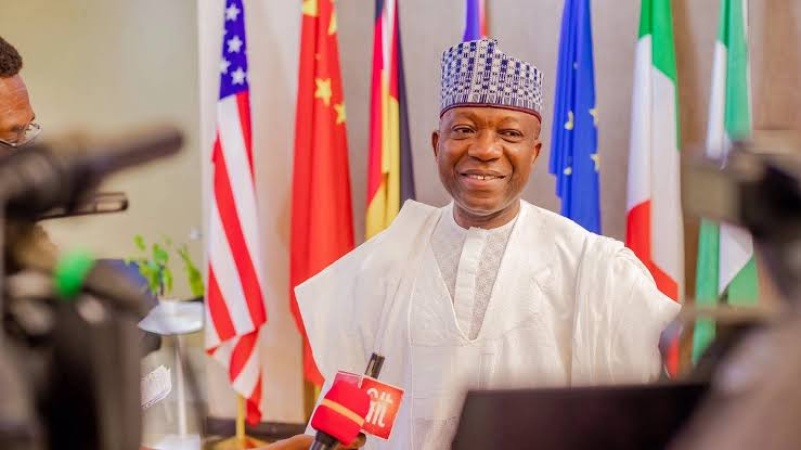
Reps Speaker, Abbas
Health of Mother Earth Foundation (HOMEF) and the GMO-Free Nigeria Alliance on Friday commended the House of Representatives on the resolution to comprehensively investigate the introduction of Genetically Modified Organisms (GMOs) into Nigeria It was learnt that the resolution seeks a halt on approval of new products pending the completion of that investigation.
This resolution followed the adoption of the motion by Rep. Muktar Shagaya at a plenary session on Thursday.
The group’s position Is contained in a press statement reacting to the resolution signed by Ms Kome Odhomor, HOMEF’s Media/Communication Lead.
They noted that the investigation which is long overdue isvitalto save the country from the dangerous path to food colonialism, contamination of genetic resources.
It will also check loss of biodiversity/nutritional diversity, soil degradation, and overall disruption of the nation’s agriculture and food systems.
“As the lawmaker rightly explained, the introduction of GMOs in Nigeria raises serious concerns about safety, regulatory oversight, and their potential impacts on the country’s biosafety,” HOMEF said.
The statement quoted Executive Director of HOMEF, Dr Nnimmo Bassey, as saying: “This investigation must be unbiased and thorough. To ensure this, the National Assembly should engage independent researchers to avoid contamination of the process by GMO promoters.
“This investigation should consider Nigeria’s agricultural landscape and investigate the underlying causes of hunger/food insecurity and as well establish definite measuresbto address those issues.
“This is the time to rescue Nigerians from being used for risky experimentations.”
The group noted that it is also key to critically examine the National Biosafety Management Agency Act for its fitness for purpose.
“That law needs to be completely reworked to close existing loopholes including the composition of its governing/decision making board by excluding GMO promoters such as the National Biotechnology Development Agency.
“The lack of provision on strict liability, inadequate public consultation measures, absolute decision-making powers of the agency, minimal reference to the precautionary principle and many others,” the statement reads in part.
On the directive by the Reps to National Agency for Food and Drug Administration and Control(NAFDAC) to ensure labelling of GM crops already in the country, the group noted that it was a herculean task. They said that the agency will need to devise strategies to have foods sold in local markets in basins, by the road sides, and in processed forms like Ogi and Akara labelled to ensure informed decision-making by the majority of people who purchase food from these sources.
“This exercise will prove that GMOs do not fit our socio-economic context. Over the years, market shelf surveys conducted by HOMEF has revealed over 50 different processed/packaged foods labelled as produced using genetically modified ingredients.
“The survey has also revealed the fact that majority of our people do not read labels,”
HOMEF advised that permits for commercialisation of the Bt Cowpea, Tela Maize, Bt Corn and all other GMOs be suspended pending the result of the investigation by the House Committee on Agriculture and others.
The statement reaffirmed the submission by Rep. Muktar Shagaya that the country needs to prioritise public health, biodiversity, increased support of small holder farmers in terms of extension service, provision of infrastructure to curtail waste.
The group advocated that peasant farmers need access to credits, access to land and the growth of the local economy.
They said that Nigeria should adopt agroecological farming which aligns well with the country’s socio economic and socio cultural context.
“Agroecology delivers increased productivity and economic resilience, revises/nourishes ecosystems.
“It strengthens local economies, mitigates climate change and promotes food sovereignty,” HOMEF stated.