ADAD
ADADUpdating your news feed...

NEWS EXPRESS is Nigeria’s leading online newspaper. Published by Africa’s international award-winning journalist, Mr. Isaac Umunna, NEWS EXPRESS is Nigeria’s first truly professional online daily newspaper. It is published from Lagos, Nigeria’s economic and media hub, and has a provision for occasional special print editions. Thanks to our vast network of sources and dedicated team of professional journalists and contributors spread across Nigeria and overseas, NEWS EXPRESS has become synonymous with newsbreaks and exclusive stories from around the world.





.webp)

.webp)
.webp)



.webp)

Loading banners
Loading banners...


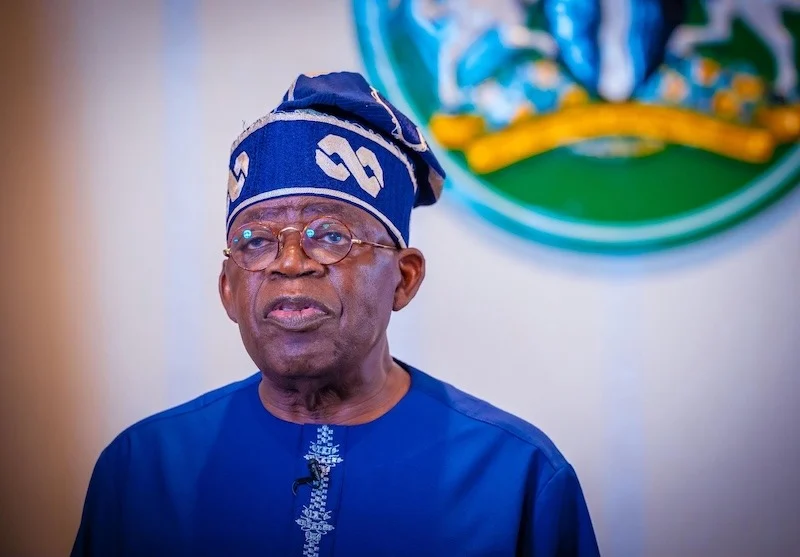
President Tinubu
Mixed reactions have continued to trail the missing of three major aviation agencies from the 2024 Appropriation Bill to the National Assembly by the Federal Government.
For the umpteenth time last week, the Nigerian Airspace Management Agency (NAMA), the Federal Airports Authority of Nigeria (FAAN) and the Nigeria Civil Aviation Agency (NCAA) were omitted from the appropriation bill by President Bola Tinubu when he presented it to the National Assembly despite the kick in some quarters in the past.
Industry experts had argued in the past that the resources earned by the agencies were only cost recoveries and not profits like other sectors of the economy.
Also, the International Civil Aviation Authority (ICAO) recommends that revenues earned in the industry by government agencies should be ploughed back into the system for upgrade of facilities and equipment, but the government had consistently ignored this.
Rather, a few years ago, the government went ahead to include some of the agencies in the Treasury Single Account (TSA) with the compulsory contributions of 15 percent of their revenues into the federation account.
On October 15, 2022, the Federal Government increased the contributions into the TSA to 40 percent, thereby further squeezing the agencies and their resources and preventing them from carrying out capital projects independently.
Mr. Chuwkudi Amokwu, aviation expert, said that the removal of the two out of the three agencies from annual budgets was not good for the system.
According to Amokwu, agencies like NAMA and NCAA could be included in the annual budgets, saying that whatever is generated by the two agencies are not profits, but cost recoveries.
He, however, said that FAAN could be exempted, describing it as a revenue generating agency in the industry.
For instance, Amokwu explained that NAMA embarks on capital projects and procurement of equipment like communication gadgets for its Air Traffic Controllers (ATCs), facilities for its engineers, training and retraining for staff, irrespective of departments, while it also ensures regular power supply to all its facilities at airports and stations across the country.
For NCAA, Amokwu explained that the apex regulatory agency was not a revenue generating agency, but earned recovery fee through the 5 percent from the Ticket Sales Charge (TSC) and Cargo Sales Charge (CSC), which it shares with other four agencies in the sector.
He emphasised that NCAA as the apex regulatory agency in the sector, ought to be above other agencies and companies, especially the airlines in a bid to effectively regulate their activities.
Amokwu argued that its technical personnel should be trained and retrained regularly in order to be on top of their games.
The aviation expert also argued that the aviation agencies should be removed from the 40 percent TSA contribution to the federation account.
He said: “I want to say that the removal of NAMA and NCAA from the annual budgets is not well-thought-out. I think it is due to ignorance. You can excuse FAAN from this because the agency generates revenue, but for others, theirs is not revenue, but recovery costs.
“We all know the cost of diesel today in the market when compared to early this year or even a year ago. The agency needs to power its equipment for 24 hours and we all know the epileptic power supply the country is battling with at the moment. NAMA still buys navigation equipment. The agency is not a cost recovery agency and doesn’t earn revenue. The government doesn’t also factor into it the replacement cost and in over a decade, I am not sure if NAMA had increased its charges to the clients.
“I think Mr. Festus Keyamo, the Minister of Aviation and Aerospace Development, should lobby the presidency on two things: inclusion of NAMA and NCAA in the annual budgets and removal of aviation agencies from 40 percent contributions to the TSA. This will be in compliance with the recommendations of ICAO.”
But Capt. Samuel Caulcrick, the former Rector, Nigerian College of Aviation Technology (NCAT), Zaria, said the removal of the agencies from appropriation bills was justifiable.
Caulcrick explained that the Civil Aviation Act, as amended, gives autonomy to the NCAA, while the 5 percent TSC/CSC funds the agency.
He also pointed out that NAMA gets 22 percent from the 5% TSC, while FAAN generates revenues from the airport charges; domestic and international airports.
Calucrick emphasised that apart from the NCAA, the government built up the infrastructure of both FAAN and NAMA and was still responsible for their upgrade.
He explained further that the TSA 40 percent deduction from the agencies’ accounts is after operational expenses, maintaining that the government position is that the two agencies (NAMA and FAAN) don’t fund their infrastructure, but only responsible for payments of salaries and wages, operational costs and others only.
He added: “What is lacking, like most public institutions in Nigeria, is not separating equity from efficiency. Equity is a social responsibility like the federal character policy, while efficiency is cutting operational costs while delivering world-class services.”
Olumide Ohunayo, the General Secretary, Aviation Safety Round Table Initiative (ASRTI), canvassed for the stoppage of the 40 percent TSA deduction from the agencies’ earnings.
He posited that it was necessary for the agencies to keep their earnings in line with the ICAO document in a bid to reinvest them into the aviation sector.
He, however, said that NAMA should be exempted from the appropriation bill, arguing that the industry was far from acquiring and installing critical equipment for the sector.
He explained that the government still needed to continue to support the agency to get to that navigation efficiency that the industry required, maintaining that it could be a win-win situation for all.
He added: “FAAN cannot continue to be an appendage of government whereby they appoint the day-to-day management and impose staff on them. In doing that, they might also need to get reputable international airport managers to come and reorganise FAAN to ensure that revenues coming in are properly channelled and used for the appropriate reasons and also deem the excessive leakages and reduce the staff strength and other things that are inhibiting FAAN from operating to maximum capacity.
“FAAN can survive without appropriation from the government because by the virtue of revenue strings coming in, it is easy for them to get facilities from organisations and these finance companies. Unfortunately, the process of accounting has made that impossible because it is not enough for people to say ‘yes, we want to invest and partner with you.’
“It is necessary for the government to stop interference in FAAN and also allow it to get independence and get a reputable management organisation to come and turnaround the system for it to be that revenue generating agency that will work in the mode of Airport Company of South Africa that will yield fund for the government and also invest in other neighbouring countries airports as an investor.”
Besides, Grp. Capt. John Ojikutu (rtd), the Chief executive Officer (CEO), Centurion Securities Limited, insisted that the Federal Government and the National Assembly were justified for leaving out some of the aviation agencies from the annual appropriation bills once the government compels them to send 40 percent of their revenues to the TSA account.
Ojikutu, however, declared that the government and the National Assembly ought to carry out investigation into the revenues of the affected three agencies to know if their revenues were sufficient enough for their annual activities before removing them from the appropriation bills.
He added: “However, not giving these agencies the annual appropriations will not have a negative impact, but we must know what the actual revenues of the other three are.” (Daily Independent)