
Updating your news feed...
NEWS EXPRESS is Nigeria’s leading online newspaper. Published by Africa’s international award-winning journalist, Mr. Isaac Umunna, NEWS EXPRESS is Nigeria’s first truly professional online daily newspaper. It is published from Lagos, Nigeria’s economic and media hub, and has a provision for occasional special print editions. Thanks to our vast network of sources and dedicated team of professional journalists and contributors spread across Nigeria and overseas, NEWS EXPRESS has become synonymous with newsbreaks and exclusive stories from around the world.




.webp)
.webp)

.webp)


Loading banners
Loading banners...


President Buhari
By TINA TIMOTHY
Foundation for Environmental Rights, Advocacy & Development (FENRAD) has expressed worry that Nigeria was far from ranking among countries with low incidences of corruption despite establishing two major anti-corruption agencies: the Independent Corrupt Practices and other related Offences Commission (ICPC) in 2000 and the Economic and Financial Crimes Commission (EFCC) in 2003.
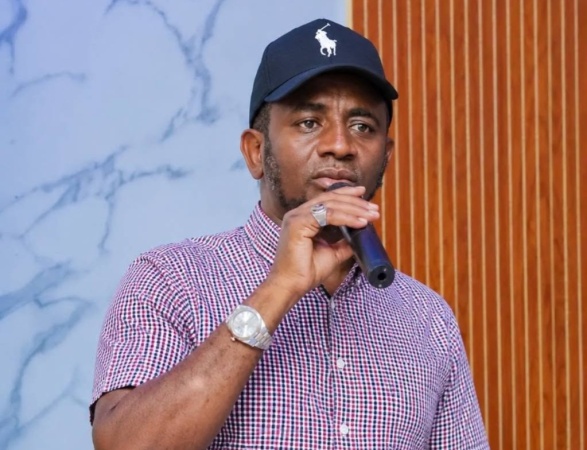
FENRAD’s Executive Director, Comrade Nelson Nnanna Nwafor, disclosed this in a statement on Friday December 9, 2022, to mark the 2022 International Anti-Corruption Day.
In the statement, FENRAD surveyed the anti-corruption trajectory of Nigeria since 1999, focusing more on the last seven years and suggested ways to tackle them.
The statement reads: “In 2003, the United Nations General Assembly (UNGA), through Resolution 58/4 adopted December 9 as International Anti-Corruption Day (IACD) making that day officially one of the United Nations observances. The essence was to help spotlight and amplify corruption among over 100 member states.
Today, the United Nations Convention against Corruption (UNCAC) has seven broad-based thematic focus areas of advocacy, ranging from Prevention, Criminalisation and Law Enforcement, then International Cooperation, to Asset Recovery and the like, through which nations today try to mainstream corrupt practices in public, private and international sectors; work together, collaborate and assist in repatriation of stolen funds and money launderers.
“Nigeria, upon 1999 return to democracy, established two major anti-corruption agencies - first, the Independent Corrupt Practices and other related Offences Commission, ICPC (2000), and later the Economic and Financial Crimes Commission, EFCC (2003). But it is alarming that Nigeria does not rank among countries with low incidences of corruption yet. This is sad, to say the least.
“Foundation for Environmental Rights Advocacy and Development, FENRAD a pro-democracy and environmental rights advocacy group, today surveys the anti-corruption trajectory of Nigeria since 1999, focusing more on the last seven years. In January, 2022, Civil Society Legislative Advocacy Centre (CISLAC), working with Transparency International, released a worrying country report on Nigeria wherein the nation placed 154th out of 180 countries, having scored a paltry 24 out of a total of 100. Based on this corruption perception index (CPI), the journey is still long for Nigeria, but a thing or two can be done and leveraged to change the story, FENRAD believes.
“Today's International Anti-Corruption Day slogan says "Uniting the World Against Corruption," a call on nations of the world to unite and fight corruption through collaborative efforts and efficiency. Nigeria too is not left out on this call. At the regional level, Nigeria is a signatory to AU's Convention on Fighting and Combating Corruption. Even in 2018, President Buhari was appointed AU’s Anti-Corruption Champion while recently Umar Yakubu, a Nigerian, was appointed to represent Africa at the UN Convention against Corruption, yet the war against corruption is far from won.
“One would have thought that at domestic level, Nigeria would have closed the gap, edged closer to countries perceived “clean” in the Transparency International corruption perception index, CPI. Sadly the nation is still ranked 154th, better only than 25 or 26 out of 180 countries. One of the three-pronged areas of President Buhari’s campaign in 2014/15 was “campaign against corruption”.
“Sadly, FENRAD regrets that under the same administration, issues like oil theft, subsidy scam, vote buying, budget padding, trading in influence and sundry corrupt practices bedevil Nigeria and Nigerians. Many are still asking what use the so-called “Abacha loot” has been put to. Both public sector and private sector corruption increased in an unheard-of scale in the last seven years.
“From ‘we are fighting corruption,’ Nigerians were told that ‘corruption is fighting back,’ and later that change begins with them. Lack of clear and articulate anti-corruption policy draws the nation back in her march towards ending corruption.”
FENRAD accused both the federal and state governments for the level of poverty in the country and called on state and no-state actors to be ready and willing to steer the country away from corruption, justice system to be empowered, appointment to sensitive positions to be based on merit, not on tribe, religion or region which characterised appointments in the last seven years, aspiring politicians to be committed to financial discipline and disclosure, detailing their assets, those belonging to their children below the age of 18 as stipulated in the 5th schedule of the 1999 constitution, amongst others.
“At sub-national level, nothing is different. Recently, President Buhari and his Minister of Finance (for state) accused governors of causing poverty among local dwellers, 70 per cent of who fell within the "63 per cent multi-dimensionally poor Nigerians!" The governors had countered the president, saying he was responsible for endemic poverty among the locals for failing to protect poor farmers, whose farms have been taken over by bandits.”
“The truth, FENRAD maintains, “is that both governments are guilty of what they accused each other. The sufferers are the poor masses. Many states are not signatory to Open Government Partnership Initiative. Financial disclosures are not made regarding public spending, attention is often focused on the centre while governors build mansions abroad and choose to proceed on sabbatical to the National Assembly - the senate, for the most part.
“FENRAD calls on state and non-state actors to exhibit a great deal of willpower to steer the country away from corruption. The weak justice system, must be empowered. Laws have to be created and where inadequate, elaborated to strengthen weak institutions. So should punishments for some crimes be reviewed. Appointment to sensitive positions should be based on merit, not on tribe, religion or region which characterised appointments in the last seven years. All intending and aspiring politicians must commit to financial discipline and disclosure, detailing their assets, those belonging to their children below the age of 18 as stipulated in the 5th schedule of the 1999 constitution. FENRAD calls for local government autonomy and for a review of the sharing formula in revenue where the federal government, being a single entity, takes over 52 per cent, the 36 states a little over 26 per cent and the local councils with 774 co-equal governments a little over 20 per cent.
“There must be a national value and programme that spearheads the crusade of anti-corruption. Else, all may be in vain. May all, FENRAD says, not be in vain, and may Nigeria join the rest of the world to fend off corruption,” he prayed.



