ADAD

Updating your news feed...
NEWS EXPRESS is Nigeria’s leading online newspaper. Published by Africa’s international award-winning journalist, Mr. Isaac Umunna, NEWS EXPRESS is Nigeria’s first truly professional online daily newspaper. It is published from Lagos, Nigeria’s economic and media hub, and has a provision for occasional special print editions. Thanks to our vast network of sources and dedicated team of professional journalists and contributors spread across Nigeria and overseas, NEWS EXPRESS has become synonymous with newsbreaks and exclusive stories from around the world.


















Loading banners
Loading banners...

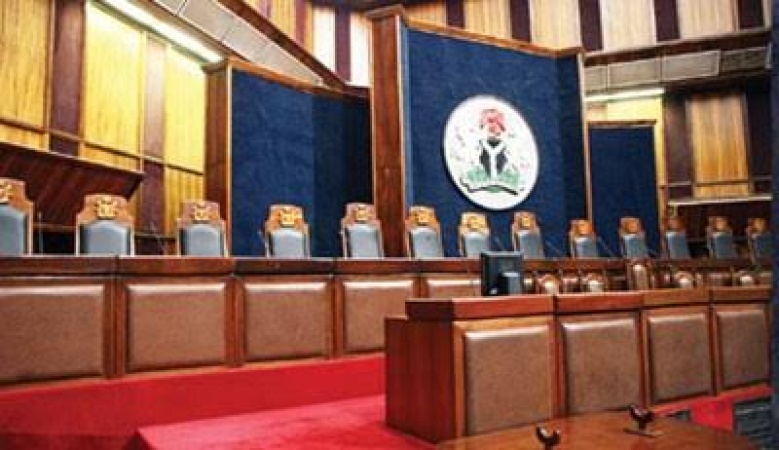
A court in Nigeria
The Independent National Electoral Commission (INEC) is facing mounting pressure over the 2027 general elections as successive court orders on party nominations continue to unsettle candidate lists less than 51 days to the polls.
While a former national commissioner, Prof. Lai Olurode, insists that the commission is bound by judicial decisions and party nominations, Ohanaeze Ndigbo chieftain, Chief Goddy Uwazurike, questions the credibility of the process and warns that the uncertainty could weaken voters’ confidence.
Judicial rulings, including orders directing INEC to recognise or remove candidates nominated by political parties, have continued to complicate preparations for the January 16 and February 5, 2027 general elections.
The development has left the electoral umpire and political parties uncertain about the final composition of the ballot, with fresh judicial pronouncements emerging as preparations for the elections gather momentum.
Section 31 of the Electoral Act 2026 provides a 90-day window for the statutory substitution of candidates nominated by political parties. Under the provision, a candidate’s withdrawal must be communicated to INEC within the stipulated period before the election.
Section 33, however, limits the circumstances in which political parties can substitute candidates to cases of death or voluntary withdrawal. In either situation, the affected party is required to conduct another primary election within 14 days of the occurrence.
October 18, 2026, was the relevant 90-day statutory deadline for the January 2027 election. However, court interventions have continued to emerge, complicating the finalisation of candidate lists.
On Tuesday, a Federal High Court in Warri, Delta State, nullified the nomination of former Deputy Senate President Ovie Omo-Agege as the Nigeria Democratic Congress (NDC) senatorial candidate for Delta Central Senatorial District.
Delivering judgment in suit No. FHC/WR/CS/120/2026, filed by Prof. Alexander Osondu Akpodiete, who challenged the validity of Omo-Agege’s nomination, Justice Hyeladzira Nganjiwa ordered INEC to immediately remove his name from its list of candidates for the election.
The court also restrained the former deputy Senate president from parading himself as the NDC senatorial candidate after the plaintiff argued that he had neither resigned his membership of the All Progressives Congress (APC) nor regularised his membership of the NDC to qualify for participation in the party’s senatorial primary.
The Warri judgment follows other judicial interventions involving senatorial candidates in Benue and Abia states.
On November 18, 2026, a Federal High Court in Abuja validated the nomination of former Benue State governor, Gabriel Suswam, as the APC senatorial candidate for Benue North-East Senatorial District, nullifying his substitution with incumbent Senator Emmanuel Udende.
Delivering judgment, Justice Inyang Ekwo upheld Suswam’s challenge to the party’s decision to replace him with Udende for the 2027 general election.
The judge affirmed that Suswam won the party’s primary election and declared his substitution unlawful and contrary to the Electoral Act and the 1999 Constitution, as amended.
It was learnt that, in a bid to dissuade the former governor from joining the opposition coalition, the APC national leadership had lured him into the ruling party with the promise of a senatorial ticket, despite offering incumbent senators automatic return tickets.
A day later, on November 19, 2026, another Federal High Court, presided over by Justice M. Umar, affirmed Erondu Uchenna Erondu Jnr as the substantive APC candidate for Abia South Senatorial District and nullified his substitution with Prince Paul Ikonne.
The court described the party’s decision to replace Erondu with Ikonne in the revised list submitted to INEC as a violation of the sanctity of party primary election outcomes.
Earlier, on July 20, the Federal High Court in Abuja, presided over by Justice Umar, dismissed a suit filed by Senator Ned Nwoko challenging the listing of Senator Ifeanyi Okowa as the valid APC candidate for Delta North Senatorial District. The court upheld the respondent’s argument that the suit was defective.
The succession of judgments has raised concerns among stakeholders about the implications of the disputes for INEC’s ability to conduct credible and hitch-free elections next year.
Olurode defends INEC’s position
A former National Commissioner of INEC, Prof. Lai Olurode, absolved the commission of complicity in the disputes over candidates’ identities, insisting that it is bound by nominations submitted by political parties and judicial decisions on contested candidacies.
He argued that INEC could not be held responsible for disputes arising from the internal nomination processes of political parties, explaining that the commission recognises political parties as the entities authorised to nominate candidates rather than individual aspirants seeking tickets.
According to him, the responsibility for submitting candidates’ names to INEC rests with political parties, while aspirants dissatisfied with their parties’ decisions have the right to seek judicial redress.
“Where a court determines that a candidate whose name was initially submitted to INEC is not the authentic nominee, but another aspirant is legally entitled to the ticket,” he noted, “the commission is obligated to comply with the ruling.”
Olurode maintained that INEC could neither substitute its judgment for that of the judiciary nor disregard a court pronouncement on the rightful candidate, stressing that the commission must operate within the law.
He said the judiciary remained the final arbiter in disputes over candidate authenticity, including determining whose name should appear on the ballot. He added that INEC could not assume the responsibility of resolving disagreements between political parties and their members.
The former commissioner, however, acknowledged that recurring nomination disputes and judicial interventions could complicate election preparations and potentially affect the commission’s ability to deliver credible polls.
He insisted that, despite the difficulties such disputes might create for the electoral timetable, INEC must respect the country’s laws and the principle of separation of powers, under which the legislature makes laws, the executive implements them and the judiciary adjudicates disputes.
Uwazurike questions credibility of court orders
Uwazurike, however, questioned the circumstances surrounding the recurring controversies, particularly the possibility of candidates being substituted or their identities altered less than 56 days to the elections.
He expressed concern that voters and political actors could be left uncertain about the candidates eventually appearing on the ballot, arguing that the opacity surrounding nomination disputes and the unpredictability of judicial pronouncements had further complicated the electoral process.
He also criticised INEC’s leadership, alleging that the commission was operating in a manner that raised questions about its credibility and public confidence.
According to him, rather than allowing controversies over candidacies to dominate the process, INEC should concentrate on preparations for the elections and demonstrate consistency in its conduct.
Uwazurike warned that uncertainty surrounding candidate disputes, alongside political violence, inconsistent party activities and disruptions to rallies, could deepen public distrust and further weaken democratic participation.
He expressed fears that Nigerians would ultimately bear the consequences of the political instability, accusing political actors of placing electoral victory above democratic principles, accountability and the country’s broader interests.
The opposing views underscore the tension between INEC’s legal obligation to comply with party nominations and court decisions and public expectations that the commission should provide certainty, transparency and confidence in the electoral process.
While Olurode insists that the commission cannot act outside the law or assume powers reserved for political parties and the judiciary, Uwazurike’s criticism raises questions about whether legal compliance alone is sufficient to reassure voters amid controversies capable of disrupting election preparations.
Party failures, late substitutions threaten electoral credibility
A former spokesman of the Pan Niger Delta Forum (PANDEF), Ken Robbison, said political parties bore much of the blame for the disputes that often lead to court-ordered changes on INEC’s candidate lists. According to him, many of the cases arose from irregular primaries, denial of aspirants’ participation, and breaches of party guidelines.
Robbison argued that INEC should not be blamed for replacing candidates’ names following court judgments. He said the commission was merely implementing judicial decisions triggered by parties’ failure to conduct credible and transparent primaries.
He, however, expressed concern that courts were still issuing judgments that displace candidates weeks before elections. Such late rulings, he said, force INEC to alter its lists and create uncertainty for parties, candidates and voters.
Robbison warned that more candidates could be affected as pending cases are decided, with some parties possibly entering elections without candidates in certain constituencies. He described the situation as evidence of politicians seeking shortcuts rather than following laid-down procedures.
He urged parties to learn from the experience and comply strictly with the Electoral Act and their internal rules in future elections. According to him, politics should not be reduced to the pursuit of public office, but should produce legitimate leaders capable of serving their constituents.
Timing of substitutions and party compliance
Lawyer Ige Asemudara, however, faulted INEC for substituting candidates’ names on its list months before a general election. He said the practice undermines electoral fairness and denies voters adequate time to assess those seeking their votes.
Asemudara acknowledged that substitutions arising from court decisions may be legally permissible. But he argued that repeated changes, especially close to election day, create confusion and weaken public confidence in the process.
He said voters need sufficient time to interact with candidates, scrutinise their credentials and make informed choices. Late substitutions, he added, destabilise political parties and deny newly listed candidates a level playing field.
Asemudara also criticised situations where a candidate is replaced following one court order, only for a higher court or another proceeding to trigger another substitution. He described such back-and-forth changes as untidy and damaging to electoral administration.
While electoral disputes should be allowed to run their full course through the courts, including the Supreme Court, he said INEC should ensure that consequential changes to its lists do not disrupt fairness, stability and meaningful voter participation.
Former INEC Resident Electoral Commissioner in Lagos, Dr Adekunle Ogunmola, and Chairman of the Northern Christian Association, Rev. Joseph Hayab, both faulted political parties for blaming the commission over candidate substitutions arising from court orders.
They said the disputes largely result from parties’ failure to comply with their constitutions and electoral laws.
Ogunmola said it was unacceptable for parties to shift responsibility for candidate substitutions to INEC. According to him, parties should take responsibility for breaches of the rules governing their primaries and nomination processes.
He also dismissed claims that the ruling government was using INEC or the judiciary to intimidate opposition parties. He said such allegations were misplaced when party stakeholders failed to comply with internal regulations and electoral laws.
“Political parties cannot disregard laid-down procedures for selecting candidates and turn around to accuse the electoral commission of bias when disputes arising from such violations are resolved through the courts,” he said.
Hayab similarly urged parties to abide by their constitutions and established procedures. He said Nigerians should not be misled into believing that INEC acted arbitrarily when it substituted candidates in compliance with judicial directives.
He explained that where courts ruled that a candidate was unlawfully nominated or did not emerge through a legitimate process, INEC was obliged to give effect to the decision in line with the law.
Hayab cautioned against accusing INEC of political vendetta or bias merely because candidates were removed. He said such claims must be supported by credible evidence, not sentiments or dissatisfaction with court outcomes.
He added that aspirants who believed they were unfairly denied tickets, or that rival candidates emerged irregularly, could seek redress in court. Those whose nominations were challenged, he said, should also be prepared to defend the processes through which they secured their tickets.
However, Hayab said allegations of judicial manipulation should not be ignored where evidence existed, as any compromise of court proceedings would raise a separate concern.
They maintained that responsibility for credible candidate selection rested primarily with political parties, not INEC, which merely enforces court decisions arising from disputed nominations. INEC has also stated that candidate nomination is the exclusive responsibility of political parties and that it has no legal authority to select, insert or substitute a candidate for any party. (The Guardian)