ADAD

Updating your news feed...
NEWS EXPRESS is Nigeria’s leading online newspaper. Published by Africa’s international award-winning journalist, Mr. Isaac Umunna, NEWS EXPRESS is Nigeria’s first truly professional online daily newspaper. It is published from Lagos, Nigeria’s economic and media hub, and has a provision for occasional special print editions. Thanks to our vast network of sources and dedicated team of professional journalists and contributors spread across Nigeria and overseas, NEWS EXPRESS has become synonymous with newsbreaks and exclusive stories from around the world.

.webp)




















Loading banners
Loading banners...

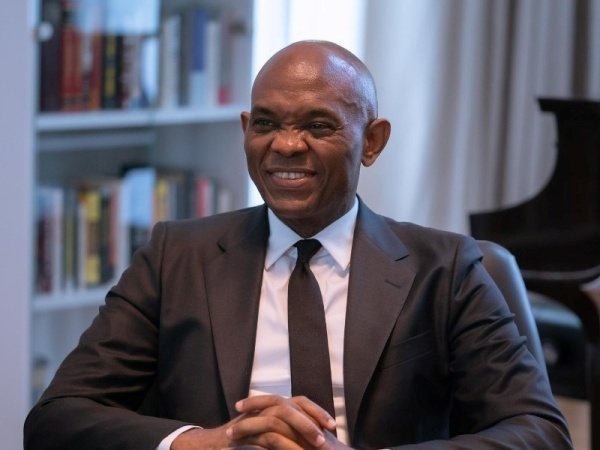
Group Chairman of Heirs Holdings and Transcorp Group, Tony Elumelu
By BONIFACE AKARAH
Businessman and investor Tony Elumelu has urged President Bola Ahmed Tinubu to sustain his administration’s economic reforms while prioritising an efficient and timely justice system to strengthen investor confidence and drive private sector growth.
Elumelu, who spoke on Thursday at the WOC Justice Summit in Abuja, said the rule of law was fundamental to attracting and retaining capital, stressing that investors needed certainty that contracts, regulations and judicial decisions would be respected.
Delivering the keynote address titled “The Rule of Law as a Catalyst for Private Sector Growth and Economic Transformation”, Elumelu said an entrepreneur’s confidence in the economy depended on three basic assurances: that contracts would remain binding, that the same rules would apply to competitors and that government changes would not undermine existing agreements.
“Each of these is a precondition for capital. Where any of them is in doubt, capital doesn’t argue. It leaves,” he said.
The Group Chairman of Heirs Holdings and Transcorp Group said capital would go to jurisdictions where it was safe and respected, adding that fair, impartial and timely court judgments were among the first conditions investors considered.
“I have said it in New York, London, Paris and I’ll say it in Abuja: capital goes where it’s safe and stays where it’s respected,” he said.
Elumelu said his own investments in banking, power, oil and gas had involved judgments not only about the Nigerian economy but also about the ability of Nigerian courts to protect investments.
“When my colleagues and I bought a struggling bank in 1997, the transaction rested on the belief that Nigerian law would protect a Nigerian buyer,” he said.
“When we invested in Transcorp, in power, in oil and gas, each time we were making a judgement call on the Nigerian courts as well as on the Nigerian economy.”
He said the next generation of Nigerian entrepreneurs should be able to make similar investment decisions with confidence, insisting that justice must become “routine, not heroic” and should not be delayed.
Turning to Tinubu, Elumelu said the administration inherited an economy facing serious challenges, including fuel subsidy costs, multiple exchange rates and a tax system he said penalised compliant businesses.
He commended the President for removing the fuel subsidy, unifying the exchange rate and signing tax reform laws, describing the decisions as “brave” despite the opposition and hardship associated with them.
“I know the cost has been borne by ordinary Nigerians, and I know you know it too. But I also know, as an entrepreneur, that an economy cannot be rebuilt on a foundation of unreality, and you ended that unreality,” he said.
According to Elumelu, the reforms also had a connection with the rule of law because transparent and predictable economic policies were essential for investment and growth.
He said subsidies allocated by discretion, exchange rates allocated without transparency and taxes collected through negotiation were inimical to the rule of law and economic growth.
Elumelu, however, said the reform process remained incomplete because delays in the justice system continued to affect the private sector.
“But justice is still being delayed. Justice is still being denied,” he said.
He called for the use of technology and the expertise of the legal profession to improve case management and settlement, suggesting the setting of key performance indicators for the justice system.
“Let us set KPIs for case management and settlement. We can be effective and efficient,” he said.
Elumelu also urged Tinubu to maintain his reform drive, saying investor confidence was growing and capital was flowing into the country.
“Your Excellency, the private sector’s ask of you is now simple. Continue the boldness. A positive track record is being created, investor confidence is growing, capital is flowing – a giant is awakening,” he said.
He also urged the administration to maintain its focus on the power sector, describing a transparent and investable electricity industry as essential to powering homes, factories, hospitals, schools and universities.
Elumelu delivered the address at the summit organised to honour Chief Wole Olanipekun, SAN, CFR, who turned 75 and marked 50 years of legal practice.
Paying tribute to Olanipekun, Elumelu described him as “the rule of law in human form”, recalling his service as Attorney-General of the old Ondo State, President of the Nigerian Bar Association and Chairman of the Body of Benchers.
He also noted that Olanipekun had served as lead counsel to four successive Nigerian presidents whose mandates were challenged in court.
Elumelu said the six volumes of cases being unveiled in honour of the senior lawyer could also be viewed as a history of Nigeria’s legal and political development.
“I would humbly suggest a second title: Nigeria Through the Cases,” he said.
He concluded by stressing the link between the rule of law and economic prosperity, saying Africa could not achieve sustainable development through dependence on foreign capital and raw materials alone.
“Africa will not be Europe’s raw-material diversification strategy. We will be an equal partner and a creator of value,” he said.
“That’s Africapitalism: the private sector leading Africa’s development. A philosophy I espouse and practice.”
Elumelu said private enterprise could not deliver that transformation without a functioning legal system.
“No private sector can do it alone. It can only do it under the law. Justice and prosperity are inseparable,” he said.