ADAD

Updating your news feed...
NEWS EXPRESS is Nigeria’s leading online newspaper. Published by Africa’s international award-winning journalist, Mr. Isaac Umunna, NEWS EXPRESS is Nigeria’s first truly professional online daily newspaper. It is published from Lagos, Nigeria’s economic and media hub, and has a provision for occasional special print editions. Thanks to our vast network of sources and dedicated team of professional journalists and contributors spread across Nigeria and overseas, NEWS EXPRESS has become synonymous with newsbreaks and exclusive stories from around the world.
.webp)
.webp)







Loading banners
Loading banners...

Underrated when handed the Flamingos job, but the tactician eventually silenced doubters by leading Nigeria to its first FIFA U17 Women’s World Cup title, proving that his coaching ability was far greater than the perception surrounding his appointment.
Contents
When Akeem Ishola Busari was appointed as head coach of Nigeria’s U17 women’s national team, the Flamingos, in April 2026, not many anticipated that he would lead the country to the summit of world football within months.
His appointment did not generate the kind of widespread excitement usually associated with a national team coaching position. Rather, it came with questions, reservations and an undercurrent of doubt about whether he possessed the experience and pedigree to handle a team competing at the highest level of youth football.
Some of the reservations were linked to his recent involvement with Pacesetter Queens, whose performance in the domestic league had failed to meet expectations. But those who judged Busari largely through the club’s position on the league table may have overlooked the circumstances he inherited.
The problems confronting Pacesetter Queens were not simply a reflection of the coach’s technical capacity. The club had been affected by structural weaknesses, including a poor organisational set-up and recruitment decisions made before Busari’s arrival.
He inherited a side whose challenges had already been shaped by decisions and deficiencies beyond his immediate control.
It was against this background that his appointment to lead the Flamingos was received with reservations. Yet, rather than allow the doubts surrounding his selection to define his tenure, Busari turned the opportunity into a platform for an extraordinary statement of coaching ability.
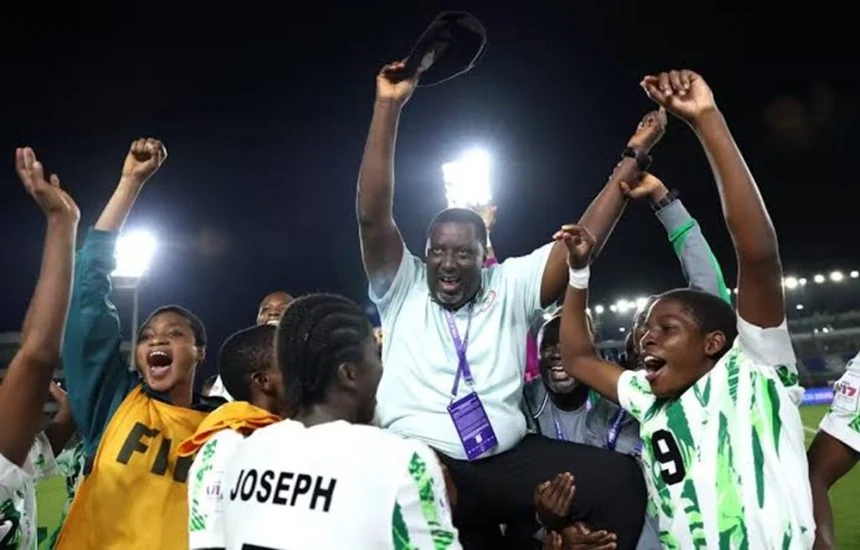
On November 7, 2026, Nigeria defeated Japan 2-1 in the final of the FIFA U17 Women’s World Cup in Morocco to emerge champions of the world. It was Nigeria’s first title in the competition and a historic breakthrough for African women’s football, as the Flamingos became the first African women’s national team to win a FIFA World Cup title.
For Busari, the triumph was more than a trophy. It was a compelling answer to those who had questioned his suitability for the job. The coach who had arrived without overwhelming public confidence had delivered an achievement that placed Nigeria firmly in the history books.
Busari’s rise to the global stage was not an overnight success. His journey through Nigerian football was built on years of coaching, continuous learning and experience across different levels of the game.
His interest in football development dates back to the early 1990s with his involvement in grassroots football.
Rather than limit himself to the excitement of the touchline, he pursued formal education and professional coaching qualifications, recognising that modern football demands more than passion and familiarity with the game.
He studied Physical and Health Education at the Lead City University, Ibadan, graduating in 2012. His academic background provided a foundation for understanding physical conditioning, player development and the scientific aspects of sports performance.
He also imbibed the culture of sustained commitment to improving his knowledge, having bagged the National Institute for Sports (NIS) coaching certificates, alongside the United States Soccer Federation Grade D, CAF B and CAF A coaching licences.
Busari also undertook the NFF-CAF Coaches Instructor course in 2021 and was selected among participants for the CAF Coaches Educators programme in 2025. These experiences underline his interest not only in coaching players but also in the broader development of coaching standards.
For Busari, the journey has been one of steady progression, with each assignment providing an opportunity to acquire fresh knowledge and understand the different demands of football.
His coaching career took him through several Nigerian clubs, where he gained experience in team management, player development and the pressures of competitive football.
His association with Shooting Stars Sports Club of Ibadan, one of Nigeria’s historic football institutions, formed an important part of his professional development. He worked within the club’s technical structure, including involvement as an assistant coach and in other coaching responsibilities.
The experience exposed him to the demands of managing a club with a rich history and a passionate following. It also provided an opportunity to work with established players and young talents in a competitive environment.
Busari later served as Technical Adviser of Crown FC, Ogbomoso, during the 2014–2015 period. His involvement with the club added another dimension to his coaching experience, particularly in the challenges of building a competitive team outside the traditional centres of Nigerian football.
Crown FC provided him with the opportunity to work within the Nigeria National League (NNL), environment and understand the realities of developing a club with limited resources while maintaining competitive ambitions.
His career also included involvement with the Nigeria national youth football structure, including the Golden Eaglets, where he served in a technical assistant capacity. Such experiences broadened his understanding of youth football and the responsibilities involved in preparing young players for international competition.
The importance of these assignments would become clearer years later when he was entrusted with the responsibility of managing the Flamingos.
Another significant chapter in Busari’s career was his appointment as head coach of Gateway United in 2017.
The assignment placed him in charge of a club with ambitions of returning to prominence in Nigerian football. During his involvement with Gateway United, the team enjoyed notable moments in domestic competitions, including its success in the Ogun State FA Cup and participation in the national Federation Cup.
The experience strengthened his exposure to the demands of senior club football, where coaches must balance results, squad management, player development and the expectations of supporters and administrators.
Busari also expanded his professional experience beyond Nigeria, with reported coaching engagements involving clubs in the Benin Republic, including JSP and Espoir.
Working in a different football environment offered him an opportunity to encounter new approaches to team preparation, tactical organisation and player management. His career profile also includes technical involvement with Nigerian clubs such as Enyimba and Rivers United.
These experiences contributed to a coaching journey that was not confined to one club, one competition or one category of football. They exposed him to different players, football cultures and competitive demands.
Although Busari had accumulated considerable experience in men’s football, his subsequent involvement in the women’s game became a defining part of his coaching journey.
His association with Bayelsa Queens brought him closer to the structure and demands of women’s football. The club is one of Nigeria’s leading women’s football sides, with a strong domestic pedigree and continental ambitions.
He also had involvement with Pacesetter Queens, where he was appointed Technical Adviser ahead of the 2025/26 season.
However, his time at the club came against the background of institutional and organisational challenges. Pacesetter Queens’ difficulties could not be separated from the state of its structure and recruitment before his appointment. The club’s struggles were therefore not a fair measure of his coaching competence, particularly when he had inherited a situation that required more than technical adjustments on the pitch.
The distinction is important because football performance is influenced by several factors, including recruitment, administration, preparation, resources and the quality of the playing personnel available to a coach.
Busari’s subsequent achievement with the Flamingoes demonstrated why a coach’s ability should not be judged solely by the position of a club whose problems predate his arrival.
On April 2, 2026, the Nigeria Football Federation (NFF), appointed Busari as head coach of the Flamingos, handing him the responsibility of preparing the national U17 women’s team for the FIFA U17 Women’s World Cup qualification campaign.
It was a major opportunity, but also a demanding assignment. Youth international football is particularly challenging because coaches have limited time to identify, assemble and prepare players capable of competing against the best teams in the world.
Busari had to build a competitive squad, establish a playing philosophy, develop team understanding and prepare the players mentally and physically for the demands of a global tournament.
One of the most revealing aspects of his coaching philosophy was his emphasis on character, mindset, attitude and merit in selecting players. In an interview with FIFA following Nigeria’s triumph, he spoke about the importance of these qualities in building a successful team.
His approach suggested that talent alone was not enough. Young players also needed discipline, commitment, the right mentality and the willingness to work for the collective interest of the team.
The Flamingos responded with performances that reflected organisation, confidence and a strong sense of purpose. As the competition progressed, the team demonstrated that it could compete with established football nations and handle the pressure of the tournament.
The climax came on November 7, 2026 for Busari, when he led Nigeria to face Japan in the final of the FIFA U17 Women’s World Cup in Morocco.
The qualification of the Flamingos for the final was an achievement in the career of Busari alone, as Nigeria became the first African nation to achieve that feat.
Japan, renowned for its technical discipline and organised approach to the game, presented a formidable challenge. But the Flamingos rose to the occasion to secure a 2-1 victory and become the world champions.
By winning the trophy, the Flamingos ended the long wait by Africa for the cadet women’s U17 trophy, and also delivered a landmark achievement for Nigerian football.
Busari too became the sixth Nigerian coach to lift the World Cup trophy after the late Sebastian Broderick-Imasuen (1985), Fanny Ikhayere Amun (1993), the late Yemi Tella (2007), Manu Garba (2013) and Emmanuel Amuneke (2015).
Given the controversy which greeted his appointment, especially among his colleagues, Busari did not merely prove his critics wrong; he also added a new chapter to Nigerian and African football history. (Tribune)