ADAD

Updating your news feed...
NEWS EXPRESS is Nigeria’s leading online newspaper. Published by Africa’s international award-winning journalist, Mr. Isaac Umunna, NEWS EXPRESS is Nigeria’s first truly professional online daily newspaper. It is published from Lagos, Nigeria’s economic and media hub, and has a provision for occasional special print editions. Thanks to our vast network of sources and dedicated team of professional journalists and contributors spread across Nigeria and overseas, NEWS EXPRESS has become synonymous with newsbreaks and exclusive stories from around the world.














.webp)



.webp)

.webp)




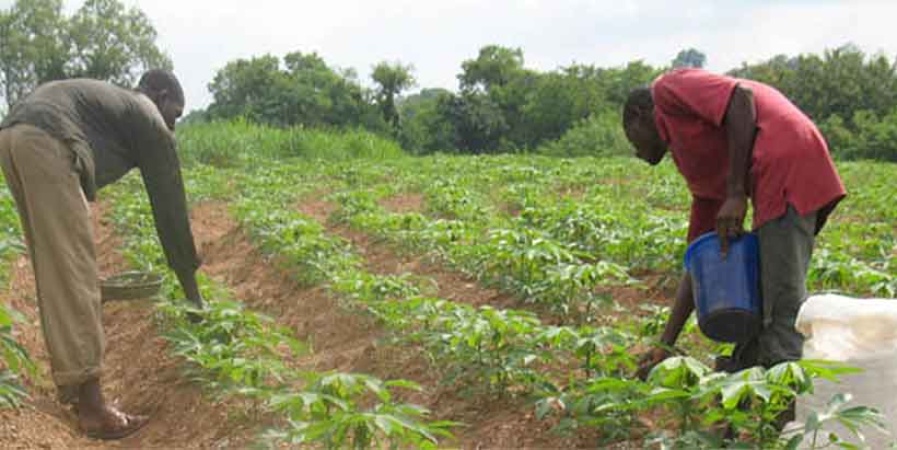
Farmers applying fertilizer in their farms
Nigeria’s quest for food security may continue to suffer setbacks unless farmers move away from indiscriminate fertiliser application and embrace soil testing and crop-specific nutrient management, agricultural experts have warned.
The experts, who spoke at the 2026 South-West Nigeria Fertiliser and Soil Health Summit in Ibadan, Oyo State, cautioned that increasing fertiliser consumption without understanding the specific nutrient requirements of farmland could undermine agricultural productivity, weaken farmers’ incomes and worsen soil degradation.
They argued that the country’s approach to fertiliser management must go beyond distributing inputs to farmers and focus on ensuring that the right fertiliser is applied to the right soil, for the right crop and at the appropriate time.
The position formed a major highlight of the communiqué issued at the end of the summit, organised by the Institute of Agricultural Research and Training (IAR&T), Obafemi Awolowo University, Moor Plantation, Ibadan, on Tuesday.
With the theme, “Fertilisers and Food Security in South-West Nigeria: The Journey So Far,” the summit brought together more than 150 scientists, farmers, policymakers, fertiliser manufacturers and distributors, agricultural extension professionals and development partners to examine the challenges confronting fertiliser utilisation and soil health in the region.
The participants expressed concern that the continued reliance on blanket fertiliser recommendations failed to address significant differences in soil fertility, acidity, phosphorus fixation, nutrient depletion and other soil-related challenges across different agroecological zones.
According to the communiqué, “The predominance of blanket fertiliser recommendations does not adequately address the variations in soil fertility, soil acidity, phosphorus fixation, nutrient depletion and other soil constraints across different agroecological zones in the region.”
The experts maintained that fertiliser recommendations should increasingly be based on soil testing, crop requirements, prevailing agroecological conditions and economically viable nutrient management practices.
They also identified high fertiliser prices, inadequate distribution networks, limited access to credit and inconsistent availability as major constraints preventing smallholder farmers from accessing and effectively utilising the agricultural input.
The summit further warned that declining soil organic matter, nutrient imbalance, erosion and other forms of soil degradation continued to undermine fertiliser-use efficiency and agricultural productivity.
To address the situation, it called on research institutions to strengthen soil fertility mapping and develop crop-, soil- and location-specific fertiliser recommendations for major crops cultivated across South-West Nigeria.
It also urged governments and relevant agricultural institutions to facilitate affordable and accessible soil testing services to enable farmers to understand the condition of their farmland before applying fertilisers.
The participants advocated integrated soil fertility management, involving the combination of mineral fertilisers with organic resources, crop residues, compost, animal manure and biological inputs, as a more sustainable approach to improving soil health and agricultural productivity.
The summit also called for stronger collaboration between fertiliser manufacturers and research institutions to develop formulations capable of addressing specific soil deficiencies, including phosphorus fixation and shortages of secondary and micronutrients.
On the impact of climate change, the experts noted that irregular rainfall patterns and increasing incidences of drought required farmers to adopt climate-smart fertiliser management strategies.
They recommended that fertiliser application guidelines should take rainfall variability, planting dates, crop water requirements and appropriate application methods into consideration.
The communiqué also raised concerns over the circulation of adulterated and substandard fertiliser products, calling on regulatory institutions to intensify inspections, product certification, market surveillance and enforcement of existing standards.
It further recommended greater investment in digital soil maps, fertiliser recommendation platforms, mobile advisory services and precision nutrient management technologies to improve fertiliser distribution, application and monitoring.
The summit stressed that sustainable fertiliser management should not be measured solely by increased crop yields but should also take account of environmental protection, farmers’ economic returns and the long-term preservation of soil health.
It called for a coordinated monitoring framework to assess the impact of fertiliser interventions on crop productivity, farmers’ income, fertiliser-use efficiency and soil health.
The summit acknowledged previous interventions by regional governments, research institutions and development partners to strengthen fertiliser and soil health systems but maintained that significant gaps remained in ensuring that fertilisers were affordable, accessible, appropriate, balanced and efficiently utilised.
It warned that increased fertiliser use alone could not guarantee food security, insisting that sustainable agricultural production required sound soil health management, scientifically informed recommendations, effective extension services, quality assurance and supportive government policies.
Earlier in his address, the chairman of the occasion and the Vice-Chancellor of Obafemi Awolowo University, Ile-Ife, Prof. Simeon Bamire, who was represented by the Dean of the Faculty of Agriculture, Prof. A.O. Ajayi, emphasised the need to redirect attention from fertiliser distribution to fertiliser-use efficiency, describing it as a critical pathway to achieving food security.
In his remarks, the Director of IAR&T, Prof. Gabriel Oluwatosin, noted that one of the key resolutions reached at the summit was the need to organise zonal fertiliser summits across the country, adding that without proper soil health management and fertilizer use, as the population is growing, farmers would not be able to secure their food security. (Vanguard)