ADAD

Updating your news feed...
NEWS EXPRESS is Nigeria’s leading online newspaper. Published by Africa’s international award-winning journalist, Mr. Isaac Umunna, NEWS EXPRESS is Nigeria’s first truly professional online daily newspaper. It is published from Lagos, Nigeria’s economic and media hub, and has a provision for occasional special print editions. Thanks to our vast network of sources and dedicated team of professional journalists and contributors spread across Nigeria and overseas, NEWS EXPRESS has become synonymous with newsbreaks and exclusive stories from around the world.



















Loading banners
Loading banners...

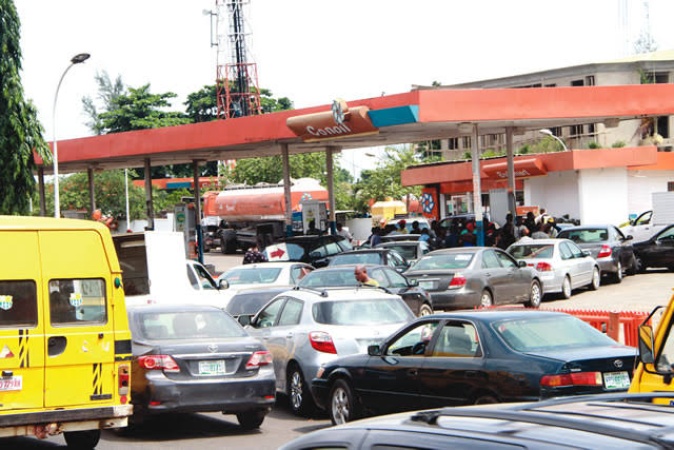
Motorists queuing up tin a fueling station
By ADEOLA AKINBOBOLA
Motorists and other stakeholders in the Federal Capital Territory (FCT) have expressed concern that they are yet to feel impact of the ₦35 reduction in the Dangote Refinery’s gantry price.
The News Agency of Nigeria (NAN) reports that the reduction by Dangote refinery was due to the decline in crude oil prices globally.
Dangote Refinery had cut its petrol gantry price to N1, 215 per liter of petrol from N1, 250 per liter, raising hopes of cheaper fuel for Nigerians.
The stakeholders said amid a decline in crude oil prices, they expected a relief from the high cost of petrol.
The global crude oil prices had fallen near or below the 90 dollars-per-barrel mark driven largely by easing geo-political tensions between the U.S. and Iran.
The development has continued to generate concerns among stakeholders, who had called on oil marketers to reflect the reduction in their retail prices.
Checks by NAN on Monday showed that petrol prices at various filling stations still ranged between N1, 385 per litre and N1, 420 per litre.
NAN observed that Salbas retail outlet currently sold at N1, 410, Rainoil retail outlet sold at N1, 410 and Empire Energies retail outlet sold at N1, 4200.
Also, MRS retail outlet sold at N1, 385, NNPC retail outlet sold at N1, 325, AY Shafa retail outlet sold at N1,399 and NIPCO retail outlet sold at N1,380.
Mr Owei Lakemfa, the former Secretary-General of the Organisation of African Trade Union Unity (OATUU), said reductions in petrol prices rarely translated into reductions in transportation fares and other consumer costs.
Lakemfa said that Nigerians most often times do not experience meaningful relief because transport operators and other service providers were often slow to adjust their charges.
He said that government must protect Nigerians from unpredictable pricing practices by oil companies and major industry players.
According to him, proper planning and the availability of strategic petroleum reserves can help cushion the impact of supply disruptions.
Lakemfa said that Nigeria lacked a long-term economic planning and poor implementation of development policies has worsened the situation.
“Such developments suggest underlying problems within the petroleum market and government should prioritise the interests of Nigerians over those of oil companies, industry players and market forces,” he said.
He said the absence of an efficient mass transit system was also a major contributor to the country’s economic challenges.
He noted that developed economies invested in reliable public transportation systems, including underground trains and railway networks to reduce the burden of transportation costs on citizens.
“Businesses cannot plan effectively in an environment characterise by uncertainty and inconsistent policies.
“Nigeria’s recurring fuel and economic challenges reflect a broader leadership problem.
“The government should adopt long-term strategies that prioritise citizens’ welfare, energy security, affordable transportation and economic stability,” he said.
A Public Affairs analyst, Mr Jide Ojo urged Nigerians to look beyond government policies and hold independent petroleum marketers accountable for failing to reflect reductions in depot prices in their retail pump prices.
Ojo expressed concern that while increases in petroleum prices were immediately passed on to consumers, reductions often take longer to reflect at filling stations.
He said these had allowed some marketers to maximise profits at the expense of ordinary Nigerians.
Ojo noted that government policies and prevailing global economic conditions played significant roles in determining fuel prices.
He said some Nigerian business operators contributed to the hardship through excessive profit-making and sharp business practices.
He expressed hope that diplomatic efforts would resolve the tensions, particularly the concerns surrounding the Strait of Hormuz, a critical global crude oil transportation route.
According to him, resolving the crisis can help stabilise international crude oil prices and potentially bring petroleum prices closer to the levels recorded.
“We also appeal to independent petroleum marketers to reflect reductions in depot prices, particularly those announced by the Dangote Refinery in their retail pump prices.
“We urge regulatory authorities to intensify monitoring and enforcement to ensure compliance with approve pricing practices,” he said.
Dr Aliyu Ilias, an economist and public affairs analyst called on the Federal Government to introduce measures to stabilise petrol prices in Nigeria, including a possible production based fuel subsidy.
Ilias said that unpredictable fuel costs were creating uncertainty for businesses and consumers.
According to him, energy security remains fundamental to economic development, and the energy sector is the engine room of the economy.
He said no company, organisation or country could achieve sustainable development without a reliable and predictable energy supply.
Ilias said that frequent changes in petrol prices made economic forecasting difficult, adding that businesses cannot plan their operations when they were uncertain about what fuel prices would be in the coming months or year.
He urged the Federal Government to consider a subsidy mechanism tied to production to promote price stability and restore confidence among businesses and consumers.
“The uncertainty over transportation costs reflects the wider challenges facing Nigerians and businesses across the country,” he said.
He called for stronger regulatory oversight by the Nigerian Midstream and Downstream Petroleum Regulatory Authority (NMDPRA), particularly in monitoring the activities of filling stations.
Illias said that filling stations often increased pump prices immediately when the cost of a new fuel supply rises but were slower to reduce prices when the cost of supply falls.
He urged the regulatory authorities to ensure that filling stations adjusted their prices fairly and promptly in response to changes in supply costs.
Ilias also urged the Federal Government to act urgently to address the situation, noting that predictable energy prices were essential for economic stability, business confidence and sustainable national development.
A motorist who resides at Jikwoyi, Mr Ishiaku Baba expressed hope that the latest reduction in the refinery’s gantry price would translate into lower pump prices.
Baba said the reduction should result in a significant decrease in petrol prices at filling stations.
He expressed concern over the continued impact of high fuel costs on transportation, household expenses and businesses.
Mrs Benita Akwu, a motorist who resides at Bwari, urged marketers to significantly reduce petrol prices so that it could reflect on cost of transportation and other essential expenses.
Akwu said that lower petrol prices would help ease the financial burden on Nigerians.
Another motorist at Dutse, Mr Thompson Abraham, urged marketers to reflect the recent reduction in their pump prices.
Abraham said a reduction in petrol prices would provide relief to road users and other Nigerians.
He said that lower petrol prices would also help reduce transportation costs, particularly for commercial operators who depended heavily on fuel.
Another motorist who resides at Gwarinpa, Mr Julius Uzor, urged marketers to ensure that reductions in their procurement and operating costs were passed on to consumers.
Uzor also called on relevant stakeholders to ensure that consumers benefited from favourable market conditions.
Mr Chinedu Ukadike, the National Publicity Secretary of the Independent Petroleum Marketers Association of Nigeria (IPMAN), told NAN that the adjustment would depend on when marketers received new supplies at the revise rates.
Ukadike said refineries and marketers would need to review their pricing arrangements and remittances based on the new supply costs. (NAN)