ADAD

Updating your news feed...
NEWS EXPRESS is Nigeria’s leading online newspaper. Published by Africa’s international award-winning journalist, Mr. Isaac Umunna, NEWS EXPRESS is Nigeria’s first truly professional online daily newspaper. It is published from Lagos, Nigeria’s economic and media hub, and has a provision for occasional special print editions. Thanks to our vast network of sources and dedicated team of professional journalists and contributors spread across Nigeria and overseas, NEWS EXPRESS has become synonymous with newsbreaks and exclusive stories from around the world.

.webp)
.webp)
.webp)
Loading banners
Loading banners...

By OUMAROU SANOU
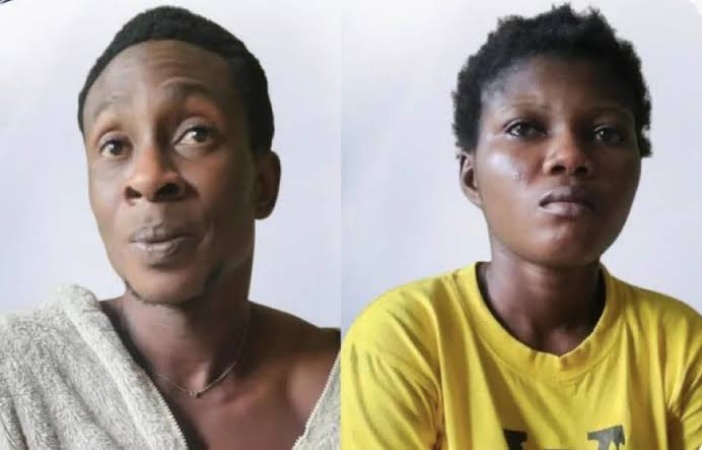
"Forgive your son." Those were the words Balogun Ridwan Adisa chose for President Bola Tinubu when the Ukrainian outlet UNITED24 Media interviewed him while he was in captivity earlier this year. He is 32. He says he left Nigeria to feed his family and find work as a mechanic or engineer. He ended up in a Russian uniform near Lyman, in Ukraine's Donetsk region, and surrendered to Ukrainian troops on 13 January 2026.
By then, Nigeria had already counted him among the dead. On 4 February, his name appeared in the press among four Nigerians said to have died fighting for Russia. The source was neither a Russian notification nor a Nigerian consular report, but a WhatsApp group run by African fighters. Adisa was alive. Nobody in authority had checked.
That single error captures how Nigeria is handling one of the quietest tragedies of our time. Our citizens are being lured into a war that is not theirs, and when they die, or are reported dead, the news reaches their families through messaging groups and foreign intelligence briefings rather than through their own government.
Moscow has denied wrongdoing at every turn. Yet on 10 September, Amnesty International concluded that Russia's recruitment of foreigners in many cases amounts to human trafficking, documenting false job offers, contracts recruits could not read and deployment to the front after as little as two weeks of training.
The numbers are stark. The investigative collective INPACT/All Eyes on Wagner has documented 1,417 Africans from 35 countries recruited between 2023 and mid-2025, at least 316 of them killed. Ukrainian military intelligence, itself a party to the conflict, says at least 215 Nigerians had signed Russian contracts by May, with 25 dead or missing. Yet the greater danger is that, as the figures rise, the people behind them vanish from view. It is time to put faces to the names.
In his interview, Adisa says he arrived at a military base expecting work in his trade. Asked to sign a contract in Russian, he was refused a phone to translate it. "I did not know they were going to use me," he says. Sixteen days of training later, he was at the front. A prisoner's account to a Ukrainian-affiliated outlet deserves scrutiny, but his appearance alive settles one thing: the report of his death was wrong.
That matters for others on the same list. According to a Daily Nigerian investigation, Abugu Stanley Onyeka and Akinlawon Tunde Quyuum left Nigeria in November 2025 with Adam Anas and others, recruited for security jobs paying 200,000 roubles a month. The group reportedly travelled on tourist visas, signed papers in Russian without translation and were sent to the front after three weeks of training. Within three months, their names were on the same WhatsApp death list that wrongly carried Adisa's. We do not even know with certainty whether they are dead. That uncertainty is itself an indictment.
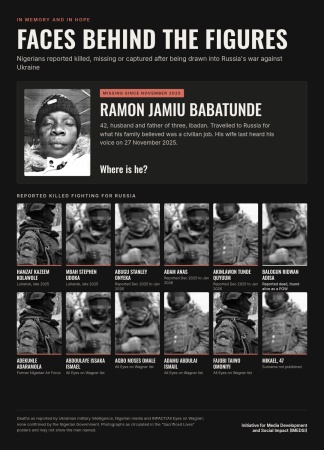
Then there is Ramon Jamiu Babatunde, a 42-year-old father of three from Ibadan who, his family says, went to Russia for civilian work. Documents seen by the Initiative for Media Development and Social Impact (IMEDSI) show he entered on a tourist visa and that, within two weeks, a form bearing his name recorded his "voluntary" enlistment in a Russian assault unit. The same form warns that anyone who refuses will be detained, deported, banned from Russia, and made to repay the airfare. His wife, Mrs Adewunmi Suliat Ramon, last heard his voice on 27 November 2025 and petitioned the Ministry of Foreign Affairs in May. His one-year contract expired last month. He has not come home, and three children still do not know whether their father is alive.
Others have been named: Hamzat Kazeem Kolawole and Mbah Stephen Udoka, whose bodies Ukrainian intelligence said it recovered in Luhansk; Ayebusiwa Olabode Victor of Ondo State, reported killed near Kharkiv in May; Fajobi Taiwo Omoniyi, Agbo Moses Omale and others listed by All Eyes on Wagner. Memorial posters bearing some of these names now circulate online. Adisa's case is a warning that such images cannot by themselves establish who has died. Families deserve certainty, not assumptions presented as fact.
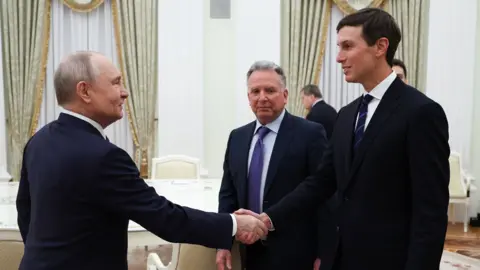
This is why the silence of last month's Russia-Africa Summit in Moscow is so disappointing. Ahead of the 28 to 29 October gathering, Amnesty International's directors across Africa urged leaders to raise the trafficking of their citizens directly with the Kremlin. Kenya's President William Ruto asked Moscow for help repatriating Kenyan recruits; Vladimir Putin offered no public answer. The summit drew 22 African heads of state, roughly half the number in 2019. For the Africans dying in Ukraine, there was no public commitment. Moscow did, however, find room for a Russia-Africa Media Forum that drew more than 200 participants from 46 African countries.
Other governments have shown what is possible. Kenya secured an undertaking from Moscow in March to stop enlisting its citizens and has brought more than 50 homes. Ghana's foreign minister confronted Sergei Lavrov in August over 62 Ghanaian deaths. Nigeria's Ministry of Foreign Affairs issued a warning in February, and it has largely stopped.
Nigeria must do more. It should demand from Moscow a full list of Nigerians under contract, captured, missing or dead, and inform every family before social media does. It should work with Kyiv and the International Committee of the Red Cross to identify Nigerians held as prisoners of war, Adisa among them, and bring them home. NAPTIP and the police must pursue the agents behind these schemes and treat those deceived as victims of trafficking, not mercenaries who chose their fate. And Abuja, with the African Union and ECOWAS, should seek for every African state the no-recruitment undertaking Kenya obtained.
None of this is about choosing between Moscow and Kyiv. Strategic autonomy must never be used as an excuse to ignore the exploitation of our citizens, and public diplomacy is no substitute for consular access and accountability.
Ridwan Adisa asked his president for forgiveness. He is not the one who should be apologising. For Mrs Ramon and her children, the question remains painfully simple: where is their husband and father? Until it is answered, Africa's diplomatic silence will be hard to justify, and African lives will remain cheap currency in other people's wars.
•Oumarou Sanou is a social critic, Pan-African observer and researcher focusing on governance, security and political transitions in the Sahel. He writes on geopolitics, regional stability and African leadership. Contact: sanououmarou386@gmail.com