ADAD

Updating your news feed...
NEWS EXPRESS is Nigeria’s leading online newspaper. Published by Africa’s international award-winning journalist, Mr. Isaac Umunna, NEWS EXPRESS is Nigeria’s first truly professional online daily newspaper. It is published from Lagos, Nigeria’s economic and media hub, and has a provision for occasional special print editions. Thanks to our vast network of sources and dedicated team of professional journalists and contributors spread across Nigeria and overseas, NEWS EXPRESS has become synonymous with newsbreaks and exclusive stories from around the world.
























Loading banners
Loading banners...

The Director-General of the National Information Technology Development Agency (NITDA), Kashifu Inuwa, has advocated stronger collaboration among government institutions, industry, academia, development partners and innovators to build a thriving digital economy.
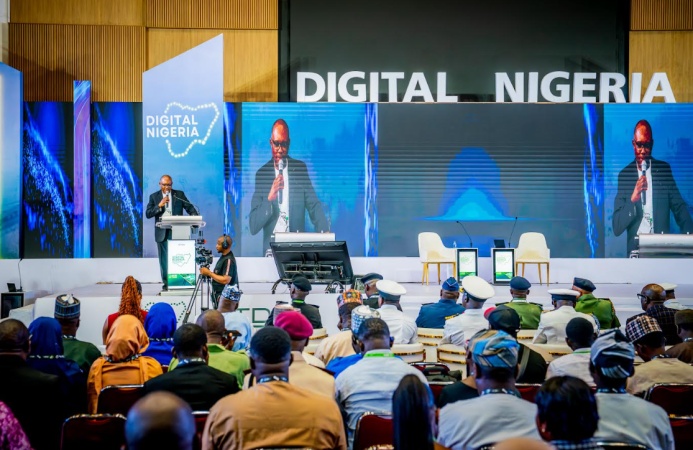
He spoke at the Digital Nigeria International Conference and Exhibition (DNICE) 2026 in Abuja, where stakeholders called for stronger collaboration between government, businesses, innovators and other players to accelerate Nigeria’s transition into a secure, intelligent and inclusive digital economy.
The NITDA DG, represented at the event by the Director of Special Duties, Dr Aristotle Onumo, noted that Nigeria had the talent, entrepreneurial spirit and innovative capacity to become a leading digital economy, but would need deliberate investments in skills, entrepreneurship, innovation, infrastructure and strategic partnerships.
“We are not here merely to discuss the future; we are here to build it. Digital Nigeria is designed to move beyond conversations to implementation, collaboration and measurable impact,” he said.
He said the conference was built around four strategic pillars focusing on the people who would build Nigeria’s digital future, how that future would be built, the skills citizens would need to thrive in the digital economy and recognition of individuals and organisations contributing to the sector.
Delivering the keynote address at the conference held at the President Bola Ahmed Tinubu International Conference Centre, the Director-General of the Nigerian Association of Chambers of Commerce, Industry, Mines and Agriculture (NACCIMA), Engr. Olusola Obadimu, said that Nigeria’s ambition to build a $1 trillion economy by 2030 will depend on its ability to convert digital innovation into productivity, industrial growth, investment and jobs.
He said that the debate over whether technology would transform Nigeria’s economy was already over, adding that the priority should now be to ensure that digital innovation produces measurable economic value.
“We are no longer debating whether digital technology will transform our economy. It already is. The question is whether Nigeria will merely consume that transformation or deliberately connect it to productivity, industrialisation, jobs, exports and national growth,” he said.
The NACCIMA DG said the target of a $1 trillion economy would require stronger alignment between technology, enterprise and investment, stressing that sustainable growth could not depend on government intervention alone.
“The road to a one-trillion-dollar economy runs through productivity. That economy will not be built in government offices. It will be built on farms, in factories, in laboratories and through businesses that create value every day,” Obadimu said.
He identified micro, small and medium enterprises (MSMEs) as critical to Nigeria’s economic transformation, arguing that digital policies would have limited impact unless they directly improved the productivity and competitiveness of small businesses.
Obadimu also highlighted the growing partnership between NACCIMA and NITDA as an effort to bridge the gap between innovation and commercialisation.
A major feature of the conference was the Builders Festival, which sought to connect technology innovators with real-world problems confronting businesses and institutions.
Presenters Glory Olamigoke and David Ogobe said the initiative received more than 1,500 applications from innovators after companies and institutions submitted operational and industry-specific challenges for solutions.
They said 21 priority challenges were identified, with 30 finalists subsequently selected to develop prototypes for presentation to investors, industry leaders and judges.
The eventual winner received a $50,000 equity-free grant, while other outstanding innovators secured grants ranging from $10,000 to $30,000, alongside access to mentors, investors, regulators, industry experts and business networks.
The initiative, they said, was designed to address the gap between Nigeria’s pool of young innovators and the funding, mentorship, infrastructure and market opportunities required to turn ideas into sustainable businesses.
The conference also placed strong emphasis on cybersecurity, data protection and digital trust.
Representing the Chief of Army Staff, the Commander of the Nigerian Army Cyber Warfare Command, Major General E. S. Mustapha, warned that the growing adoption of artificial intelligence and other emerging technologies was creating new cybersecurity and national security challenges.
He called for stronger collaboration, capacity building and investment in digital skills to strengthen Nigeria’s digital resilience.
The Inspector-General of Police, IGP Tunji Disu, represented by Commissioner of Police Ayodele Oluyemi, also highlighted the growing role of technology in intelligence-led policing, citing artificial intelligence, data analytics, digital forensics and secure communication systems.
The National Commissioner and Chief Executive Officer of the Nigeria Data Protection Commission, Dr Vincent Olatunji, represented by the Head of Innovation Department, Ms Adaobi Nwankwo, stressed the importance of data privacy, responsible data governance and public confidence in digital transformation.
Olatunji said digital innovation must develop within an environment that protects citizens’ rights and personal data.
Speaking for the Federal Character Commission, Mr Paul Apiade said digital transformation must expand opportunities rather than create new forms of exclusion.
He said technology was increasingly important to governance, transparency and public service delivery, while urging stakeholders to ensure that Nigerians across geographical, gender and social divides could benefit from the digital economy.
Across the conference, participants stressed the need to move beyond discussions about digital transformation and establish stronger links between innovation and industry, startups and customers, skills and jobs, ideas and investment, and policy and implementation.
The consensus was that the impact of Digital Nigeria 2026 would ultimately be measured by the businesses created, technologies commercialised, investments attracted, jobs generated and lives improved beyond the conference.
•PHOTO: NITDA DG’s representative, Dr Aristotle Onumo, the Director of Special Duties, presenting his address at DNICE 2026 in Abuja.