ADAD

Updating your news feed...
NEWS EXPRESS is Nigeria’s leading online newspaper. Published by Africa’s international award-winning journalist, Mr. Isaac Umunna, NEWS EXPRESS is Nigeria’s first truly professional online daily newspaper. It is published from Lagos, Nigeria’s economic and media hub, and has a provision for occasional special print editions. Thanks to our vast network of sources and dedicated team of professional journalists and contributors spread across Nigeria and overseas, NEWS EXPRESS has become synonymous with newsbreaks and exclusive stories from around the world.














Loading banners
Loading banners...

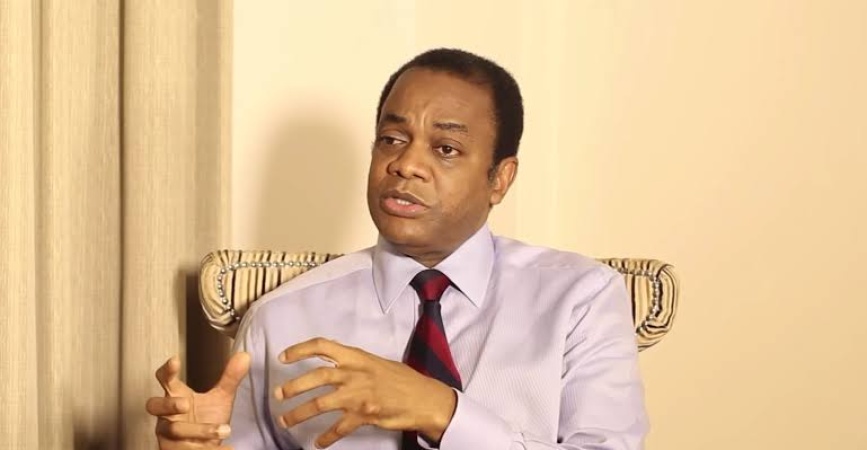
PRP presidential candidate and former Cross Rivers State governor, Donald Duke
Presidential candidate of the Peoples Redemption Party (PRP), Donald Duke, has warned that the alleged abuse of state power by the All Progressives Congress (APC) could plunge Nigeria into a political crisis reminiscent of the events of 1966, which culminated in military intervention and the country’s devastating civil war.
Duke, former governor of Cross River State, accused the APC-led administration of systematically weakening opposition parties through the alleged manipulation of the judiciary, interference with electoral institutions, restrictions on campaign activities and political intimidation, warning that the desperation to retain power could undermine democracy and threaten national stability.
His warning came against the backdrop of Monday’s disclosure by the Independent National Electoral Commission (INEC) that it had removed 1,608,660 fictitious entries from the national voters’ register and identified 54 officials implicated in registration irregularities across 10 states, a development that has renewed concerns over the integrity of the electoral register ahead of the 2027 general elections.
Speaking at the PRP’s 2026 National Retreat in Abuja, yesterday, where he unveiled his manifesto, ‘A Compact for Nigeria’s Renewal’, Duke drew parallels between the prevailing political atmosphere and the events preceding the collapse of Nigeria’s First Republic, cautioning that the failure of opposition parties to close ranks and resist what he described as the growing abuse of state institutions could expose the country to another dangerous political confrontation.
He particularly expressed concern over the alleged compromise of the courts and INEC, claiming that opposition parties were increasingly being denied a level playing field through judicial decisions, restrictions on access to campaign venues, limitations on political advertising and acts of thuggery.
“We have witnessed the unabashed attempts to whittle the opposition by the party in government, using and abusing several instruments of state power, such as the courts, restrictions to campaign and rally venues, advertising rights and outright thuggery in some instances.”
Duke alleged that the APC had demonstrated disregard for democratic norms and values, warning that the consequences of allowing political institutions to become instruments for suppressing opposition could extend beyond the 2027 general elections.
“Having described the field of play and the desperation of the administration to retain power no matter what it may entail, it is incumbent on us as a party and a people to ask ourselves how to tackle this hydra-headed aberration, which if unchecked, will push our country into a conflagration that is reminiscent of the 1966 quagmire that led to a civil war that cost over three million lives.”
Duke recalled that the political crisis of the First Republic began with struggles for the retention of power and eventually degenerated into military intervention and civil war, arguing that the country had yet to recover fully from the consequences of that period.
He warned that the similarities he perceived between the political developments of 1966 and the current situation should compel political leaders to act responsibly rather than allow personal ambitions and partisan interests to jeopardise the country’s democratic future.
“The events then and today, sixty years thereafter, are frighteningly similar. You then begin to wonder if those events and lives lost then mean anything to us today,” he said.
According to him, the opposition’s failure to establish a common front against abuses of political power during the First Republic contributed to the deterioration of the situation, stressing that contemporary political leaders must learn from history to prevent a recurrence.
He argued that opposition parties did not necessarily have to merge or abandon their individual political ambitions to defend democracy, but must agree on common principles and collective action to ensure that electoral rules were respected and state institutions remained impartial.
“There has been a clarion call for the opposition to come together to address our common concerns. Not necessarily to compromise the ambitions of anybody but more importantly to ensure that rules are obeyed and a government for the people, by the people, emerges,” Duke said.
The former governor lamented that personal ambition and political rivalry had continued to frustrate efforts to build a united opposition, warning that the failure to subordinate individual interests to the defence of democratic institutions could prove disastrous.
“Apparently, we are bedevilled by the EMI LOKAN syndrome. Our inability to stand forth as a rampart to ensure that the democracy that we fought hard to establish is not desecrated may come to haunt us if urgent steps are not taken.
“We erred in 2023 and we are repeating same in 2027. It is said, fool me once, shame on you; fool me twice, shame on me. The shame will certainly be on us,” he stated.
Speaking with journalists after the programme, Duke clarified that the proposed opposition alliance should go beyond negotiations over who would emerge as its presidential candidate, insisting that participating parties must first agree on a common vision for Nigeria and a credible programme of governance.
He said he was prepared to support another candidate if the coalition reached a democratic consensus on the most suitable person to lead it, stressing that individual ambition should not undermine the collective objective of rescuing the country’s democratic institutions. “You can’t call for a democrat and you’re not submitting to the rules and to the regulations of democracy.”
Duke added that if the coalition agreed on the best candidate through an acceptable process, he would respect the outcome.
“At the end of the day, I’m a sportsman about it,” he declared.
He also accused the judiciary of becoming susceptible to political influence, alleging that the outcome of cases involving the government could increasingly be predicted in favour of those exercising state power.
“Unfortunately, the instrument of justice through the courts has been so compromised and captured by the state, such that the outcome of any matter that involves the government can be forecasted well in advance and it is certainly not going to be in favour of the party not in government,” he alleged.
Expanding on his concerns during the interaction with journalists, Duke likened the judiciary’s role in democratic contests to that of a referee in a sporting competition, warning that public confidence in the entire electoral process could collapse if those entrusted with dispensing justice were perceived as partisan.
“If you go to a match and you have a biased referee, then the integrity of the entire game is compromised.”
He, however, expressed hope that newly appointed judicial officers would discharge their responsibilities without fear or favour, reminding them that their decisions would have far-reaching implications for Nigeria’s democratic future.
Duke extended his criticism to INEC, questioning the commission’s independence and impartiality in the discharge of its constitutional responsibilities.
The PRP candidate cited what he described as revelations concerning more than 10 million questionable voter registrations, warning that the development raised serious concerns about the integrity of the electoral process.
However, INEC had on Monday announced the removal of 1,608,660 fictitious entries from the voters’ register and identified 54 officials implicated in registration irregularities across 10 states.
Although the commission’s disclosure confirmed the discovery of substantial irregularities in the register, it did not establish Duke’s claim that more than 10 million questionable registrations had been uncovered or that the electoral body was acting under the influence of the ruling party.
Duke compared the alleged registration irregularities with the postponement of the 2019 presidential election shortly before voting was scheduled to commence, maintaining that the present situation could pose an even greater threat to electoral credibility.
He further alleged that the limited visibility of opposition campaign billboards, posters and political messages on state-owned radio and television stations was deliberate and designed to undermine political competition.
“What should be clear to us all, the players and the electorate, is that we would be foolish to expect a free and fair electoral process, what some may term a level playing field.”
He also expressed concern over judicial decisions affecting political parties close to the elections, arguing that prolonged litigation could effectively deny affected parties the opportunity to obtain remedies before the polls.
“We have already witnessed the spurious judgement being meted barely two months to the elections. By the time it goes through the rigmarole of the judicial process, the elections will be over,” Duke said.
Turning to the economy, the former governor accused the Federal Government of presenting worsening living conditions as economic reforms, arguing that the administration had failed to demonstrate how its policies were improving the welfare of ordinary Nigerians.
He listed hunger, poverty, higher taxes, depreciation of the naira, rising electricity costs, mounting public borrowing, declining purchasing power, increased transportation costs and nationwide insecurity among the difficulties confronting citizens.
“Never has hunger, poverty, higher taxes, a depreciated naira, higher electricity costs, constant borrowings, low purchasing power, higher transport cost, fusion of three annual budgets into one budgetary cycle and nationwide insecurity been a euphemism for reform.
“It is only in Nigeria that hardship is termed reform,” he declared.
Duke maintained that leadership should be measured by the welfare and security of citizens rather than the presentation of economic difficulties as unavoidable sacrifices, stressing that governments had a responsibility to provide visible improvements in public services and living standards.
“Leadership is about responsibility and visible good service to the people, to ensure their welfare and wellbeing, their safety and security and the overall furtherance of good government,” he said.
Also speaking at the retreat, PRP National Chairman, Dr. Hakeem Baba-Ahmed, said the gathering marked an important stage in the party’s transition from political aspirations to the practical task of presenting itself as a credible alternative government.
He commended Duke, his running mate, Malam Sule Mohammed, and more than 500 other candidates contesting elections on the party’s platform, describing them as individuals with the integrity, competence and courage required to confront Nigeria’s economic and security challenges.
Baba-Ahmed acknowledged the difficulties facing the party, particularly the advantages enjoyed by incumbent politicians through their access to state power and substantial financial resources.
“We will find resistance from politicians who bribe our people for our future, while we ask for trust and the courage to choose quality and integrity,” he said.
He urged Nigerians to reject vote-buying and resist attempts to compromise their electoral choices through financial inducements. “Nigeria and Nigerians are not for sale,” he declared.
The national chairman also announced that PRP candidates would be required to sign a binding compact with their constituents as part of the party’s commitment to accountability, responsible leadership and public service.
“This agreement commits aspirants to unprecedented accountability, service and adherence to the foundational values of the 70-year-old progressive movement.” Baba-Ahmed reaffirmed the party’s participation in the emerging Coalition for Democracy and urged its candidates to conduct their campaigns with sincerity, respect and a commitment to national renewal.
Duke, meanwhile, urged the PRP and other opposition parties to adopt a more tactical and strategic approach to defending democratic institutions, warning that conventional political methods might prove inadequate against what he described as an administration unwilling to respect established rules.
“We, the opposition, must be tactical and strategic. David did not defeat Goliath in a wrestling bout, but by strategy and unconventional means.”
He warned that unless opposition leaders overcame their differences and acted collectively to protect the electoral process, the consequences of their failure could extend beyond the fortunes of individual political parties to the survival of Nigeria’s democracy and the stability of the country. (The Sun)