ADAD

Updating your news feed...
NEWS EXPRESS is Nigeria’s leading online newspaper. Published by Africa’s international award-winning journalist, Mr. Isaac Umunna, NEWS EXPRESS is Nigeria’s first truly professional online daily newspaper. It is published from Lagos, Nigeria’s economic and media hub, and has a provision for occasional special print editions. Thanks to our vast network of sources and dedicated team of professional journalists and contributors spread across Nigeria and overseas, NEWS EXPRESS has become synonymous with newsbreaks and exclusive stories from around the world.


















Loading banners
Loading banners...

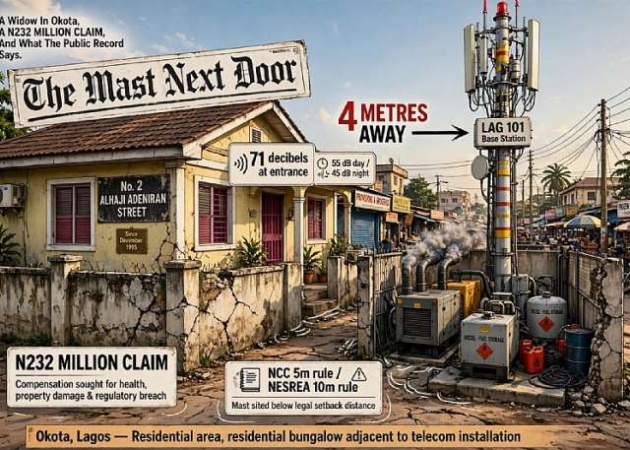
A widow in Okota, Lagos, alleges a telecom mast 4 metres from her home has caused 21 years of noise, vibration and fumes, ODIMEGWU ONWUMERE writes. She is claiming N232m from Airtel and ATC. Using court papers, LASEPA limits, and NCC guidelines, this story tests her claim against the companies’ and the regulator’s public record. It shows the environmental and social cost of Nigeria’s digital expansion, examines diesel-powered towers in residential areas, noise and setback rules, and the conflict between NCC’s 5-metre rule and NESREA’s 10-metre rule, giving the claimant, the companies, and the regulator a fair hearing based on public records
Sarah Akinya did not set out to fight two big companies. She only wanted to sleep in her own house in peace.
She has lived in that house since December 1995. It is a four-bedroom bungalow at No. 2 Alhaji Adeniran Street, off Moshobolaje Street, Ago Palace Way, in Okota, Lagos. In her amended statement of claim, filed through her lawyer, Ajibola O. Ajiboye of Fadeson Legal Practice, she puts it plainly. She has occupied that house since December 1995. That is her home. That is where her life happened.
Then, in April 2004, something changed next door.
Workers came to No. 4 Alhaji Adeniran Street. They dug. They poured concrete. They brought steel. By July that year, it was clear what they were building. It was not another house. It was a telecommunications mast. The site would later be known in court papers as LAG 101 Base Station.
In her own words, as captured in the court papers, Akinya says the dispute began in April 2004 when Airtel commenced construction on the adjoining property. By July, she says, it had become clear that the company was installing a telecoms mast. She does not describe it as a small pole. She describes a high-capacity mast, heavy-duty electricity generators, an energy reservoir and fuel storage facilities, allegedly located about four metres from her perimeter wall.
Four metres. That is less than the length of a small car. From her bedroom window, the mast is not far away. It is right there.
She is now in court. She has sued Airtel Networks Limited and ATC Nigeria Wireless Infrastructure Limited before the Lagos State High Court. She is asking for N232 million. She wants N200 million for what she calls nuisance from noise, vibration, fumes, smoke and radiation. She wants another N32 million for annoyance, discomfort, illness, inconvenience, pain and suffering. And beyond money, she wants the court to order the companies to pull the facility down and move it somewhere else. If the court will not do that, she wants an order to stop them from running it in a way that keeps disturbing her home.
The case is marked LD/970/2007. It is before Justice Abisoye Jubril Bashua of the Lagos Judicial Division.
What she describes in that claim is not one bad night. It is years of living next to machines that hardly rest. Through her counsel, she alleges that the continuous operation of the generators had exposed her household to persistent noise and vibrations, causing cracks in the walls of her building and the boundary fence. She further claims, in the language of the court file, that fumes, smoke and other emissions had spread into her living environment, settling on furniture and floors and creating serious health concerns for the occupants.
These are allegations. The court has not decided on them. Neither Airtel nor ATC has been found liable. That matters, because this story has three sides, not two, and the public record shows all three have been making their case for years, in court, in regulators’ offices, and in company reports.
Start with the companies. Airtel, ATC and LASEPA were asked to confirm the inspection report and the site measurement for LAG 101. As at press time, neither the companies nor LASEPA had responded on the specific measurements, and no statement of defence had been made public for this case. What the companies have said, on the record, about how they run sites in general, is available, and it must be weighed.
ATC, through its parent American Tower Corporation, says in its 2022 Sustainability Report that in Africa, greenhouse gas emissions per tower fell by 21 percent against its 2019 baseline, in large part due to increased deployment of on-site solar power. Renewable energy source hours nearly doubled since 2019, and diesel generator run time was reduced by approximately half. The company says it has invested about $300 million in energy reduction initiatives in Africa since 2018, cutting on-site diesel consumption by nearly 43.5 million litres a year compared with business-as-usual operations, which it equates to roughly 117,000 metric tons of carbon dioxide equivalent avoided.
Airtel Africa, for its part, has said its renewed 12-year tower lease with ATC, covering about 7,100 sites across Nigeria, Uganda, Kenya and Niger, includes a focus on renewable energy solutions, particularly for a significant number of sites in Nigeria, to reduce diesel dependency and operating costs. Airtel Nigeria itself says it has now passed 17,000 sites across the country, after adding more than 1,000 new 5G sites in 2026. That growth is the business reason the masts exist. Nigerians want calls that connect, data that loads, money that moves. Without towers in crowded streets like Okota, none of that happens.
The tower business itself explains why two companies are in court. In Nigeria, operators rarely own all their towers. Specialist companies called towercos own and manage most of them. ATC Nigeria, part of American Tower, is the second-biggest player, with around 8,000 sites. It first entered Nigeria in 2014 by acquiring thousands of towers from Airtel. On 15 January 2026, Justice Bashua agreed to join ATC as the second defendant, because court papers identify ATC, with an office on the 10th Floor, Alliance Place, 33A Alfred Rewane Road, Ikoyi, Lagos, as the company now responsible for managing and operating the mast. Akinya’s lawyers later wrote to ATC’s management on 2 September 2026, with copies served on the Registrar of the Lagos State High Court, Yaba Division.
For Akinya, the question is not who owns the mast on paper. The question is what the mast has allegedly done to her house.
She tells another small story inside the big one, and it matters because it shows how trust broke down. In her claim, she alleges negligence over damage to her perimeter fence. She says a trailer conveying a generator for installation at the site struck the fence, damaging part of it in an incident allegedly witnessed by maintenance operators. Although the operators reportedly promised to repair the damaged section, she says the work was not completed. She alleges that the weakened fence subsequently collapsed during heavy rainfall, leaving the property exposed and raising security concerns for her household. The companies have not, in the public record, admitted that account. The court will have to test it against their own logs, their maintenance records, and the evidence of witnesses.
But the strongest paper she holds may not be her own words. It is a report from the government.
The Lagos State Environmental Protection Agency, LASEPA, inspected the area. According to her claim, the agency found that noise around the facility was above what is allowed in a residential area. The report, as cited in her claim, recorded 71 decibels at the entrance to her property and 61 decibels at five metres away.
To understand what those numbers mean, you have to know the rule. In Lagos, noise above 55 decibels during the day and 45 decibels at night in a residential area counts as excessive noise. The Lagos State Environmental Management and Protection Law, 2017, Part VI, Section 177, prohibits excessive noise in private and public places. LASEPA’s General Manager, Dr Babatunde Ajayi, said at the 11th Noiseless Lagos Summit in May that noise accounted for about 65 percent of complaints received by the agency. Of the 8,437 environmental complaints received by the agency in 2025, 3,300 were noise-related. By May 2026, that share had climbed to about 65 percent.
In other words, if Akinya’s account is right, she is not alone. Lagos is getting louder, and people are complaining more.
After its inspection, LASEPA, under Dr Ajayi, reportedly told the operators to fix the noise, install soundproofing, redirect the exhaust pipes and follow environmental rules. Akinya is relying on that intervention. She says it proves that what she heard and felt was not imagined. The state measured it. What the public record does not yet show is whether the operators complied, when, and to what extent. That gap is for the court to fill, with the LASEPA file, the maintenance log book, and any follow-up inspection.
There is a second public record that cuts the other way, and fairness demands it be stated. Nigerian courts do not grant these claims on allegation alone. In June 2024, a Federal High Court in Lagos struck out a suit by HEDA Resource Centre against ATC Nigeria and MTN Nigeria, which had sought to stop base stations near HIS Towers sites. The court held the suit was speculative and failed to disclose any reasonable cause of action. That case was different in facts, but it shows the test Akinya must pass. She must prove, with evidence, not just that a mast is near her house, but that its operation caused the specific damage she claims.
Now, the regulator. The Nigerian Communications Commission, NCC, did not comment on LAG 101 specifically. Its standing public position, repeated over years, is this. The NCC says no health hazard is associated with telecommunication towers in residential areas. Its Executive Commissioner of Technical Services, Abraham Oshadami, said at the commission’s training for media executives in Lagos on 20 June 2021:
“There is really no health hazards associated with telecom masts [in residential areas]. My little understanding about this is that the radiation is even far away, up there.
“Not even as close as the TV in our homes. The radiation coming from masts is not up to what we get from our phones.
“I don’t think there’s any cause for panic.”
He added: “No sickness has been linked to radiation in all those years when wireless services have been in place.”
On distance, the NCC’s position is also on record. Its 2009 Guidelines on Technical Specifications for the Installation of Telecommunications Masts and Towers say towers above 25 metres in height would not be permitted in residential districts, but where they are permitted, they should be placed at a minimum setback of 5 metres to the nearest demised property, excluding the fence, and prior permission must be obtained from the Commission. The NCC says that a 5-metre setback is not an admission of health risk.
Oshadami said: “So, those setbacks you see are for physical safety. Sometimes, where there is a defect in the mast, it could fall. So there must be a standard so that if anything happens, there will be no physical damage to anyone.”
On generators, which is the core of Akinya’s complaint, not just the mast itself, the same 2009 Guidelines say all generators within a base station must be sited 5 metres away from demised properties, excluding the fence, must be sound-proof, supported by down-pads and installed on good shock absorbers to minimise vibrations, and must be placed so exhaust pipes are not directed towards any demised property. The NCC also says no mast should be installed without its approval.
“It is in our regulation that before telcos install masts anywhere, they must seek an approval from us. And the NCC also goes there to inspect. If any mast does not meet specifications, it won’t be approved.”
In its guidance on health and safety around base stations, the NCC adds that it applies the International Commission on Non-Ionizing Radiation Protection, ICNIRP, guidelines, and that its review has not found, so far, any link between base stations and an elevated risk of cancer.
Later, in its new Guidelines on Technical Specifications for the Deployment of Infrastructure, the NCC raised the bar. It said towers above 25 metres would not be permitted in residential areas, and where permitted, they should be placed at a minimum setback of 10 metres to the nearest demised property, excluding the fence, and that towers sited in contravention shall be removed and the owner shall bear the cost of removal. That last point is important for this case.
The NCC’s own newer rule is now 10 metres, not 5 metres. That brings it in line with NESREA, which says new facilities shall have a minimum setback of ten metres from the perimeter wall of residential premises. Akinya alleges 4 metres. If the court accepts her measurement, the site would fail even the old NCC rule, and fail the new rule by 6 metres. If the court finds a different measurement, her claim on distance weakens. That is why the measurement, not the argument, will decide this part of the case.
Distance matters because of power. In Nigeria, the national grid fails often. When it fails, base stations do not go quiet. They switch to diesel. That is why those rules were written. Officials knew what happens when a big generator sits next to a bedroom.
There is also the question of radiation, and here the public record is clear that the science is contested in public, but settled in regulation. Akinya’s claim lists radiation among the harms she alleges. The NCC, as above, says it applies ICNIRP guidelines endorsed by the World Health Organization. At the same time, the International Agency for Research on Cancer in 2011 classified radiofrequency radiation as a possible human carcinogen, Class 2B, and some independent studies in Nigeria have reported readings above ICNIRP limits at some sites, while others have found readings well below limits. That is why Akinya’s lawyers, if they want to win on radiation, will need more than a general claim. They will need a measurement at her house, tied to ICNIRP limits, and an expert to explain it. The court, not this article, will decide if that evidence exists.
For now, Akinya waits. She has waited since 2004. She has waited through letters, through inspections, through court dates. She is a widow who says, in the words of her own court papers, that she has been deprived of the peaceful enjoyment of her property, that her household has been exposed to persistent noise and vibrations, and that fumes and smoke have spread into her living environment.
The court will decide if she gets N232 million. It will decide if the mast must move. It will decide if an injunction should stop the nuisance she alleges. Those are legal questions.
But there is a human question underneath them, and it will remain even after the judgment. In a city that needs phones and needs power, how do we make sure the cost of connection is not paid, night after night, by the woman who lives, as she alleges, four metres away? The companies’ public record says they are investing to cut diesel, cut noise, and cut emissions. The regulator’s public record says masts are safe if the rules are followed, and that generators must be sound-proofed and set back. Akinya’s court papers say that, at her address, the change has not yet arrived. The court must now decide which record is true for LAG 101.
Hat is the question Sarah Akinya has put before the court. It is also the question Nigeria has still not answered.
•Onwumere is Chairman Advocacy Network on Religious and Cultural Coexistence (ANORACC).
Editor’s note on sources: This story was supported by public records – Akinya’s amended statement of claim as reported in court coverage, LASEPA’s published noise limits, the NCC’s 2009 and updated Guidelines, NESREA’s setback regulations, ATC’s Sustainability Report, Airtel Africa’s public disclosures, and the reported June 2024 HEDA judgment. No defendant has been found liable. Where a fact rests only on the claimant’s filing, it is attributed as an allegation.