 ADAD
Updating your news feed...

NEWS EXPRESS is Nigeria’s leading online newspaper. Published by Africa’s international award-winning journalist, Mr. Isaac Umunna, NEWS EXPRESS is Nigeria’s first truly professional online daily newspaper. It is published from Lagos, Nigeria’s economic and media hub, and has a provision for occasional special print editions. Thanks to our vast network of sources and dedicated team of professional journalists and contributors spread across Nigeria and overseas, NEWS EXPRESS has become synonymous with newsbreaks and exclusive stories from around the world.










Loading banners
Loading banners...

By BONIFACE AKARAH
The Human Rights Writers Association of Nigeria (HURIWA) has called on the Federal Government to immediately suspend toll collection along the Keffi–Akwanga–Lafia–Makurdi highway, describing the multiple toll points as an additional financial burden on motorists, transport operators, traders and businesses.
The association made the demand in a statement dated November 3, 2026, signed by its National Coordinator, Comrade Emmanuel Nnadozie Onwubiko.
HURIWA said the tolling arrangement was particularly burdensome amid rising transportation costs, high food prices and declining purchasing power, warning that repeated payments along the same corridor could further increase the cost of moving passengers and goods.
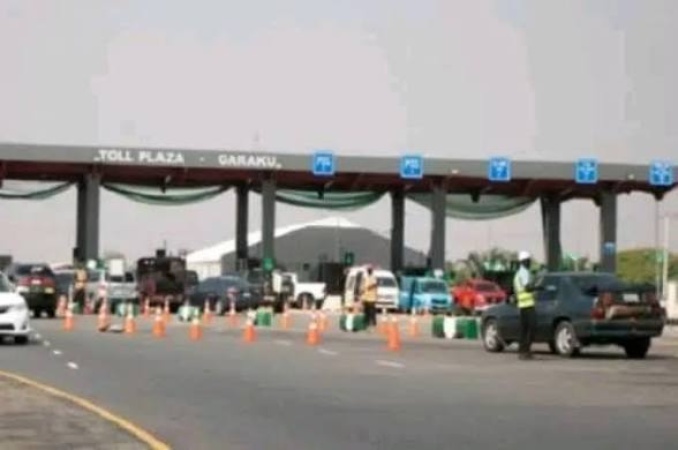
The Federal Government commenced toll operations on February 4, 2025, along the 227.2-kilometre Abuja–Keffi–Akwanga–Lafia–Makurdi highway. The four principal toll locations are Keffi, including Garaku, Akwanga, Lafia and Makurdi.
Under the published fee structure cited by HURIWA, saloon cars pay N500 at each toll point, SUVs and jeeps N800, minibuses and light buses N1, 000, while trucks, buses and multi-axle vehicles pay N1, 600.
The association calculated that a saloon car travelling through all four toll points could pay N2, 000 for a one-way journey and N4, 000 for a return trip, assuming payment is required at every plaza in both directions.
It warned that the charges could increase transport fares and the prices of goods as commercial operators transfer additional costs to passengers and consumers.
“These are not insignificant amounts in an economy where commercial drivers must contend with fuel costs, vehicle maintenance, spare parts, levies and other operational expenses. The consequences are eventually transferred to passengers and consumers through higher transport fares and increased prices of goods,” HURIWA said.
Questions over road quality and toll administration
The association said road users had reported peeling surfaces and deterioration in some sections before toll collection began. It also raised concerns about poorly constructed culverts and drainage structures, some of which were reportedly damaged during the road’s first year of use.
It called for an independent technical audit to establish the extent of the reported defects and determine whether construction standards, supervision, contractual obligations and maintenance arrangements had been met.
HURIWA insisted that motorists should not be made to pay tolls for infrastructure whose durability and maintenance standards remain questionable.
“A tolling regime must not become a mechanism for collecting money from citizens while fundamental defects in the infrastructure remain unresolved,” the association stated.
It called on the Federal Government and relevant project authorities to publish verifiable information on the road’s construction standards, defect-liability arrangements, maintenance obligations and measures taken to address reported failures.
The group also criticised the reported challenges associated with the cashless tolling system, which relies on point-of-sale terminals, ATM cards and preloaded electronic cards, with a minimum preloaded value of N10, 000.
According to HURIWA, motorists have complained about payment delays, inadequate access to required payment instruments and the inconvenience of making repeated transactions at separate toll points.
“A cashless payment system may have administrative advantages, but it must not be implemented in a manner that creates avoidable hardship, long queues and severe traffic congestion,” the association said.
It called for an Integrated payment system, accessible alternatives for motorists and measures to prevent toll plazas from becoming traffic bottlenecks.
Warns of impact on food prices
HURIWA described the highway as a strategic economic corridor connecting farms, markets, communities and distribution centres across Nasarawa and Benue states, two important food-producing states in North-Central Nigeria.
It warned that additional transportation costs could affect farmers, agricultural traders, wholesalers and transport operators, with consequences for food prices across the country.
“Any policy that increases the cost of moving agricultural produce along this corridor threatens the sustainability of businesses and places additional pressure on food prices. The consequences are not limited to motorists in Nasarawa and Benue; they extend to households across Nigeria that depend on produce transported through the region,” the statement said.
The association acknowledged that the Federal Government had defended the tolling arrangement as part of a public-private partnership framework intended to support road maintenance and recover financing obligations, including a China Exim Bank loan.
However, HURIWA argued that financing obligations did not automatically justify every tolling arrangement or remove the government’s responsibility to protect citizens from disproportionate charges.
“Where public infrastructure is tolled, the authorities must demonstrate that the charges are reasonable, the collection system Is efficient, the road meets acceptable standards and the proceeds are managed transparently,” it stated.
HURIWA demanded the publication of the concession and tolling agreements, revenue-sharing arrangements, maintenance obligations and mechanisms for auditing collections and expenditure.
Lists demands for government
Among its demands, HURIWA called for the immediate suspension of toll collection pending an independent review of the policy and its implementation.
It also urged the Federal Ministry of Works to review the number and distribution of toll plazas, commission an independent technical audit of the highway, resolve payment difficulties and engage transport unions, traders, farmers, affected communities and state legislatures.
The association further demanded a transparent revenue-accountability mechanism that would enable the public to know how much is collected, how the funds are spent and what improvements road users should expect.
Government must prioritise public welfare
HURIWA urged President Bola Tinubu to direct an urgent review of the tolling regime and suspend collections until the concerns of motorists, commercial operators and affected communities are addressed.
It stressed that It was not opposed to responsible infrastructure financing but objected to tolling policies that lacked sufficient transparency, imposed disproportionate cumulative charges and failed to address complaints about road quality and operational efficiency.
“The Federal Government must demonstrate that the public interest comes before revenue collection. Until it does so, the multiple toll gates on the Keffi–Lafia–Makurdi highway will remain a troubling symbol of a policy that places the financial burden of infrastructure on citizens without adequately demonstrating fairness, efficiency and accountability,” the association said.




