ADAD
Updating your news feed...

NEWS EXPRESS is Nigeria’s leading online newspaper. Published by Africa’s international award-winning journalist, Mr. Isaac Umunna, NEWS EXPRESS is Nigeria’s first truly professional online daily newspaper. It is published from Lagos, Nigeria’s economic and media hub, and has a provision for occasional special print editions. Thanks to our vast network of sources and dedicated team of professional journalists and contributors spread across Nigeria and overseas, NEWS EXPRESS has become synonymous with newsbreaks and exclusive stories from around the world.








.webp)

Loading banners
Loading banners...

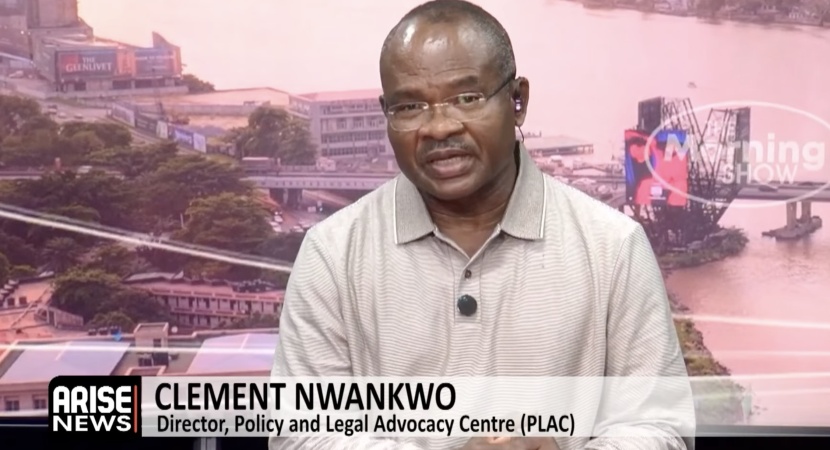
The Director of the Policy and Legal Advocacy Centre (PLAC), Clement Nwankwo, has raised concerns over artificial intelligence (AI)-generated information and photographs in Nigeria’s voter register, warning that the register lacks credibility ahead of the 2027 general election.
Speaking during an interview with ARISE NEWS on Thursday, Nwankwo said the disputed entries raised questions about the credibility of the register, particularly after the Independent National Electoral Commission (INEC) reported that the number of registered voters had risen from more than 90 million to 103 million while also questioning the commission’s preparedness for the elections.
“Technology has of course come forward, and now what we see is what is now referred to as AI generated information and photographs that have been inserted into the voter register.”
He said civil society organisations and individuals were using different technological tools, including AI. “And the verdict you see, of course, is that using AI, you can tell quite clearly that the voter register has very serious problems.”
Nwankwo questioned the increase in the number of registered voters and whether the 103 million figure accurately represented the number of eligible voters in Nigeria. “We did see voter register that jumped from 90-something million to 103 million. And questions are arising as to how that jump happened and who is on that voter’s register, I think that we do not have 103 million persons who are eligible to vote in this country.”
He emphasised that country needed to address the credibility of its voter register. “It means that we must go back to the drawing board. And I think it’s too late though for 2027 that you talk of a new voter register. But this country must come to terms with the fact that its current voter register has no credibility.”
Nwankwo also questioned INEC’s preparedness for the 2027 elections. “You must brief the political parties. You must call them in and say, these are what you are doing. But is INEC doing so? No. The parties don’t know what is going on, and it should be that the parties should know what INEC is doing.”
“So I don’t see that communication going on. I don’t see INEC putting out information on its preparedness.”
The PLAC director said concerns about the voter register formed part of wider gaps in preparations for the elections. “And as we speak right now, looking at the threshold document, it is clear that there are lapses and gaps that may be difficult to rectify as we speak.”
Nwankwo warned that more Nigerians could be prevented from voting in 2027 if INEC failed to address problems involving the transfer. “I think you will see an even larger number of people disenfranchised in the 2027 election, because INEC has not done what it should do to ensure that people can move and have their voting unit migrate to where they have recently moved to.”
He also questioned whether INEC had provided clear instructions on how voters could challenge errors in their registration details or raise objections to information in the register. “I have no evidence as we speak right now that INEC has followed up from displaying the voter register to including information on how citizens can make those objections and claims.”
Nwankwo said the concerns extended beyond individual registration details to discrepancies in the information uploaded by INEC. “If a lot of us remember, when INEC opened the window for continuous voter registration, a lot of the political parties and politicians went to their constituencies and said they were mobilising registration of voters. And that’s when this window opened, that you had all sorts of names generated.”
He compared the current concerns with earlier voter registration exercises in which names of prominent people. “I think we need to look at the previous exercises prior to 2010, when all sorts of names were entered into the register. Michael Jackson, Muhammad Ali, and all of that number of names. And people were using palm panels to put in fingerprints and so on.”
Nwankwo said the Electoral Act required INEC to display the voter register and allow claims and objections before finalising the register for an election. “The Electoral Act requires that INEC displays the voter’s register within a certain period. I think it’s 90 days before the elections. And it’s supposed to receive claims and objections, which means that once it displays it, it’s supposed to be on display for at least seven days. And it takes claims and objections and then goes and finalises a voter register that should be ready for elections at least 60 days before the elections.”
He added that access to the register should be made easier through technology. “And everyone, everyone who can pay for it is entitled to access to the voter register. And in these days, when you have technology, it means that you really shouldn’t be paying too much other than access this on INEC’s portal.”
Nwankwo also said the Electoral Act did not require INEC to use AI for elections. “I must say very, very clearly that there is nothing in the Electoral Act that says that INEC should use AI. And that means that we even have to define what AI is.”
Asked whether the 2027 elections should be postponed to give INEC more time to address the problems, Nwankwo said. “I am not going to go into conversation about a postponement of election, because I do know that there was a push to even have these elections conducted in November this year. And it was only when references were made and some of us said, look, you can’t have an election in November because the constitution gives you a 30-day to 150-day window to conduct elections, and November doesn’t fall into that. That’s when the next available date after November was fixed for January 16th. And INEC prosecuted all the options, and this affected political parties tremendously in terms of how they should conduct primaries, the timelines and so on.”
“So I would never be one to say postpone elections, because even if you were to postpone elections, will INEC be ready? And I make the point quite clearly that I do not think that we’re all ready for these elections.”
He warned that a last-minute announcement of a postponement could undermine public confidence and national security.
“And I think it would be a shame if this country were to come close to January 16th to hear anybody talk about postponement of elections. I think it would be a serious, serious breach of national security and indeed national confidence if this were to happen.”
Nwankwo also warned that weaknesses in the electoral process could create opportunities for manipulation. “I think that given our electoral environment and given recent electoral operations, it is quite clear that you do have a lot of lapses that could be used to manipulate the elections. But I must say again, we don’t have a credible voter register going into 2027.” (AriseNews TV, but headline reworked)