ADAD
Updating your news feed...

NEWS EXPRESS is Nigeria’s leading online newspaper. Published by Africa’s international award-winning journalist, Mr. Isaac Umunna, NEWS EXPRESS is Nigeria’s first truly professional online daily newspaper. It is published from Lagos, Nigeria’s economic and media hub, and has a provision for occasional special print editions. Thanks to our vast network of sources and dedicated team of professional journalists and contributors spread across Nigeria and overseas, NEWS EXPRESS has become synonymous with newsbreaks and exclusive stories from around the world.
.webp)



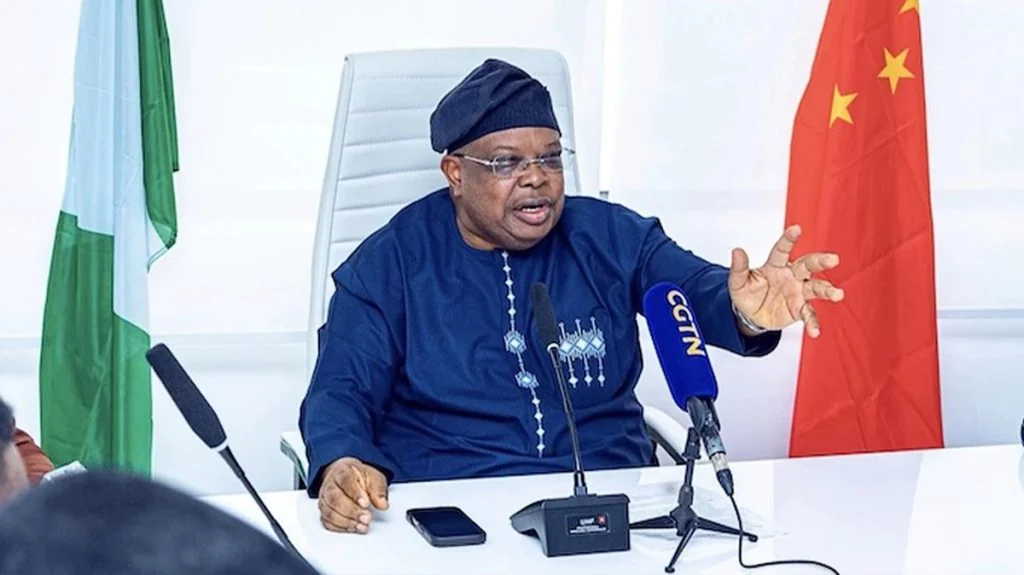
The Lagos–Ogun economic corridor accounts for about 50 percent of Nigeria’s electricity demand, the Minister of Power, Joseph Tegbe, has said
For this reason, the minister disclosed that the Federal Government is prioritise the axis, alongside two other major economic corridors, for targeted power infrastructure upgrades to improve electricity supply to businesses and industries.
The minister disclosed this at the 13th Nigeria Energy Exhibition and Leadership Summit, identifying the Lagos–Ogun, Enugu–Onitsha–Port Harcourt and Abuja–Kaduna–Kano corridors as priority zones under the government’s strategy to stabilise the national grid and strengthen electricity delivery.
Tegbe said the concentration of commercial activities, manufacturing facilities, data centres and expanding residential developments along the Lagos–Ogun corridor made it critical to the government’s efforts to improve power supply and accelerate economic growth.
He disclosed that the government was considering the construction of additional substations, including facilities equipped with transformers with capacities of 200MVA to 300MVA, to meet the corridor’s growing electricity needs.
According to him, the corridor-based strategy is designed to direct investments towards areas where improved electricity supply can generate the greatest economic benefits before the programme is extended to other parts of the country.
“The corridor approach is important because we can’t address a 50-year problem across a nation as big as Nigeria overnight,” the minister said.
He explained that the Lagos–Ogun corridor and the Abuja franchise area would serve as proof-of-concept locations for the wider national programme, adding that the initiative would align federal interventions with state electricity market reforms and private sector investments.
The minister said he had held a four-hour meeting with the Lagos State governor and key power sector stakeholders to discuss measures required to improve electricity supply and advance the ambition of achieving 24-hour power in Lagos.
The meeting, he said, involved the Transmission Company of Nigeria, the Nigerian Independent System Operator and other power sector officials, with discussions focusing on identifying critical infrastructure gaps and prioritising interventions.
He added that the recommendations from the meeting would inform further discussions with President Bola Tinubu on the implementation of the proposed measures.
On the other priority zones, Tegbe said the Enugu–Onitsha–Port Harcourt corridor would support industrial, energy and trading centres across the South-East and South-South, while the Abuja–Kaduna–Kano axis would strengthen electricity supply to manufacturing, agriculture and commercial activities across northern Nigeria.
He said the three corridors were selected to ensure that available resources were directed towards areas with significant electricity demand and economic potential.
The minister stressed that the initiative was not intended to override electricity reforms being undertaken by individual states but to ensure that national infrastructure investments complemented state-level plans.
To guide spending, he disclosed that the Federal Government had commenced a technical audit of power infrastructure nationwide to determine the condition of existing assets and identify the most urgent generation and transmission challenges.
He said the audit, which began about four weeks before the summit, was expected to be completed within weeks, noting that its findings would help the government prioritise investments based on identified needs rather than assumptions.
He identified inadequate gas supply to power plants, pipeline vandalism, overstretched transmission infrastructure and high distribution losses as major constraints affecting reliable electricity delivery.
He said aggregate technical, commercial and collection losses in the distribution segment ranged between 30 and 40 per cent, partly because of inadequate metering and estimated billing.
The minister also disclosed that the power sector’s outstanding debt stood at N3.3tn, of which N1.23tn had been paid down, as the government works to address liquidity challenges and prevent further accumulation of liabilities.
He said the government was exploring ways to improve the utilisation of existing generation capacity and transmission infrastructure by connecting available electricity to industries and commercial clusters with unmet demand.
He outlined a three-phase implementation plan covering grid stabilisation from June 2026 to February 2027, expansion from March 2027 through 2028, and broader sector transformation from 2028 onward.
He said the immediate objective was to improve the reliability of electricity supply while strengthening the commercial foundations needed to attract sustained investment into the sector. (Tribune)









.webp)


.webp)